Wrenthrush: The Unique Songbird of the Talamancan Forests
The wrenthrush (Zeledonia coronata), also known as the zeledonia, is a remarkable example of avian uniqueness. Endemic to the Talamancan montane forests, this nine-primaried oscine (a group of songbirds with a highly developed vocal apparatus) stands alone in its taxonomic classification, representing a distinct lineage within the bird world.
Key Facts
- Scientific Name: Zeledonia coronata
- Conservation Status: Least Concern (IUCN 3.1)
- Distribution: Endemic to Costa Rica and western Panama.
- Habitat: High-altitude montane evergreen and elfin forests.
- Unique Status: The only member of its genus (Zeledonia) and family (Zeledoniidae).
- Diet: Primarily arthropods, including spiders and Lepidoptera larvae.
Taxonomy and Systematics
Despite its common name, the wrenthrush is neither a wren (Troglodytidae) nor a thrush (Turdidae). For years, scientists struggled to place it correctly, associating it with thrushes, Old World flycatchers, and later, New World warblers. However, modern phylogenetic studies—which analyze nuclear and mitochondrial DNA—led to a major reassessment.
In 2017, the wrenthrush was moved into its own dedicated family, Zeledoniidae. While its exact placement is still debated, most experts agree it is closely related to Caribbean families such as the Cuban warblers (Teretistridae) and spindalises (Spindalidae). The genus name honors José Castulo Zeledón, a prominent Costa Rican ornithologist.
Physical Description
The wrenthrush is a small, plump bird measuring between 10 and 11.5 cm (3.9 to 4.5 in) in length and weighing approximately 21 g (0.74 oz). It possesses a short, thin bill similar to that of a New World warbler and a notably short tail.
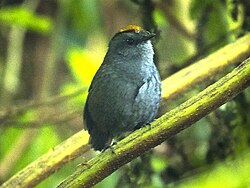
Adults are characterized by a striking yellow-orange patch on their crown, bordered by black. Their faces and necks are a leaden gray, while their upperparts, flanks, and tail exhibit a dull olive bronze hue. Juveniles differ from adults in that they lack the orange crown and possess more brownish upperparts.
Distribution and Habitat
This species is found in a discontinuous range stretching from the Cordillera de Guanacaste in northern Costa Rica into the Chiriquí and Veraguas provinces of western Panama. It thrives in montane evergreen forests and elfin forests—high-altitude environments defined by persistent fog and wetness.
The wrenthrush is particularly fond of dense vegetation near streams, especially areas with Chusquea bamboo. While it can be found from 1,500 m (4,900 ft) up to the treeline, it is most commonly sighted around 2,500 m (8,200 ft) in Costa Rica.
Behavior and Ecology
Movement and Locomotion
The wrenthrush is essentially sedentary, rarely moving between different elevations. It is a weak flier with short, rounded wings and a small keel (the bone where flight muscles attach). Because it seldom takes to the wing and only for short distances, some researchers have speculated that the species may be evolving toward flightlessness.
Feeding Habits
Foraging primarily by hopping along the ground and through branches, the wrenthrush hunts for arthropods, with a preference for spiders and the larvae of Lepidoptera (butterflies and moths). While it prefers dense cover, it will occasionally hunt in vines and epiphytes up to 10 m (30 ft) above the ground.
Breeding and Nesting
The breeding season typically runs from March to early July. Nests are rare finds; they are dome-shaped structures constructed from moss, twigs, and leaves, featuring a side entrance and a lining of grass and dried leaves. These nests are usually tucked into cavities in earthen banks and hidden by overhanging plants. Typical clutch sizes consist of three eggs, and the period from hatching to fledging is at least 18 days, with both parents sharing provisioning duties.
Vocalizations
Both males and females sing, frequently performing as a duet. Their activity peaks at dawn and dusk, though they are vocal throughout the day during the breeding season. Their primary song is described as "ssee-del-deet," with a strong emphasis on the final syllable, while their primary call is a thin "pseee."
Conservation Status
The IUCN currently lists the wrenthrush as Least Concern. Although it has a small geographic range and its exact population size is unknown, the population is believed to be stable. While habitat destruction could pose a future risk, its specialized high-altitude habitat is not currently under immediate threat.
| Feature | Details |
|---|---|
| Length | 10 – 11.5 cm |
| Weight | ~21 g |
| Primary Habitat | Montane and Elfin Forests |
| Diet | Arthropods (Spiders, Lepidoptera larvae) |
| Range | Costa Rica and Western Panama |
| Family | Zeledoniidae |
Frequently Asked Questions
Is the wrenthrush actually a type of wren or thrush?
No. Despite its name, DNA analysis has proven that it is not closely related to either wrens or thrushes. It is the sole member of its own family, Zeledoniidae.
Where can the wrenthrush be found in the wild?
It is endemic to the Talamancan montane forests, specifically in northern Costa Rica and the Chiriquí and Veraguas provinces of western Panama.
What makes the wrenthrush's flight unique?
The wrenthrush is a very weak flier with short wings and a small keel. It rarely flies and only for short distances, leading to theories that it may be evolving toward flightlessness.
How can you identify an adult wrenthrush?
Adults are identified by a distinct yellow-orange patch with black borders on their crown, leaden gray faces, and dull olive bronze upperparts.
What is the diet of the wrenthrush?
The wrenthrush feeds on arthropods, specifically targeting spiders and the larvae of Lepidoptera, foraging both on the ground and in vegetation up to 10 meters high.