Wragby: A Journey Through the History of a Lincolnshire Village
Nestled in the heart of the countryside, Wragby is a settlement with roots stretching back to the Viking era. Its name originates from the Old Norse wraggibȳ, which translates to 'Wraggi's village'. From its early mentions in historical records to its evolution into a modern stopping point for travelers heading to the coast, Wragby offers a rich tapestry of English heritage.
Early History and the Domesday Book
Wragby first appears in the Domesday Book—the great survey of England commissioned by William the Conqueror in 1086—under the name "Waragebi". At that time, the village was a modest community consisting of 23 households, a church, and a mill.
During this period, the village was divided into two manors. One was held by Erenis of Buron and the other by Waldin the Artificer. Evidence of this medieval manorial complex survives today at the Rout Yard, a scheduled monument featuring two moated islands and associated ditched enclosures. It is believed that the Rout Yard represents the Buron manor, which was historically responsible for the local church.
The Evolution of Wragby's Churches
The spiritual center of Wragby has shifted over the centuries. The original church associated with the Buron manor was dismantled in 1836 to make way for a new place of worship closer to the village center. While the main structure was removed, an 18th-century brick-built chancel remained in use as a cemetery chapel until the 1980s.
In 1839, W. A. Nicholson constructed the Grade II listed All Saints Church. Although the ruins of the older church are no longer visible to the naked eye, the Wragby Heritage Group, with funding from the Heritage Lottery Fund, has worked to preserve the site. They have cleared the old churchyard, repaired damaged headstones, and installed information boards to help visitors locate the original site, which sits 440 yards (400 m) from All Saints Church. Some artifacts from the original building are still preserved within the current church.
Commerce, Trade, and Local Industry
Wragby once thrived as a market town and staging center. This status was formalized through a charter granted by Charles II, requested by the Duke of Buckingham, which allowed for one weekly market and two annual fairs. The market took place every Thursday, while fairs were held on May 1st and between September 28th and 29th.
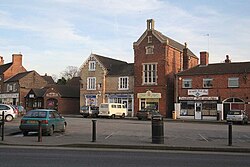
Into the early 20th century, the market remained a hub for selling butter and eggs, and the cattle market continued to operate until shortly after the Second World War. Today, the traditional market place is primarily used for parking and occasional events, with some market activities shifting to the car park of the Adam and Eve Pub.
Beyond trade, the village supported various local industries and institutions. A grammar school was founded in 1635 and rebuilt in 1775; both buildings are now residential homes. The village also featured wind power, including a Grade II listed windmill built in 1831 with six sails that operated until 1903. Historical OS maps from 1887 indicate a second windmill near Victoria Street, though it had disappeared by 1906.
Cultural Curiosities and Natural History
Wragby has played host to unexpected events and notable figures. In October 1818, the Brady touring company of actors set up a temporary theatre in the village before continuing their journey to Bardney. In the realm of music, the band The Sinking Ships, formed in 1979 and known for the song 'Strangers', originated from Wragby.
The village is also linked to a significant event in British natural history. In 1883, the last European wildcat in England was killed at Bullington Wood, located near Wragby.
Modern Development and Growth
In recent decades, Wragby has evolved into a convenient stopping point for those traveling to the coastal town of Skegness. The village provides various amenities, including a supermarket, a café, a fish shop, and three public houses.
The population has grown significantly through the development of new housing estates. Following the buyout of local builder Hugh Bourn by the Kier Group, the land was eventually sold to Linden Homes (a subsidiary of Galliford Try). This led to the construction of several sites, including Carpenters Lodge, with development continuing through 2012.
Key Facts
- Etymology: Derived from Old Norse wraggibȳ ('Wraggi's village').
- Domesday Record: Listed as "Waragebi" with 23 households, a mill, and a church.
- Historic Sites: The Rout Yard is a scheduled monument of a medieval manorial complex.
- Architecture: All Saints Church (built 1839) is Grade II listed.
- Natural History: Site of the last European wildcat killing in England (1883).
- Commerce: Formerly a market town with a charter from Charles II.
| Landmark | Period/Date | Significance |
|---|---|---|
| Rout Yard | Medieval | Scheduled monument; remains of a manorial complex. |
| Grammar School | Founded 1635 | Early educational center; now residential. |
| All Saints Church | 1839 | Grade II listed village church. |
| Village Windmill | 1831–1903 | Grade II listed six-sail windmill. |
Frequently Asked Questions
What does the name Wragby mean?
The name comes from the Old Norse word wraggibȳ, which means 'Wraggi's village'.
What is the Rout Yard?
The Rout Yard is a scheduled monument consisting of two moated islands and ditched enclosures, representing the remains of a medieval manorial complex, possibly the manor of Erenis of Buron.
When was the current All Saints Church built?
All Saints Church was built in 1839 by W. A. Nicholson, replacing an older church that was dismantled in 1836.
What is the significance of Bullington Wood?
Bullington Wood is historically significant because it is where the last European wildcat in England was killed in 1883.
Was Wragby always a residential village?
No, Wragby was historically a market town and staging center with a royal charter from Charles II for one market and two fairs.