Wellington: A Journey Through Somerset's Historic Market Town
From its early roots as a temple clearing to its evolution into a bustling center of trade and industry, Wellington possesses a rich tapestry of English history. Located in Somerset, this town has transitioned from a medieval settlement to a hub of clothmaking and financial innovation, leaving behind architectural landmarks that still define its landscape today.
Early Origins and Medieval Growth
The earliest records of the area date back to between 899 and 909, when Edward the Elder granted the land, then known as Weolingtun (possibly meaning "the settlement in the temple clearing"), to Bishop Asser. By the time of the Domesday Book in 1086, the settlement was recorded as Walintone and was owned by Gisa, the Bishop of Wells. The parish was historically part of the Kilmersdon Hundred.
Archaeological evidence suggests the area's significance extends even further back. At Longforth Farm near Tonedale, evidence of Bronze Age occupation has been identified. Furthermore, excavations for modern housing revealed a building from the 12th to 14th centuries, spanning 0.4 hectares (0.99 acres) and featuring decorated floor tiles.
Wellington's status as a town was officially established by a royal charter in 1215. During the medieval period, it flourished as a trade center on the primary route between Bristol and Exeter. The town's layout followed the common pattern of the era, with the church positioned at the eastern end.
Power, Conflict, and Industrial Rise
The ownership of the manor shifted through the centuries. In 1548, it was sold to Edward Seymour, the 1st Duke of Somerset, though it returned to the bishops following his execution. By the late 16th century, the manor came under the protection of Judge John Popham and his descendants. However, the manor house they constructed was destroyed during the English Civil War.
A devastating fire in 1731 led to a major rebuilding of the town. In the aftermath, Wellington emerged as a primary center for clothmaking across Somerset and Devon. This growth was accelerated by fires in nearby Taunton and Tiverton, which shifted trade toward Wellington. By 1831, the census recorded 258 dedicated cloth workers in the town.
The Legacy of the Duke of Wellington
The town shares a prestigious connection with Arthur Wellesley, who took the title of his Marquessate from Wellington in 1809. To honor his victory at the Battle of Waterloo, the Wellington Monument was commissioned. The foundation stone was laid in 1817 on the Duke's own land, though funding difficulties delayed its completion until 1854.
The monument is a grade II* listed triangular tower standing 175 feet (53 m) high. Now managed by the National Trust, the structure was slated for a £4 million recladding project in 2009. Nearby, Wellington Hill features a large, spotlit obelisk dedicated to the Duke.
Transport and Infrastructure Evolution
The 18th and 19th centuries brought transformative changes to Wellington's connectivity. Turnpikes first improved road travel, followed by the arrival of the Grand Western Canal in 1835.
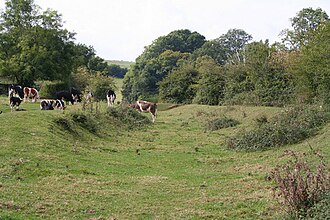
On May 1, 1843, the Bristol and Exeter Railway reached the town. The original station featured a classic Brunel design but was rebuilt in 1932 to include two loop lines, which required moving the platforms back. Because the station sat at the foot of a steep incline, it served as a base for banking locomotives—engines used to assist heavy westbound trains climbing toward the Whiteball Tunnel. The station eventually closed on October 5, 1964.
In the 20th century, the opening of the M5 motorway in the 1960s and 1970s further integrated Wellington with Taunton, facilitating a rise in commuting residents.
The Fox, Fowler & Co. Bank
Wellington was also the birthplace of a significant financial institution: the Fox, Fowler and Company bank, founded by Thomas Fox. The bank expanded rapidly, establishing its head office in the family home on Fore Street and opening branches in towns such as Bridgwater, Barnstaple, and Ilfracombe.
Fox, Fowler & Co. holds a unique place in British financial history as the last private bank in England to issue its own notes. These notes remained legal tender until 1964. Today, only nine of these notes are known to be in circulation, with one example displayed at the British Museum.
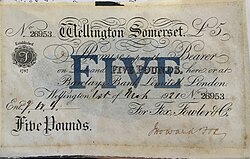
One of the final nine notes—and potentially the only uncancelled example—is currently on display at Tone Dale House.
Key Facts
- Town Status: Granted by royal charter in 1215.
- Industrial Peak: A major clothmaking center; 258 workers recorded in 1831.
- The Monument: A 175-foot triangular tower celebrating the victory at Waterloo, completed in 1854.
- Banking History: Fox, Fowler & Co. was the last private English bank to issue its own legal tender notes.
- Railway Significance: Served as a critical point for banking locomotives heading to Whiteball Tunnel.
| Period/Year | Event/Development |
|---|---|
| 899–909 | Land granted to Bishop Asser as Weolingtun. |
| 1086 | Recorded as Walintone in the Domesday Book. |
| 1215 | Granted official town status via royal charter. |
| 1731 | Major town rebuilding following a fire. |
| 1835 | Grand Western Canal reaches the town. |
| 1843 | Opening of the Bristol and Exeter Railway station. |
| 1927 | Fox, Fowler & Co. merges with Lloyds Bank. |
| 1964 | Closure of Wellington station and end of private bank note legality. |
Frequently Asked Questions
What is the significance of the Wellington Monument?
The monument is a 175-foot triangular tower built to celebrate the Duke of Wellington's victory at the Battle of Waterloo. It is a grade II* listed building now owned by the National Trust.
Why was Wellington important for the railway?
Wellington station was located at the base of a steep incline, making it a vital location for banking locomotives that helped push heavy westbound trains up toward the Whiteball Tunnel.
What was unique about the Fox, Fowler & Co. bank?
It was the final private bank in England to issue its own banknotes, which remained legal tender until 1964.
How did the town's economy change in the 18th century?
Following a fire in 1731 and disasters in nearby Taunton and Tiverton, Wellington became a dominant center for clothmaking across Somerset and Devon.
Where can I see the original Fox, Fowler bank notes?
One example is on display at the British Museum, and a potentially uncancelled £5 note is displayed at Tone Dale House.