World Trade Organization: Governing Global Commerce and Trade Policy
The World Trade Organization (WTO) is the primary intergovernmental organization responsible for regulating and facilitating international trade. Established to ensure that trade flows as smoothly, predictably, and freely as possible, the WTO focuses on the reduction of tariffs—taxes on imported goods—and other barriers to trade that can hinder global economic growth.
Headquartered at the Centre William Rappard in Geneva, Switzerland, the organization serves a worldwide region, providing a structured framework where member nations can negotiate trade agreements and resolve disputes through a legalistic process.
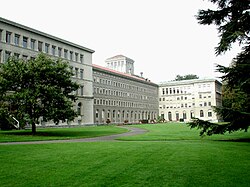
Key Facts
- Founded: January 1, 1995.
- Membership: 166 members, including 162 UN member states, the European Union, Hong Kong, Macao, and Taiwan.
- Current Leadership: Director-General Ngozi Okonjo-Iweala (since 2021).
- Primary Goal: Reduction of tariffs and other trade barriers.
- Official Languages: English, French, and Spanish.
- 2024 Budget: CHF 204,928,900.
History and Evolution
The WTO did not emerge in a vacuum; it was the result of decades of international effort to stabilize global markets. Its foundations were laid during the Bretton Woods era, where economists like John Maynard Keynes and Harry Dexter White sought to create a new international financial architecture.
![The economists Harry Dexter White (left) and John Maynard Keynes (right) at the Bretton Woods Conference in New Hampshire[19]](/images/3f/c6/3fc626ac08701693c095cb9e9427da74eee6ff15266143ec731998c52ef72a55.jpg)
Before the WTO, the General Agreement on Tariffs and Trade (GATT) served as the primary framework for trade negotiations. The transition from GATT to the WTO occurred following the Uruguay Round (1986–1994), which culminated in the Agreement Establishing the WTO. This transition expanded the scope of international trade law beyond just goods to include services and intellectual property.
The Uruguay Round Legacy
The Uruguay Round introduced several critical multilateral agreements that remain central to the WTO's operations today:
- GATT 1994: Updated rules for trade in goods.
- GATS: The General Agreement on Trade in Services.
- TRIPS: The Agreement on Trade-Related Aspects of Intellectual Property Rights.
- TRIMS: Trade Related Investment Measures.
Organizational Structure and Governance
The WTO operates through a hierarchical structure designed to balance the interests of diverse economies. The highest authority is the Ministerial Conference, a biennial gathering where members discuss new policies and agreements.
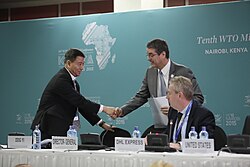
Below the Ministerial Conference, the organization is managed by three primary bodies:
- The General Council: Handles the day-to-day operations.
- The Dispute Settlement Body: Resolves trade conflicts between members.
- The Trade Policy Review Body: Conducts periodic reviews of members' trade policies to ensure transparency.
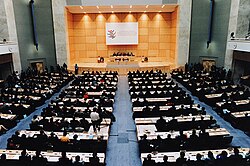
Core Functions and Trade Principles
The WTO acts as both a forum for negotiation and a judge for trade disputes. One of its most vital roles is the Dispute Settlement mechanism, which prevents trade wars by providing a legal path to resolve disagreements over agreement interpretations.
Beyond legalities, the WTO supports economic development through initiatives like Aid for Trade, which helps developing nations build the capacity necessary to participate in global commerce.
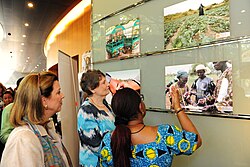
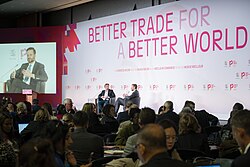
The organization also produces the World Trade Report, a key publication that analyzes global trade trends and provides data-driven insights for policymakers.
Membership and Accession
Becoming a member of the WTO is a rigorous process known as accession. This process can take several years and involves multiple stages of negotiation and review.
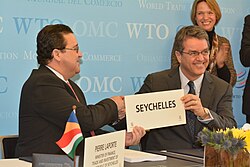
The typical accession path includes:
- Submission of a Memorandum on the Foreign Trade Regime.
- Establishment of a Working Party.
- Working party meetings to negotiate terms.
- Submission of offers for Goods and Services.
- Adoption of a Factual Summary or Draft Working Party Report.
![WTO accession progress:[106] Draft Working Party Report or Factual Summary adopted Goods or Services offers submitted Working party meetings Memorandum on Foreign Trade Regime submitted Working party established](/images/37/5e/375e7e537cf828f3f8865171c188c232d8178d6c67aa27fd68d2c95ccbe4c1d7.webp)
Financial Overview
The WTO is funded by its members, with contributions based on their share of international trade. The United States and China are the largest contributors.
| Rank | Country | Contribution (CHF) | Percentage |
|---|---|---|---|
| 1 | United States | 22,808,985 | 11.667% |
| 2 | China | 21,031,890 | 10.758% |
| 3 | Germany | 14,058,405 | 7.191% |
| 4 | Japan | 7,411,405 | 3.791% |
| 5 | France | 7,387,945 | 3.779% |
Frequently Asked Questions
What is the difference between GATT and the WTO?
GATT was a provisional agreement focused solely on trade in goods. The WTO is a permanent intergovernmental organization with a broader mandate that includes trade in services (GATS) and intellectual property (TRIPS), as well as a more robust dispute settlement mechanism.
Who leads the World Trade Organization?
The WTO is led by a Director-General. As of 2021, the Director-General is Ngozi Okonjo-Iweala of Nigeria.
How does a country join the WTO?
A country must go through an accession process, which involves submitting a memorandum on its trade regime, negotiating terms with a Working Party, and making specific offers regarding the liberalization of its goods and services markets.
What is the purpose of the TRIPS agreement?
The Agreement on Trade-Related Aspects of Intellectual Property Rights (TRIPS) sets minimum standards for the regulation of intellectual property, ensuring that patents, copyrights, and trademarks are protected globally to encourage innovation.
How are trade disputes resolved?
Disputes are handled by the Dispute Settlement Body. This process involves consultations and, if necessary, the establishment of panels to rule on whether a member's actions violate WTO agreements.