International Trade: Dynamics, Global Trends, and Economic Impacts
International trade is the exchange of capital, goods, and services across international borders or territories. This global exchange is driven by the fundamental need or demand for products and services that may not be available or efficiently produced within a single country. For most nations, this activity represents a significant portion of their Gross Domestic Product (GDP), the total monetary value of all finished goods and services produced within a country's borders.
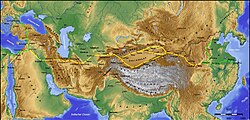
While the exchange of goods between distant peoples is an ancient practice, its economic, social, and political importance has accelerated in recent centuries. Early examples include the Uttarapatha, the Amber Road, salt roads, and the famous Silk Road.
Unlike domestic trade, international trade is a highly complex process. When transactions occur between two or more states, they are influenced by a variety of external factors, including differing currencies, government policies, judicial systems, national laws, and varying market conditions.
Key Facts
- Global Scale: The United States and China are the world's largest trading states by total value.
- Top Commodities: Mineral fuels, oils, and electronic equipment are among the most valuable exported goods globally.
- Food Dependency: A 2020 study suggests that for 72–89% of the global population, local production within a 100 km radius cannot meet total food demand.
- Resource Risk: Economic globalization has been linked to decreased security in global supply chains for water, energy, and land.
- Complexity: International trade is governed by a mix of state laws, tariffs (taxes on imports/exports), and international trade law.
Global Trade Statistics and Leading Economies
The landscape of global trade is dominated by a few key players and specific high-value sectors. According to World Trade Organization data for 2025, the United States and China lead the world in total trade volume, combining merchandise and commercial services.
| Rank | State | Merchandise | Commercial Services | Digitally Delivered Services | Total |
|---|---|---|---|---|---|
| – | World | 52,865 | 18,243 | 9,625 | 80,733 |
| 1 | United States | 5,692 | 2,079 | 1,305 | 9,076 |
| 2 | China | 6,355 | 1,130 | 411 | 7,896 |
| 3 | Germany | 3,307 | 1,090 | 605 | 5,002 |
| 4 | United Kingdom | 1,505 | 1,173 | 816 | 3,494 |
| 5 | Netherlands | 1,859 | 720 | 445 | 3,024 |
| 6 | France | 1,469 | 783 | 402 | 2,654 |
| 7 | India | 1,198 | 692 | 453 | 2,343 |
| 8 | Ireland | 293 | 1,102 | 929 | 2,324 |
| 9 | Singapore | 1,073 | 807 | 440 | 2,320 |
| 10 | Japan | 1,494 | 503 | 305 | 2,302 |
Most Traded Commodities
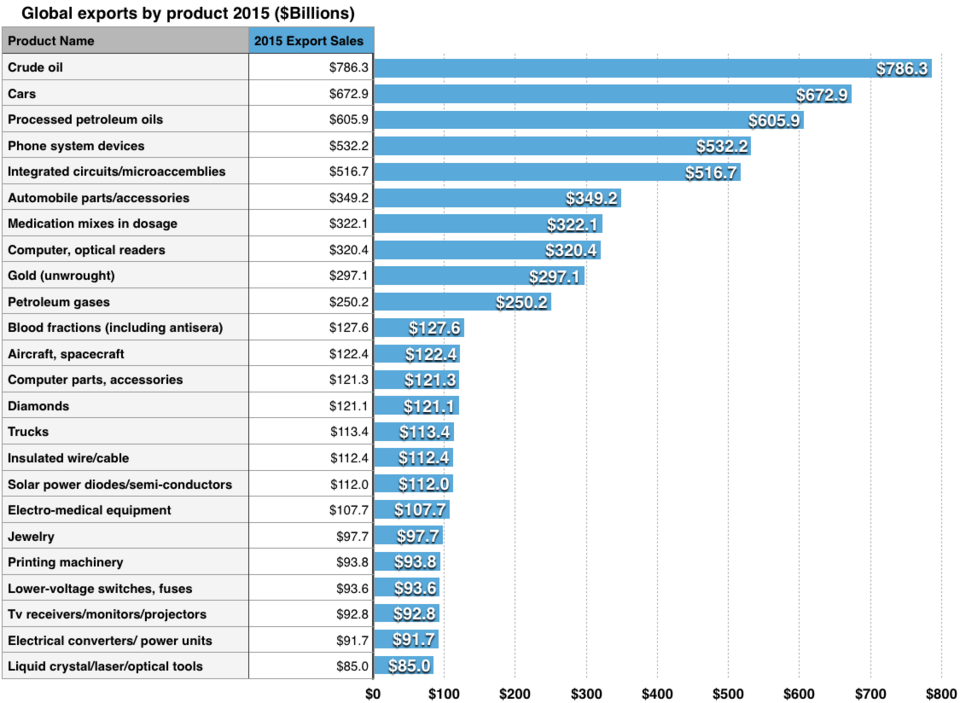
The value of exported goods varies wildly by category. As of 2022, the highest value exports were dominated by energy and technology.
- Mineral fuels, oils, and distillation products: US$ 3,988,389 million
- Electrical and electronic equipment: US$ 3,493,553 million
- Vehicles (excluding railway): US$ 1,621,658 million
- Pharmaceutical products: US$ 875,345 million
- Plastics and articles thereof: US$ 815,554 million
Trade-offs: Local Production vs. Global Trade
Food Security and Environmental Impact
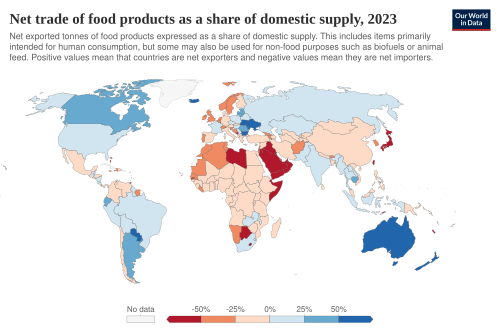
The debate between local and distant food production is complex. While localizing food may offer benefits like the recycling of nutrients and water, it is often insufficient to meet total demand. A 2020 study found that local crop production alone cannot sustain the majority of the global population. Furthermore, "food miles" (the distance food travels) are considered a relatively minor factor in carbon emissions compared to other production variables. In some cases, importing from a distant region is more environmentally friendly than using local greenhouses or long-term storage.
Employment and Resource Security
The impact of trade on employment is mixed. Some studies suggest international trade can increase local employment, while others indicate that rising exposure to imports can negatively affect labor income in both manufacturing and non-manufacturing sectors.
Beyond labor, globalization has impacted resource security. Analysis across 189 countries suggests that global supply chains have increased exposure to risks regarding over-exploited land, energy, and water. Diversifying trading partners does not necessarily reduce these risks or improve a nation's self-sufficiency.
Illicit Trade and Regulatory Challenges
Despite the benefits of legal trade, illicit activities persist. A notable example is the illegal gold trade in West Africa. In Mali, tax exemptions on small-scale gold exports (applying only to the first 50 kg per month) have facilitated the smuggling of millions of dollars worth of gold to hubs like Dubai, UAE. For instance, in 2014, Mali's gold production was 45.8 tonnes, yet the UAE's gold imports from the region were significantly higher at 59.9 tonnes.
Frequently Asked Questions
What is the difference between domestic and international trade?
Domestic trade occurs within a single country's borders, while international trade involves the exchange of goods and services across borders. International trade is more complex because it must account for different currencies, laws, government policies, and judicial systems.
Can local food production replace international food trade?
For most of the world, the answer is no. Research indicates that for 72–89% of the global population, local production within a 100 km radius is insufficient to meet current consumption patterns.
What are the most valuable goods traded globally?
The highest value exports include mineral fuels and oils, electrical and electronic equipment, and vehicles (excluding railway).
How does international trade affect resource security?
Economic globalization has generally decreased the security of global supply chains, leaving many countries more exposed to risks associated with degraded or over-exploited water, land, and energy resources.
What is World Trade Week?
World Trade Week is an observance in the United States, started in 1935, designed to encourage companies of all sizes to engage more actively in the import and export of goods and services.