Woodcreepers: Specialized Climbers of the Neotropics
The woodcreepers, scientifically known as Dendrocolaptinae, are a fascinating subfamily of suboscine passerine birds found exclusively in the Neotropics. While they may look similar to the treecreepers of the Old World, this is a classic example of convergent evolution—where unrelated species evolve similar traits to adapt to similar environments. In reality, woodcreepers are closely related to the ovenbirds (Furnariidae).
Comprising 60 species across 16 genera, these birds are master climbers of the Central and South American forests. From the dense rainforests of the Amazon to high-altitude cloud forests, woodcreepers have evolved highly specialized physical traits that allow them to thrive in vertical environments.
Key Facts
- Distribution: Endemic to the Neotropics, with the highest diversity in the Amazon Basin.
- Physical Traits: Characterized by stiff, rigid tails used for support while climbing.
- Diet: Primarily insectivores, often following army ant swarms to catch flushed prey.
- Taxonomy: Now classified as a subfamily of the ovenbirds (Furnariidae).
- Size Range: Varies from 13 cm (wedge-billed woodcreeper) to 35 cm (strong-billed woodcreeper).
Physical Characteristics and Adaptations
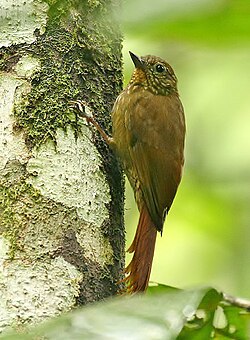
Woodcreepers are generally brownish or rufous in color, a camouflage that helps them blend into the bark of the trees they inhabit. Their most striking adaptation is the stiff tail, which acts as a prop against the tree trunk, supporting most of the bird's body weight. If a woodcreeper loses its tail feathers, its ability to climb is severely impaired.
Their movement is a rhythmic process of flexing their legs and hopping upward. To assist this, their feet are modified for gripping; the front toes have strong claws, and the fourth toe is as long as the third to provide a more secure grasp around branches. Additionally, they possess a unique belly feather growth pattern not found in any other bird species.
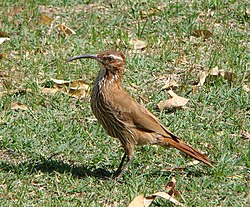
Variation between species is most evident in the bill. Depending on the species, bills can be straight or highly decurved (curved downward), sometimes accounting for up to a quarter of the bird's total length.
Habitat and Distribution
The heart of woodcreeper diversity is the Amazon Basin, where as many as 19 species may coexist in a single area. While most prefer rainforests, they are also found in pine-oak woodlands, montane cloud forests, and pine forests. A few specialized species, such as the scimitar-billed woodcreeper, have adapted to savannahs and open woodlands.
Interestingly, woodcreepers are entirely absent from the temperate forests of southern South America.
Diet and Foraging Behavior
As insectivores, woodcreepers feed mainly on insects, though they also consume spiders, centipedes, millipedes, and occasionally small lizards. While some plant material has been found in a few specimens, it is not considered a regular part of their diet.
They employ two primary foraging techniques:
- Probing: Investigating rough bark, moss, bromeliads, and dead leaves to find hidden prey.
- Sallying: Launching briefly into the air to snatch insects that were flushed out by the bird's movement.
Many woodcreepers are social foragers, joining mixed-species feeding flocks in the lower levels of the forest. Some species are particularly known for attending army ant swarms, positioning themselves to catch the insects fleeing from the ants.
Systematics and Classification
The classification of woodcreepers has shifted as genetic research has advanced. Once considered their own family (Dendrocolaptidae), they are now mostly placed within the ovenbird family (Furnariidae) based on mitochondrial and nuclear DNA sequence data.
Molecular data has also corrected previous misconceptions based on morphology. For example, it was discovered that the Greater scythebill is more closely related to Drymornis than to other scythebills in the Campylorhamphus genus. Current research continues to refine the species-level taxonomy, particularly within the genus Xiphorhynchus.
| Category | Details |
|---|---|
| Scientific Name | Dendrocolaptinae |
| Family | Furnariidae (Ovenbirds) |
| Number of Species | 60 |
| Number of Genera | 16 |
| Primary Habitat | Neotropical Forests (Amazon Basin center) |
| Nesting Habit | Arboreal cavity-nesting |
Frequently Asked Questions
How do woodcreepers differ from Old World treecreepers?
Although they look and behave similarly, they are only distantly related. Their similarities are the result of convergent evolution, meaning they independently evolved similar traits to fill the same ecological niche in different parts of the world.
What is the purpose of a woodcreeper's stiff tail?
The rigid tail feathers act as a structural support, allowing the bird to maintain an upright vertical posture and support most of its body weight while climbing tree trunks.
Why are woodcreepers difficult to identify?
Many species have very similar brown upperparts and are often seen pressed against dark tree trunks in shaded forests, making their distinctive underparts hard to see. Experts rely on bill shape, call, and specific spotting or streaking patterns for identification.
Do woodcreepers live in groups?
They are generally solitary or found in pairs, but they frequently join mixed-species feeding flocks, typically those that forage in the lower levels of the forest rather than the canopy.
How do they raise their young?
Woodcreepers are arboreal cavity-nesters. They typically lay two or three white eggs, which are incubated for approximately 15 to 21 days.