Woodcocks: The Specialized Sandpipers of the Forest
Woodcocks are a unique group of eight living species of sandpipers belonging to the genus Scolopax. While many sandpipers are associated with open coastlines, woodcocks have adapted to the shelter of the woodlands. Their name, first recorded in English around 1050, describes their preferred habitat, and a collective group of these birds is known as a "fall."
These birds are masters of camouflage and specialized foraging, possessing physiological traits that allow them to thrive in the soft soils of the Northern Hemisphere and various tropical island chains.
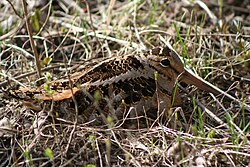
Key Facts
- Genus: Scolopax, established by Carl Linnaeus in 1758.
- Species Count: 8 living species, including two widespread and six island endemics.
- Vision: Eyes positioned on the sides of the head provide a full 360° field of view.
- Specialization: A flexible upper mandible tip allows for efficient probing of soft ground.
- Behavior: Known for "roding," a distinctive display performed at dawn or dusk.
Taxonomy and Evolutionary History
The genus Scolopax was introduced by Swedish naturalist Carl Linnaeus in the tenth edition of Systema Naturae. The type species for the genus is the Eurasian woodcock (Scolopax rusticola). Evolutionarily, woodcocks are most closely related to the jack snipe (Lymnocryptes minimus), with further ties to the snipe genera Gallinago and Coenocorypha.
Research suggests that the lineages leading to Gallinago and Scolopax diverged during the Eocene epoch, approximately 33.9 to 55.8 million years ago. While the genus Scolopax is only known from the late Pliocene onwards, these birds have shown a propensity for rapid speciation when inhabiting island chains.
Island Endemism and Extinction
Many woodcock species are local endemics, meaning they are found only in specific geographic areas. This is evident in the Ryukyu Islands, the Philippines, Indonesia, and New Guinea. Subfossil evidence also reveals a lost radiation of Caribbean woodcocks in the Greater Antilles. These prehistoric birds may have been more closely related to Old World species and likely vanished following human arrival in the region.
Species Diversity
The genus is divided between two widespread species and several localized ones. The American and Eurasian woodcocks cover vast territories in North America and Eurasia, respectively, while the others are restricted to specific islands.
| Species Name | Scientific Name | Distribution |
|---|---|---|
| American woodcock | Scolopax minor | North America (Widespread) |
| Eurasian woodcock | Scolopax rusticola | Europe and Asia (Widespread) |
| Amami woodcock | Scolopax mira | Amami Islands, Japan |
| Bukidnon woodcock | Scolopax bukidnonensis | Luzon and Mindanao, Philippines |
| Javan woodcock | Scolopax saturata | Sumatra and Java, Indonesia |
| New Guinea woodcock | Scolopax rosenbergii | New Guinea |
| Moluccan woodcock | Scolopax rochussenii | Maluku Islands, Indonesia |
| Sulawesi woodcock | Scolopax celebensis | Sulawesi, Indonesia |
Physical Characteristics and Ecology
Woodcocks are characterized by stocky bodies and cryptic plumage—a mix of brown and blackish tones that blend seamlessly into the forest floor. Their most striking feature is the long, slender bill. Unlike most birds, the tip of the upper mandible is flexible, which is essential for their feeding method.
As nocturnal or crepuscular foragers, they search for invertebrates in soft ground during the evening or night. Their 360° vision allows them to remain vigilant against predators while feeding. During the breeding season, they engage in roding, a specialized display typically occurring at dawn or dusk.
Distribution of the Eurasian Woodcock
The Eurasian woodcock has an expansive breeding range. It extends from western Ireland across Europe and Asia into northern Japan, primarily favoring boreal forests. Its range reaches from the tree line in Norway south to the Pyrenees and northern Spain, with isolated breeding stations in the Azores, Madeira, and the Canary Islands. In Asia, they are found as far south as the Himalayas and Kashmir.
The Fossil Record
Beyond living species, several extinct woodcocks are known through fossil and subfossil remains. These include Scolopax carmesinae from the Mediterranean (Menorca) and Scolopax hutchensi from Florida. In the Caribbean, Scolopax anthonyi (Puerto Rico) and Scolopax brachycarpa (Hispaniola) provide evidence of the genus's former reach during the Holocene.
Human Interaction and Hunting
Woodcocks have historically been targeted as gamebirds. Unfortunately, this has led to the rarity of several island-endemic species due to overhunting. Interestingly, the cocker spaniel dog breed was originally developed specifically for hunting these birds.
Beyond hunting, the Eurasian woodcock has contributed to the arts; its pin feathers (the coverts of the leading primary wing feather) have been used by artists as high-precision brushtips for fine painting.
Frequently Asked Questions
What is "roding" in woodcocks?
Roding is a distinctive behavioral display performed by woodcocks, typically occurring during the dawn or dusk hours.
How do woodcocks see in 360 degrees?
Their eyes are located on the sides of their heads, allowing them to monitor their entire surroundings simultaneously while foraging.
What is unique about a woodcock's bill?
The tip of the upper mandible is flexible, which allows the bird to probe and capture invertebrates in soft soil more effectively than birds with rigid bills.
Which woodcock species are the most common?
The American woodcock (Scolopax minor) and the Eurasian woodcock (Scolopax rusticola) are the only two widespread species; the others are local endemics.
Why is the cocker spaniel named after the woodcock?
The breed was originally developed and bred specifically for the purpose of hunting woodcocks.