Bar-tailed Godwit: The Master of Non-stop Migration
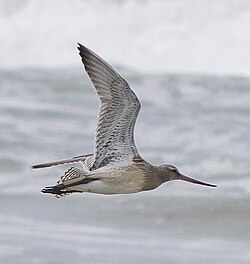
The bar-tailed godwit (Limosa lapponica) is a large, strongly migratory wader belonging to the family Scolopacidae. Renowned for its extraordinary endurance, this bird is a specialist of coastal mudflats and estuaries, where it feeds on shellfish and bristle-worms. With its distinctive long legs, upturned bill, and striking red breeding plumage, the godwit is as visually recognizable as it is biologically impressive.
These birds breed across the Arctic coasts and tundra, stretching from Scandinavia to Alaska, before traveling vast distances to overwinter in the temperate and tropical regions of Australia and New Zealand.
Key Facts
- World Record Flights: Holds the record for the longest known non-stop flight of any bird.
- Migration Distance: The round-trip journey for the L. l. baueri subspecies exceeds 29,000 km.
- Conservation Status: Classified as Near Threatened by the IUCN.
- Diet: Primarily feeds on bristle-worms and shellfish in coastal environments.
- Key Staging Area: The Yalu Jiang coastal wetland in the Yellow Sea is critical for their survival.
Taxonomy and Physical Description
The bar-tailed godwit is classified under the genus Limosa. There are currently five recognized subspecies, distributed from west to east. Among these, L. l. baueri is the largest, breeding in Chukotka and north/west Alaska and wintering in Australasia. This subspecies has a population of fewer than 150,000 birds, with approximately 75,000 wintering in New Zealand.
Physically, the godwit is adapted for its lifestyle with a long, upturned bill for probing mud and strong legs for wading. During the breeding season, males exhibit a vibrant red plumage.
The Phenomenon of Non-stop Migration
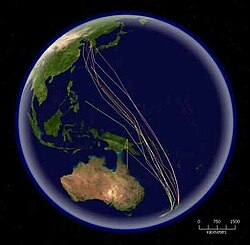
The migration of the bar-tailed godwit is one of the most extreme feats in the animal kingdom. While some subspecies, such as L. l. menzbieri, follow the Asian coastline, the L. l. baueri subspecies performs a direct, non-stop flight across the Pacific Ocean from Alaska to Australasia—a distance of roughly 11,000 km (7,000 mi).
Satellite tracking has revealed staggering individual records. One female, flagged 'E7', flew 11,680 km (7,260 mi) from Alaska to the Piako River in New Zealand in just eight days. In 2021, a male identified as 4BBRW flew 13,000 km (8,100 mi) from Alaska to New South Wales. Most recently, in 2022, a juvenile flagged 'B6' set a record by flying a minimum of 13,560 km (8,430 mi) to Tasmania in 11 days and one hour.
Fueling the Journey
To survive these journeys without pausing to feed, godwits undergo significant physiological changes. They deposit massive amounts of fat—often 35% to 40% of their body mass—and catabolize (break down) lean tissue from their internal organs to provide energy. L. l. baueri deposits 75-85g more fat than the smaller L. l. taymyrensis subspecies to account for the higher flight costs of their larger body size.

Behavior and Ecology
Breeding and Social Interaction
During the breeding season, godwits engage in complex social behaviors. Males perform ceremonial flights to attract females, which consist of four stages: ascent, limping flight, gliding, and descent. Their communication is diverse, utilizing nine different vocalizations with varying frequencies to convey information or establish dominance.
Staging and Stopovers
Despite their ability to fly non-stop, the return journey north often involves a critical stopover. The Yalu Jiang coastal wetland in the Yellow Sea serves as the most important staging ground. L. l. baueri birds typically rest here for about 41 days before completing the final 7,000 km leg to Alaska.
Conservation Status and Threats
The bar-tailed godwit is currently listed as Near Threatened, with a global population estimated at 1.1 million individuals as of 2025. However, populations are declining. In New Zealand, numbers dropped from over 100,000 in the late 1980s to 67,500 in 2018.
The primary threat is the loss of intertidal staging areas in the Yellow Sea. The reclamation of mudflats and the construction of seawalls have severely reduced food supplies. Additionally, these birds are highly sensitive to disturbance at high-tide roosts, which causes stress and prevents necessary rest. Consequently, L. l. baueri and L. l. menzbieri were listed as Endangered under the Australian EPBC Act in 2024.
| Feature | Details |
|---|---|
| Scientific Name | Limosa lapponica |
| Max Non-stop Distance | 13,560 km (Juvenile 'B6') |
| Primary Diet | Bristle-worms and shellfish |
| Key Breeding Grounds | Arctic coasts (Scandinavia to Alaska) |
| Conservation Status | Near Threatened (IUCN) |
| Critical Habitat | Yellow Sea mudflats (Yalu Jiang) |
Frequently Asked Questions
What is the longest non-stop flight recorded for a bar-tailed godwit?
The current record was set in 2022 by a juvenile godwit flagged 'B6', which flew a minimum of 13,560 km (8,430 mi) from Alaska to Tasmania in 11 days and one hour.
How do these birds survive thousands of kilometers without food?
They store immense quantities of fat (up to 40% of their body mass) and break down lean tissue from their own organs to fuel their flight.
Why is the Yellow Sea so important for the godwits?
The Yellow Sea, specifically the Yalu Jiang coastal wetland, is a critical staging ground where birds rest and refuel for several weeks before continuing their migration to the Arctic.
What are the main threats to the bar-tailed godwit population?
The main threats include habitat loss and degradation of mudflats due to seawall construction and land reclamation, as well as human disturbance at high-tide roosts.
How does the breeding plumage differ from the non-breeding plumage?
During the breeding season, the bar-tailed godwit develops a distinctive and conspicuous red plumage, whereas its non-breeding plumage is more muted.