William Shockley: The Architect of the Transistor and Silicon Valley
William Shockley was a pivotal figure in 20th-century physics, whose work at Bell Telephone Laboratories laid the foundation for the modern digital age. By seeking a solid-state alternative to the fragile vacuum tubes of the era, Shockley and his colleagues triggered a technological revolution that transitioned the world from analog to digital electronics.
Early Career and Military Contributions
Shockley was recruited to Bell Telephone Laboratories in 1936 by Mervin Kelly, who sought to build a team of solid-state physicists—scientists specializing in the physical properties of solid materials. Working under Clinton Davisson in Murray Hill, New Jersey, Shockley explored copper-oxide semiconductor materials to replace vacuum tubes in the national telephone system. While early prototypes in 1939 were unsuccessful, Shockley established himself as a theoretical leader, publishing fundamental papers in Physical Review and securing his first patent for an electron discharge device in 1938.
During World War II, Shockley's focus shifted toward military applications. In 1942, he pioneered delay-line memory, a form of electronic storage that was approximately as fast as vacuum tube technology but cost only 1/100th as much. This innovation was later integrated into the ENIAC computer by 1945.
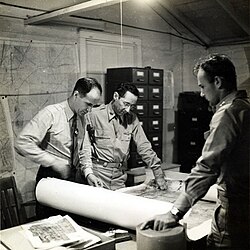
Shockley also served as a research director for Columbia University's Anti-Submarine Warfare Operations Group, where he optimized depth charge patterns and convoying techniques. His later work included training B-29 bomber pilots in the use of radar bomb sights, for which he received the Medal for Merit in 1946. Additionally, a 1945 report he prepared for the War Department estimating Japanese casualties during a potential mainland invasion influenced the U.S. decision to use atomic bombs on Hiroshima and Nagasaki.
The Invention of the Transistor
Following the war, Bell Labs formed a solid-state physics group led by Shockley and chemist Stanley Morgan. The team, which included John Bardeen and Walter Brattain, aimed to create a solid-state amplifier. Initial attempts to use an external electrical field to affect semiconductor conductivity failed until Bardeen proposed the theory of surface states—conditions at the material's surface that blocked the electrical field from penetrating the semiconductor.
Through a collaborative process of experimentation and theoretical refinement, the team utilized electrolytes and point contacts to achieve power amplification. This culminated in the creation of the point contact transistor. However, internal friction arose when Bell Labs' attorneys filed patents for the device without Shockley's name, as the design differed from his original field effect principle.
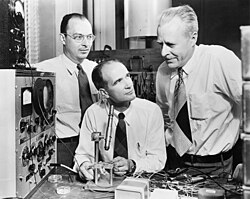
Driven by professional frustration and a belief that point contact transistors were too fragile for commercial use, Shockley secretly researched a more robust design. He theorized the concept of minority carrier injection and developed the junction transistor (or "sandwich" transistor). This design, proven in April 1949 and officially announced as the bipolar junction transistor in July 1951, became the industry standard through the 1960s.
Shockley further solidified the field's theoretical framework with his 1950 book, Electrons and Holes in Semiconductors. This 558-page treatise introduced the differential equations governing electron flow and the famous Shockley diode equation, serving as the primary reference for semiconductor research for years to come.
The Birth of Silicon Valley
In 1956, Shockley moved to Mountain View, California, to establish Shockley Semiconductor Laboratory. As a division of Beckman Instruments, Inc., it was the first company in the region to focus on silicon semiconductor devices, effectively seeding what would become known as Silicon Valley.
Despite his brilliance, Shockley was a polarizing manager. Described as autocratic and paranoid, he frequently alienated his staff. This tension peaked in 1957 when eight top researchers, known as the "traitorous eight," resigned to form Fairchild Semiconductor. Shockley Semiconductor never recovered from this exodus and was eventually closed after being sold to ITT. However, the legacy of this split was profound: over the next two decades, more than 65 new enterprises were founded by individuals connected to Fairchild.
Key Facts
- Primary Invention: Co-invented the transistor and independently invented the bipolar junction transistor.
- Military Impact: Developed low-cost delay-line memory used in the ENIAC computer.
- Academic Contribution: Authored the seminal text Electrons and Holes in Semiconductors (1950).
- Regional Legacy: Founded the first silicon semiconductor company in Mountain View, CA, sparking the growth of Silicon Valley.
- Honors: Awarded the Medal for Merit in 1946 for his work with B-29 radar bomb sights.
| Period | Organization | Key Achievement/Role |
|---|---|---|
| 1936–1953 | Bell Labs | Invention of the junction transistor; delay-line memory. |
| 1942–1946 | Columbia University / US Military | Anti-submarine warfare and B-29 radar training. |
| 1953–1955 | Caltech | Academic transition. |
| 1956–1960 | Shockley Semiconductor | Pioneered silicon devices in Mountain View, CA. |
Frequently Asked Questions
What is the difference between a point contact and a junction transistor?
The point contact transistor used conducting wires touching the semiconductor surface, which Shockley viewed as fragile and difficult to manufacture. The junction transistor used a "sandwich" structure of layers, making it more robust and commercially viable.
How did Shockley contribute to the ENIAC computer?
Shockley developed delay-line memory, which provided a way to store electronic data at approximately the same speed as vacuum tube memory but at 1/100th of the cost.
Who were the "traitorous eight"?
They were eight of Shockley's most talented researchers who resigned from Shockley Semiconductor in 1957 due to his domineering management style. They went on to found Fairchild Semiconductor.
What was the significance of the book Electrons and Holes in Semiconductors?
Published in 1950, this treatise provided the mathematical and theoretical foundation for semiconductor physics, including the Shockley diode equation and the principles of drift and diffusion.
Did Shockley receive sole credit for the transistor?
While often thrust into the spotlight, the invention was a team effort involving John Bardeen and Walter Brattain. Bell Labs presented them as a team, though Shockley's later friction with them led to their professional separation.