William Pye: The Master of Water and Metal Sculpture
William Pye is a distinguished artist renowned for his ability to blend industrial materials with the fluid grace of nature. Specializing in metal, stone, and most notably water, Pye has spent decades creating public installations that challenge the viewer's perception of movement and form. From abstract geometric structures to breathtaking water walls, his work bridges the gap between rigid engineering and organic beauty.
Early Life and Artistic Foundation
The influence of academic and artistic excellence ran deep in Pye's upbringing. He is the son of Sir David Randall Pye FRS, a prominent mechanical engineer and academic administrator. Early inspiration was provided by his aunt, the sculptor Ethel Pye, who helped spark his interest in three-dimensional art.
Pye's formal education began after he completed his National Service from 1956 to 1958. He pursued his artistic training at the Wimbledon School of Art (1958–61) and later at the prestigious Royal College of Art (1961–65). This rigorous training provided the technical foundation necessary for his later experiments with complex materials.
Academic Career and Artistic Evolution
Before establishing himself as a full-time sculptor, Pye shared his expertise through teaching. He taught at the Central School of Art from 1965 to 1970, followed by a five-year tenure at Goldsmiths, University of London. His international reach expanded in 1972 when he served as a visiting professor at California State University.
Pye's style evolved significantly over the decades. In the 1960s, his work was primarily abstract, focusing on the interplay between metal and stone. By the 1970s, he transitioned toward abstract geometrical works crafted from stainless steel, often incorporating kinetic aspects—elements that move or rely on motion to complete the artistic experience.
Major Commissions and Public Works
Throughout his career, Pye has been commissioned to create landmark pieces across the globe. His ability to manipulate water as a sculptural medium has made him a sought-after artist for corporate and civic spaces.
One of his earliest significant works, Zemran (1971), is a stainless steel sculpture located at the Southbank Centre in London. Recognizing its cultural importance, Historic England advised that it be listed Grade II in 2016.
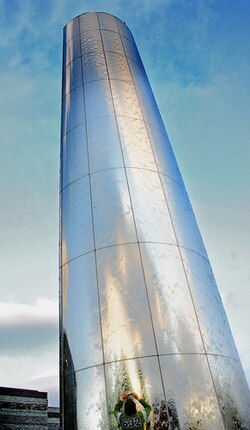
Pye's mastery of water is evident in the Jet Stream and Slipstream installations (1987) at Gatwick Airport's North Terminal, and the massive 13×70m wall of water created for the British Pavilion at the Seville Expo '92 in Spain.
Other notable works include the Tetra Trellis (1993), a tetrahedron-shaped stainless steel water sculpture for the Tetra Pak UK Headquarters, and the Derby Cascade (1995) in Market Square, Derby.
In 2000, Pye created Kanagawa or The Wave in West Sussex. This bronze sculpture, which includes a patch of pebbles, is a direct homage to the famous Hokusai print, The Hollow of the Deep Sea Wave off Kanagawa.
Recent and Specialized Works
Pye's versatility extends to sacred and sporting spaces. In 2008, he created the font for Salisbury Cathedral to commemorate the 750th anniversary of the cathedral's completion. More recently, in 2016, his water sculpture Alchemilla was unveiled at the All England Lawn Tennis and Croquet Club to coincide with the start of the Wimbledon Championships.
Key Facts
- Specializations: Metal, stone, and water sculptures.
- Education: Wimbledon School of Art and the Royal College of Art.
- Notable Honor: Elected Honorary Fellow of the Royal Institute of British Architects (RIBA) in 1993.
- First Solo Show: Held at the Redfern Gallery in London in 1966.
- Key Material: Frequent use of stainless steel for geometric and kinetic works.
Summary of Notable Works
| Work | Year | Location | Material/Type |
|---|---|---|---|
| Zemran | 1971 | Southbank Centre, London | Stainless Steel |
| Double Somersault | 1976 | Sheffield Children's Hospital | Sculpture |
| Jet Stream & Slipstream | 1987 | Gatwick Airport | Water |
| British Pavilion Wall | 1992 | Seville Expo '92, Spain | Water |
| Tetra Trellis | 1993 | Tetra Pak UK HQ | Stainless Steel/Water |
| Kanagawa or The Wave | 2000 | Selsey, West Sussex | Bronze |
| Vannpaviljong | 2011 | Drammen, Norway | Sculpture |
Frequently Asked Questions
What materials does William Pye primarily use?
William Pye is best known for his work with water, stainless steel, bronze, and stone.
Where can I see William Pye's work in London?
One of his most prominent London works is Zemran, a Grade II listed stainless steel sculpture located at the Southbank Centre.
What is the significance of the sculpture "Kanagawa or The Wave"?
Located in West Sussex, this bronze piece is an artistic echo of the famous Hokusai print, The Hollow of the Deep Sea Wave off Kanagawa.
Has William Pye taught art?
Yes, he taught at the Central School of Art (1965–1970) and Goldsmiths, University of London, and served as a visiting professor at California State University in 1972.
What professional honors has William Pye received?
In 1993, he was elected as an Honorary Fellow of the Royal Institute of British Architects.