Concrete Art: The Evolution of Geometrical Abstraction
Concrete art is an art movement defined by its rigorous commitment to geometrical abstraction. Unlike traditional abstract art, which often begins with a real-world subject and simplifies it, Concrete art seeks to create a reality of its own. It focuses on the use of purely plastic elements—lines, planes, and colors—to create works that do not refer to anything outside of themselves.
The movement was first conceptualized by Theo van Doesburg in 1930 to distinguish his vision from other abstract styles of the era. Following his death in 1931, the movement was expanded and popularized by Max Bill, who helped export these ideals to Latin America and organized pivotal international exhibitions. After World War II, the style gained global momentum, influencing a wide array of international art movements.
Key Facts
- Founder: Formulated by Theo van Doesburg in 1930.
- Core Philosophy: Art should be conceived by the mind and executed without reference to nature, sentiment, or symbolism.
- Primary Elements: Relies exclusively on surfaces, colors, and geometric forms.
- Key Proponent: Max Bill popularized the movement post-1944 and organized its first international exhibition.
- Global Reach: Significant developments occurred in Europe, South America (Argentina, Brazil), and Cuba.
- Legacy: Paved the way for Optical art, Kinetic art, and Programmatic art.
Origins and the Art Concret Group
The roots of Concrete art can be traced back to 1920s Russia as an evolution of Constructivism (an art form focusing on industrial materials and geometric construction). In 1929, Theo van Doesburg sought to create a new collective of artists who were entirely free of referentiality—meaning their work did not refer to any external object or emotion.
After a failed attempt to collaborate with Joaquín Torres-García, van Doesburg proposed a rival group called Art Concret. He rejected the term "abstract" because he felt it had negative connotations of removing something from reality; instead, he chose "concrete" to describe art that was a positive, self-contained reality.
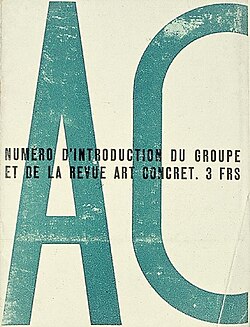
In May 1930, the group published the Revue Art Concret, a French-language magazine featuring a joint manifesto. This manifesto demanded absolute clarity and a mechanical, anti-impressionistic technique, asserting that a painting should have no meaning other than itself.
The Basis of Concrete Painting
According to the group's manifesto, the fundamental rules of Concrete painting included:
- Art must be universal and conceived entirely by the mind before execution.
- The exclusion of lyricism, drama, and symbolism.
- The use of purely plastic elements: surfaces and colors.
- A construction that is simple and visually controllable.
Theoretical Foundations
The movement drew heavily from the synthesis of Russian Constructivism and Dutch Neo-plasticism (a style characterized by primary colors and rectangular grids). Art historians note that this approach abandoned the artificiality of representation in favor of technological authenticity, drawing inspiration from architecture and engineering materials like steel, glass, and aluminum.
To achieve universality, artists abandoned subjectivity. Many proponents, such as Victor Vasarély and Jean Dewasne, studied science before turning to painting. They argued that the use of pure geometry was not a rejection of the past, but a reassertion of eternal mathematical values stripped of historical disguises.
Global Development and Expansion
After World War II, Concrete art expanded rapidly. Max Bill, a former Bauhaus student, organized the first international exhibition in Basle in 1944 and founded the abstract-konkret bulletin. In Italy, the Movimento d'arte concreta (MAC) emerged in 1948, led by Alberto Magnelli.
In France, the Groupe Espace was founded in 1951 to harmonize painting, sculpture, and architecture into a single discipline, advocating for the presence of plastic arts in all aspects of human activity.
The movement also found fertile ground in Latin America. Joaquín Torres-García mentored artists in South America, leading to the formation of Arte Concreto Invención in Buenos Aires (1945). In Brazil, the Neo-Concrete Manifesto of 1959 expanded the definition of "concrete" to include poetry and photography. Meanwhile, in Cuba, Loló Soldevilla and Pedro de Oraá founded the Galería Color-Luz, fostering a group known as Los Diez Pintores Concretos, which blended European geometry with Cuban color and lyricism.
![Max Bill, Continuity (Colossus of Frankfurt), 1986, collection: Deutsche Bank, Frankfurt am Main. Max Bill "was keen on creating works based on mathematical and geometric foundations—material manifestations of intellectual processes that resisted symbolism."[10]](/images/67/3e/673ec6fb9572f7c725cd5040a337ee540cafe74df1e0e5d2cae6fe7a3aad2842.jpg)
Cold vs. Warm Abstraction
As the movement evolved, critics distinguished between cold abstraction (the geometric, mathematical approach of Concrete art) and warm abstraction (Lyrical abstraction, which reintroduced personal emotion). Cold abstraction eventually evolved into modern movements such as optical art and kinetic art.
International Concrete Art Groups
The following table summarizes the global spread of Concrete art movements between 1944 and 1967.
| City | Group | Year | Key Artists |
|---|---|---|---|
| Zurich | Die Zürcher Schule der Konkreten | 1944 | Max Bill, Richard Paul Lohse, Camille Graeser |
| Buenos Aires | Asociación Arte Concreto-Invención | 1945 | Tomás Maldonado, Raúl Lozza |
| Milan | Movimento Arte Concreta (MAC) | 1948 | Atanasio Soldati, Bruno Munari, Ettore Sottsass |
| Paris | Group Espace | 1951 | Sonia Delaunay, Victor Vasarély |
| Rio de Janeiro | Grupo Frente | 1952 | Lygia Clark, Lygia Pape |
| Havana | Los Diez Pintores Concretos | 1957–1961 | Pedro de Oraá, Loló Soldevilla |
| Prague | Klub konkrétistů | 1967 | Eduard Antal, Jiří Valoch |
Frequently Asked Questions
What is the difference between abstract art and concrete art?
While abstract art often simplifies or distorts a real-world subject, concrete art is non-referential. It does not start with a subject; instead, it uses geometric elements to create a new, "concrete" reality that exists only as itself.
Who were the most influential figures in the movement?
Theo van Doesburg formulated the original concept and the Art Concret group. Max Bill was instrumental in defining the movement's theoretical framework and promoting it internationally after 1944.
How did Concrete art influence later art styles?
The "cold abstraction" of Concrete art, with its focus on mathematics and technology, served as the foundation for Optical art (Op art), Kinetic art, and Programmatic art.
Where can I see Concrete art today?
Dedicated institutions include the Haus Konstruktiv in Zurich, the Museum of Concrete Art in Ingolstadt, and The Mondriaan House in Amersfoort.