White House East Room: A History of Post-1952 Refurbishments
The East Room of the White House serves as one of the most prestigious spaces in the Executive Mansion, hosting everything from formal receptions to intimate performances. Since 1952, the room has undergone several waves of refurbishment, reflecting the tastes of various First Ladies and the evolving standards of historic preservation. From the meticulous design choices of Jacqueline Kennedy to the conservation efforts of the Reagan and Clinton administrations, the room's evolution balances modern utility with timeless elegance.
The Kennedy Era: A Vision of Historic Elegance
In 1961 and 1962, Jacqueline Kennedy launched extensive renovations of the White House. For the East Room, she collaborated with American antiques expert Henry Francis du Pont and French interior designer Stéphane Boudin of Maison Jansen. While many other rooms were heavily altered, the East Room's changes were focused on refinement and historical cohesion.
Window Treatments and Textiles
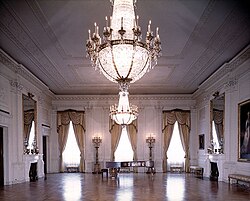
The most significant update was the installation of new draperies. Kennedy requested opaque silk undercurtains and yellow drapes. After a lengthy design process involving a custom-manufactured gold and cream silk lampas (a luxury fabric with a raised pattern) featuring birds, butterflies, and floral motifs, the final curtains were hung in 1965. These were installed as straight panels from the original 1902 gilt wooden cornices. The project took nearly three years and cost $26,149, funded by the sales of Mrs. Kennedy's White House guidebook.
Furniture and Architectural Details
To create a unified historic look, Boudin removed several items, including 1902 console tables and 1952 Adam-style camelback sofas, replacing the latter with gilt benches. The administration also restored four Monroe-era candelabra to the southern mantels and added early 19th-century crystal candelabra to the northern wall. To complement the portraits of George and Martha Washington, portraits of Bushrod Washington and Julia Ann Blackburn Washington by Chester Harding were added to the east wall.
Other notable changes included painting the fireplace mantels to resemble white marble and the introduction of portable ashtrays. After rejecting an expensive Maison Jansen design, Kennedy designed her own standing ashtrays, which were crafted from dark wood by White House carpenters with granite tops provided by Jansen.
The First Portable Stage
Jacqueline Kennedy introduced a small, portable stage clad in red velvet for intimate performances. Designed by ballet impresario Lincoln Kirstein, the stage was stored off-site and required three men eight hours to install and prepare.
Expansions Under Johnson and Carter
President Lyndon B. Johnson and First Lady Lady Bird Johnson preferred larger-scale entertainment. This led to the commission of a much larger stage designed by Jo Mielziner. This new stage occupied one-third of the room and featured cream-white pilasters to match the architecture, though the cost of the original fabric was too high, leading Mielziner to use American-made gold silk curtains instead. Setting up this stage required eight men and three days.
In 1964, President Johnson established the Committee for the Preservation of the White House to provide expert advice on the decor and conservation of public rooms. Additionally, in 1967, the Italian government donated a 30-piece 18th-century Neapolitan nativity scene (creche), which has been displayed in the East Room every Christmas since. The Carter administration later added ten more antique Italian figures to this set.
By 1978, the East Room's parquet flooring had suffered significant wear and was completely replaced during the Carter administration.
Modern Conservation: Reagan to George W. Bush
The Reagan administration focused on conservation and restoration. Nancy Reagan oversaw a $730,000 project that included assessing the East Room's plasterwork and paneling. Minor updates included repainting the room in its traditional warm cream color and adding gold silk swag valances. New over-draperies were also installed at a cost of $130,000.
During the Clinton administration, the 1960s faux-marble paint was removed from the mantels and baseboards, revealing the original 1951 "rouge antique" reddish marble from Vermont. In 1995, three wool carpets costing $259,330 were installed to protect the oak floors. These carpets, funded by the White House Endowment Fund, were designed to mirror the 1820s plaster ceiling moldings.
The most recent significant update occurred in 2003 under George W. Bush. The Committee for the Preservation of the White House replaced the Reagan-era swag valances with deeper, more substantial versions (12 inches deeper) and repainted the room in its signature warm cream. This $200,000 refurbishment was also funded by private donations.
Key Facts
- Funding: Many renovations, including the 1960s drapes and 1990s carpets, were funded by private donations or book sales rather than public funds.
- The Creche: A 30-piece 18th-century Italian nativity scene has been a holiday staple in the room since 1967.
- Material Restoration: The "rouge antique" Vermont marble was hidden under white paint from the 1960s until the Clinton administration.
- Preservation: The Committee for the Preservation of the White House was created in 1964 to ensure professional oversight of the room's decor.
| Administration | Key Changes | Notable Materials/Costs |
|---|---|---|
| Kennedy | New drapes, portable stage, faux-marble mantels | Gold/cream silk lampas ($26,149) |
| Johnson/Carter | Large performance stage, new flooring, Italian creche | American gold silk curtains |
| Reagan | Conservation of plaster/paneling, new valances | Over-draperies ($130,000) |
| Clinton | Restored red marble, installed wool carpets | Wool carpets ($259,330) |
| George W. Bush | Updated swag valances, repainting | Refurbishment cost ($200,000) |
Frequently Asked Questions
How were the expensive Kennedy-era curtains paid for?
The $26,149 cost for the drapes and valances was covered by the sales of Jacqueline Kennedy's guidebook to the White House.
What is the significance of the "rouge antique" marble?
It is the original reddish Vermont marble installed during the 1951 renovation, which had been painted over to look like white marble during the 1960s before being restored in the 1990s.
Who manages the preservation of the East Room today?
The Committee for the Preservation of the White House, established by executive order in 1964, advises the President and First Lady on the room's decor and conservation.
Why were wool carpets installed in 1995?
The carpets were installed to protect the original oak floors from dirt and debris, and their design was specifically chosen to reflect the 1820s plaster ceiling moldings.
How did the stages used by the Kennedys and Johnsons differ?
The Kennedy stage was small, portable, and designed for intimate performances, while the Johnson stage was much larger (occupying one-third of the room) and designed for elaborate productions.