White-eyes: The Sociable Girdle-eyed Birds of the Tropics
The white-eyes, belonging to the family Zosteropidae, are small, energetic passerine birds found across a vast stretch of the globe. These birds are native to tropical, subtropical, and temperate regions of Sub-Saharan Africa, southern and eastern Asia, and Australasia. They are particularly prevalent on tropical islands within the Indian Ocean, the western Pacific Ocean, and the Gulf of Guinea.
While some species are widespread, many white-eyes are endemic, meaning they are found only on a single island or within a specific archipelago. A notable example is the silvereye (Zosterops lateralis), which naturally colonized New Zealand starting in 1855, where it is locally known as the "wax-eye" or "tauhou." Other species have been introduced to new regions, such as the Japanese white-eye in Hawaii and the silvereye in the Society Islands of French Polynesia.
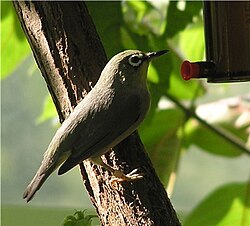
Key Facts
- Family: Zosteropidae, consisting of 149 species across 13 genera.
- Defining Feature: A conspicuous ring of tiny white feathers around the eyes.
- Diet: Primarily insectivorous, but also consume nectar and various fruits.
- Distribution: Africa, Asia, and Australasia, with high island endemism.
- Behavior: Highly sociable birds that form large flocks outside of the breeding season.
Physical Characteristics and Behavior
White-eyes generally possess an understated appearance, with plumage that is typically olive-green on top and pale grey underneath. However, variation exists; some species feature bright yellow or white throats and breasts, while others have buff-colored flanks. Their scientific name is derived from the Ancient Greek for "girdle-eye," referring to the distinctive white eye-ring seen in many species.
Physically, these birds are adapted for a varied diet. They possess slender, pointed bills and brush-tipped tongues, which are characteristic of nectarivorous birds (birds that feed on nectar). They also have rounded wings and strong legs, reaching a maximum length of approximately 15 cm (5.9 in).
In terms of social structure, white-eyes are remarkably gregarious. They travel in large flocks, only dispersing when the breeding season arrives. They construct nests in trees and typically lay between two and four pale blue eggs.
While they are beneficial to many ecosystems, some species can be pests. In Australia, the silvereye is known to pierce grapes in vineyards, which can lead to subsequent insect damage or infection.
Systematics and Classification
The family Zosteropidae was first introduced as a subfamily in 1853 by French naturalist Charles Lucien Bonaparte. For a long time, white-eyes were viewed as a distinct family because their morphology (physical form) and ecology are very similar across species, resulting in limited adaptive radiation.
Modern genetic research has shifted our understanding of their lineage. In 2003, researcher Alice Cibois used mtDNA sequence data to suggest that white-eyes form a clade (a group sharing a common ancestor) that includes the yuhinas. Previously, yuhinas were grouped with Old World babblers, a diverse and often loosely defined group.
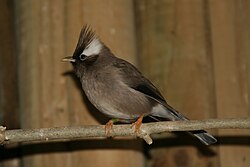
Recent studies continue to refine these relationships. Research by Cai et al. (2019) and Oliveros et al. (2021) has provided deeper insights into the phylogeny of the group. For instance, the genus Apalopteron, once thought to be a honeyeater, was moved to the white-eye family in 1995 based on behavioral and genetic evidence. Conversely, the Madanga (Madanga ruficollis) was removed from this family and is now classified as an atypical member of the Motacillidae.
Taxonomic Summary
The family currently comprises 149 species distributed among 13 genera. The genus Zosterops is by far the largest, containing 110 species.
| Genus | Common Name / Note | Approx. Species Count |
|---|---|---|
| Zosterops | Typical White-eyes | 110 |
| Heleia | Heleias | 10 |
| Yuhina | Yuhinas | 7 |
| Zosterornis | Striped Babblers | 5 |
| Sterrhoptilus | Babblers | 4 |
| Staphida | - | 3 |
| Dasycrotapha | Pygmy Babblers | 3 |
| Rukia | White-eyes | 2 |
| Other Genera | Parayuhina, Cleptornis, Megazosterops, Apalopteron, Tephrozosterops | Various |
Frequently Asked Questions
What gives white-eyes their name?
Many species in the Zosteropidae family have a distinctive ring of tiny white feathers around their eyes, which is reflected in both their common name and their scientific name, derived from the Greek word for "girdle-eye."
What do white-eyes eat?
White-eyes are primarily insectivorous, meaning they eat insects, but they also supplement their diet with nectar and various types of fruits.
Where are white-eyes found?
They are native to Sub-Saharan Africa, southern and eastern Asia, and Australasia, with a strong presence on tropical islands in the Indian and Pacific Oceans.
Are white-eyes related to babblers?
Yes, genetic evidence suggests they are closely related to the yuhinas and the "true" Old World babblers (Timaliidae), leading some taxonomists to suggest they be merged into the Timaliidae family as a subfamily.
Can white-eyes be pests?
Yes, specifically the silvereye (Zosterops lateralis) can cause issues in Australian vineyards by piercing grapes, which opens the fruit to insect damage and infection.