Honeyeaters: The Diverse Nectar-Feeders of Australasia
The honeyeaters are a large and diverse family of small to medium-sized birds known scientifically as Meliphagidae. Primarily found across Australia and New Guinea, these birds have expanded their reach into New Zealand, the Pacific islands (as far east as Samoa and Tonga), and the Indonesian islands of Wallacea. While Bali hosts a single species, the heart of their population remains in the Australasian region.
With 186 species spread across 55 genera, honeyeaters play a vital role in their ecosystems. Roughly half of the species are native to Australia, with many others inhabiting New Guinea. Though they share similar behaviors and appearances with other nectar-feeding birds like sunbirds and flowerpeckers, they are not closely related. Instead, they are a prime example of convergent evolution, where unrelated species independently evolve similar traits to adapt to similar environments or diets.
Key Facts
- Family: Meliphagidae, comprising 186 species in 55 genera.
- Distribution: Most common in Australia and New Guinea; also found in New Zealand, Pacific islands, and Wallacea.
- Diet: Primarily nectarivorous, but many also eat insects and fruit.
- Specialization: Many possess a brush-tipped tongue for efficient liquid absorption.
- Ecological Role: Essential pollinators for plants in the Proteaceae, Myrtaceae, and Ericaceae families.
Diet and Physical Adaptations
Honeyeaters exhibit varied dietary habits. While many are nectarivorous (nectar-eating), others are insectivorous (insect-eating) or frugivorous (fruit-eating), and many combine these diets. To support this, many genera have evolved a highly specialized brush-tipped tongue. This tongue is frayed and fringed with bristles that soak up nectar quickly; the bird then flicks the tongue into a flower and uses its upper mandible to compress the liquid out.
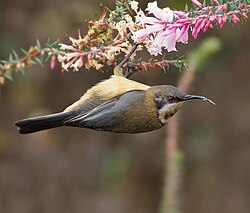
Unlike American hummingbirds, honeyeaters are not adapted for sustained hovering flight. Instead, they typically flit between perches in outer foliage, stretching their bodies or hanging upside down to reach food. However, smaller species may occasionally hover to collect nectar.
Insects provide a critical protein source, especially during breeding seasons. While most honeyeaters catch insects by hawking (catching prey in flight) or gleaning (picking prey off surfaces), larger species like the white-eared honeyeater and the strong-billed honeyeater of Tasmania probe under bark for food. Some species are highly specialized, such as the painted honeyeater, which focuses on mistletoe.
Distribution and Movement
The movement patterns of honeyeaters are complex and not fully understood. While a few species are definitely migratory, most exhibit local mobility, moving between preferred habitats as environmental conditions shift. Many species track the flowering cycles of their favorite plants. Birds living in arid zones tend to travel further and less predictably than those in more fertile regions.
| Feature | Details |
|---|---|
| Scientific Family | Meliphagidae |
| Primary Regions | Australia, New Guinea, New Zealand, Pacific Islands |
| Key Physical Trait | Brush-tipped tongue for nectar absorption |
| Feeding Methods | Hawking, gleaning, and probing |
| Closest Relatives | Maluridae, Pardalotidae, and Acanthizidae |
Taxonomy and Systematics
The classification of honeyeaters has evolved with genetic research. For example, the golden honeyeater (Cleptornis) and Bonin honeyeater (Apalopteron) were moved to the Zosteropidae family. Similarly, the New Zealand stitchbird (Notiomystis) was moved to its own family, Notiomystidae.
Interestingly, MacGregor's honeyeater was historically misclassified as a bird-of-paradise (Paradisaeidae) before being correctly placed within Meliphagidae. Recent discoveries also include the wattled smoky honeyeater (Melipotes carolae), discovered in 2005 in the Foja Mountains of Papua. Additionally, a 2008 study determined that the extinct Hawaiian genera Moho and Chaetoptila belong to their own distinct family, Mohoidae, rather than Meliphagidae.
Frequently Asked Questions
Are honeyeaters related to sunbirds?
No. Although they look and behave similarly because they both feed on nectar, they are unrelated. Their similarities are the result of convergent evolution.
How do honeyeaters drink nectar?
Many species use a specialized brush-tipped tongue that soaks up liquid. They flick the tongue into the flower and then use their upper bill to squeeze the nectar out.
Do honeyeaters only eat nectar?
No. While nectar is a primary food source, nearly all honeyeaters eat insects and small creatures. Some also eat fruit, and certain species specialize in mistletoe.
Where are honeyeaters primarily found?
They are most common in Australia and New Guinea, but their range extends to New Zealand, the Pacific islands (including Samoa and Tonga), and the Indonesian islands of Wallacea.
What role do honeyeaters play in the environment?
They are important pollinators for many Australasian flowering plants, particularly those in the Proteaceae, Myrtaceae, and Ericaceae families.