West Indian Ocean Coelacanth: The Living Fossil of the Deep
The West Indian Ocean coelacanth (Latimeria chalumnae), also known as the gombessa or African coelacanth, is one of the most enigmatic creatures in the ocean. As a crossopterygian—a lobe-finned fish—it belongs to a rare order of vertebrates that are more closely related to lungfish and tetrapods (four-limbed vertebrates) than to common ray-finned fishes. Long thought to have gone extinct millions of years ago, its rediscovery in the 20th century stunned the scientific community, earning it the nickname "living fossil."
Key Facts
- Scientific Name: Latimeria chalumnae
- Conservation Status: Critically Endangered (IUCN 3.1)
- Distinctive Feature: Vivid royal blue pigment with camouflage spots.
- Habitat: Underwater lava caves in the western Indian Ocean.
- Reproduction: Ovoviviparous (eggs hatch internally) with a 12-month gestation.
- Closest Relative: Lungfish (based on genetic sequencing).
The Dramatic Rediscovery in South Africa
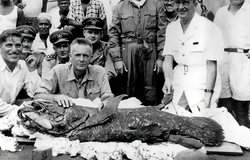
For centuries, the coelacanth was known only through the fossil record. This changed on December 22, 1938, when Hendrik Goosen, captain of the trawler Nerine, discovered a strange, steely blue fish during a trawl between the Chalumna and Ncera Rivers in South Africa. Goosen ensured the specimen was preserved and delivered it to Marjorie Courtenay-Latimer, the curator of the East London Museum.
Unable to identify the creature in her texts, Courtenay-Latimer contacted Professor J. L. B. Smith. Upon his return from a holiday, Smith immediately recognized the fish as a coelacanth. He named the species Latimeria chalumnae in honor of Courtenay-Latimer and the waters where it was found.
Because the original specimen had been taxidermied, its internal organs and skeleton were inaccessible, leaving some scientific doubt about its classification. This sparked a decade-long search for a second specimen to confirm the findings.
Expanding Scientific Knowledge
In 1952, a second specimen was captured off the coast of Anjouan in the Comoros. Initially placed in a separate genus called Malania (named after South African Prime Minister Daniel François Malan), it was later determined to be the same species as the South African find.
Genetic Insights and Evolution
For years, the coelacanth was believed to be the closest living relative to the first land-dwelling tetrapods due to its physical characteristics. However, genome sequencing conducted in 2013 revealed that lungfish are actually the closest relatives to land tetrapods. This discovery provided critical insights into the evolutionary transition from water to land.
Anatomy and Physiology
The West Indian Ocean coelacanth is a robust fish, with females reaching up to 2 metres (6 ft 7 in) and males up to 1.68 metres (5 ft 6 in). They typically average around 45 kg in weight.
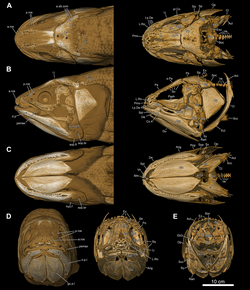
To survive in the dim light of the deep ocean, the species has evolved several specialized adaptations:
- Visual Enhancements: Large eyes with an abundance of rods and a choroidal tapetum lucidum—a reflective layer that increases light absorption.
- Camouflage: A deep royal blue color with spots to blend into the environment.
- Osmoregulation: To balance osmotic pressure (the movement of water across membranes), they retain urea in their blood.
Physiologically, they possess a rectal gland, pituitary gland, pancreas, and spinal cord, similar to cartilaginous fish. They are ovoviviparous, meaning they retain eggs internally until they hatch, though they have low fecundity due to a long gestation period of approximately 12 months.
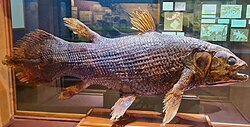
![Preserved specimen of Latimeria chalumnae in the Natural History Museum, Vienna, Austria [length: 170 cm (67 in) – weight: 60 kg (130 lb)]. This specimen was caught on 18 October 1974, next to Salimani/Selimani (Grand Comoro, Comoro Islands) 11°48′40.7″S 43°16′3.3″E / 11.811306°S 43.267583°E.](/images/64/35/64351621a484a9ce9bea312716e7df237cfdbbc277fd26ace54d7778a4a6d706.jpg)
Habitat and Unique Behaviors
These fish are primarily found at depths between 70 and 140 metres, though they have been spotted as shallow as 54 metres and as deep as 243 metres. They typically reside in underwater lava caves during the day for protection and venture out to feed at night.
The coelacanth is an opportunistic feeder, preying on various fish species such as Amioides polyacanthus and Beryx splendens. One of their most remarkable behaviors is the "headstand," where they position themselves vertically to slurp prey from cave crevices. This is made possible by a unique ability to move both the upper and lower jaw, a trait not found in any other living vertebrate with a bony skeleton.
Conservation Status and Population
The West Indian Ocean coelacanth is currently listed as Critically Endangered by the IUCN. They are distributed sparsely across the western Indian Ocean, from South Africa to Kenya, the Comoros, and Madagascar.
| Feature | Details |
|---|---|
| Scientific Name | Latimeria chalumnae |
| Max Length | 2 metres (Females) |
| Primary Habitat | Lava caves (70–243m depth) |
| Conservation Status | Critically Endangered / CITES Appendix I |
| Estimated Population | 500 or fewer (as of 1998 estimate) |
Population declines are a significant concern; between 1991 and 1994, the population was estimated to have reduced by 30%. To prevent extinction, the species was added to CITES Appendix I in 1989, which strictly forbids international commercial trade.
Frequently Asked Questions
Is the coelacanth actually a "living fossil"?
While the term is popular because the fish resembles ancestors from the fossil record, modern research shows they have undergone morphological diversity and are not entirely unchanged over millions of years.
How does the coelacanth differ from the Indonesian coelacanth?
The West Indian Ocean coelacanth (L. chalumnae) is vivid blue, whereas the Indonesian coelacanth (L. menadoensis) is identifiable by its brownish-grey color.
What is the "headstand" behavior?
The headstand is a feeding technique where the fish hangs vertically to extract prey from crevices in lava caves, utilizing its unique mobile upper and lower jaws.
Why is the coelacanth critically endangered?
The species has a very sparse distribution, low fecundity (few offspring), and a long gestation period, making it highly vulnerable to population reductions and accidental capture.
Are coelacanths related to humans?
They are more closely related to tetrapods (including humans) and lungfish than they are to common ray-finned fish, though genetic sequencing confirms lungfish are the closest living relatives to land vertebrates.