Weimar Republic Political Paramilitaries and Affiliated Groups
The era of the Weimar Republic was marked by intense political polarization and the rise of paramilitary organizations. These groups, often affiliated with specific political parties or movements, operated as armed wings that sought to influence German politics through propaganda, intimidation, and direct violence. From the ultra-nationalist right to the revolutionary left, these organizations mirrored the instability of the democratic state they inhabited.
Key Facts
- Der Stahlhelm was a massive veterans' organization with approximately 500,000 members.
- The Sturmabteilung (SA) grew to be the largest Nazi paramilitary unit, reaching 4.5 million members by 1934.
- The Reichsbanner Schwarz-Rot-Gold served as the primary defender of the republic, peaking at over three million members.
- The Roter Frontkämpferbund was the militant arm of the Communist Party (KPD), reaching 110,000 members.
- Many right-wing groups, including the SA and Bund Oberland, collaborated in the Deutscher Kampfbund to execute the Beer Hall Putsch.
Right-Wing Organizations
Right-wing groups in the Weimar era were characterized by their opposition to the republic, antisemitism, and a desire for a return to authoritarianism or monarchy.
Veterans and Nationalist Leagues
Der Stahlhelm, Bund der Frontsoldaten (The Steel Helmet, League of Front-Line Soldiers) was formed in December 1918. Led by Franz Seldte and Theodor Duesterberg, it maintained ties to the Reichswehr (the national army) and aligned with the conservative German National People's Party (DNVP). In 1931, it joined the Harzburg Front, an anti-democratic alliance including the Nazi Party and the Pan-German League. It was eventually integrated into the SA in 1934 and dissolved in 1935.
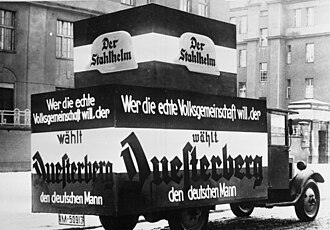
Other influential nationalist groups included the Deutschvölkischer Schutz- und Trutzbund, an antisemitic Völkisch (ethnic-nationalist) group led by Alfred Roth. It focused on revisionist propaganda regarding World War I and was banned in 1922. Similarly, the Bund Oberland, a Pan-German group, opposed the Treaty of Versailles and participated in the Beer Hall Putsch before its dissolution in 1933.
Militant Secret Societies and Coup Attempts
The Organisation Consul (O.C.) was an ultra-nationalist secret society founded in 1920 by Hermann Ehrhardt and former members of the Marinebrigade Ehrhardt. The O.C. engaged in Feme murders (vigilante killings) and political assassinations, most notably targeting Finance Minister Matthias Erzberger and Foreign Minister Walther Rathenau. After the O.C. was banned in 1922, the Viking League (Bund Wiking) was established as its successor, advocating for a military dictatorship until it was dissolved in 1928.
The Nazi Paramilitary: Sturmabteilung (SA)
Founded by Adolf Hitler in 1920, the Sturmabteilung (SA), or "brownshirts," served as the Nazi Party's muscle. Composed largely of former Freikorps (volunteer paramilitary) members, the SA protected Nazi meetings and engaged in street battles with left-wing opponents. Under Ernst Röhm, the SA expanded massively, though its political influence was curtailed after the Night of the Long Knives in June 1934.
Regional and Monarchist Groups
In Bavaria, the Bund Bayern und Reich supported the Wittelsbach dynasty and Bavarian separatism, peaking at 57,000 members before being absorbed by Der Stahlhelm in 1930. Meanwhile, the Wehrverband Reichsflagge sought the return of the Hohenzollern empire. A breakaway faction of this group, led by Ernst Röhm, formed the Bund Reichskriegsflagge, which participated in the Beer Hall Putsch.
The Deutscher Kampfbund
The Deutscher Kampfbund (German Battle League) was a short-lived umbrella organization created in September 1923 to coordinate the SA, Bund Oberland, and Bund Reichskriegsflagge. With Hitler as its political leader, the league planned the Beer Hall Putsch and was banned immediately following the coup's failure.
Center to Center-Left Organizations
These groups were primarily focused on protecting the democratic structures of the Weimar Republic from extremist threats.
The Reichsbanner Schwarz-Rot-Gold was the most significant pro-republican force, comprising members from the Social Democratic Party (SPD), the German Democratic Party, and the Catholic Centre Party. It stood as a military bulwark against both the SA and the Communist Roter Frontkämpferbund. In 1931, the Eiserne Front (Iron Front) was formed as a broader coalition of the Reichsbanner and labor unions to strengthen the Social Democrats during the 1932 elections.
The Jungdeutscher Orden (Young German Order) began as a paramilitary group seeking to recreate the camaraderie of the front lines to bridge class divides. It eventually merged its political arm into the German State Party before being banned in 1933.
Left-Wing Organizations
Left-wing paramilitaries were largely affiliated with the Communist Party of Germany (KPD) or anarchist movements, aiming for a socialist or council-based republic.
Communist Militancy
The Roter Frontkämpferbund (Red Front Fighters' League), founded in 1924, was the KPD's primary militant wing. It was banned in 1929 following the Blutmai (Bloody May) demonstrations in Berlin. Subsequent successor groups included the Kampfbund gegen den Faschismus and Antifaschistische Aktion, the latter of which focused on boosting KPD election campaigns in 1932.
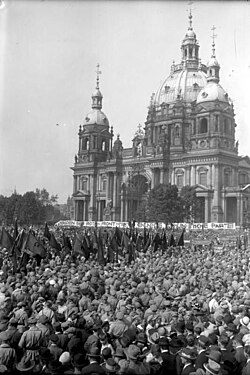
The KPD also operated the Antifaschistische Junge Garde as its youth wing, which was banned in 1933.
Worker Uprisings and Anarchism
The Rote Ruhrarmee (Ruhr Red Army) was a massive uprising of 50,000 workers in 1920 who sought to establish a council republic. This movement was violently suppressed by government troops and Freikorps. Additionally, the Schwarze Scharen (Black Band) consisted of anarchist and anarcho-syndicalist youth affiliated with the Free Workers' Union of Germany (FAUD).
Summary of Major Political Groups
| Organization | Political Alignment | Peak Membership (Approx.) | Primary Goal |
|---|---|---|---|
| Sturmabteilung (SA) | Far-Right (Nazi) | 4,500,000 | Nazi power; street intimidation |
| Reichsbanner | Center / Center-Left | 3,000,000+ | Defense of the Republic |
| Der Stahlhelm | Right-Wing / Conservative | 500,000 | Anti-republicanism; veterans' interests |
| Roter Frontkämpferbund | Far-Left (Communist) | 110,000 | Communist revolution |
| Bund Bayern und Reich | Right-Wing / Monarchist | 57,000 | Bavarian separatism / Monarchy |
Frequently Asked Questions
What was the role of the SA in the Nazi Party?
The SA, or Storm Division, served as the paramilitary wing of the Nazi Party. They were used to protect party meetings, march in rallies, and engage in street violence against political opponents, particularly those on the left.
How did the Reichsbanner differ from the SA?
While the SA sought to overthrow the Weimar Republic to install a Nazi regime, the Reichsbanner Schwarz-Rot-Gold was dedicated to defending the republic's democratic institutions against extremists from both the right and the left.
What was the Beer Hall Putsch and who was involved?
The Beer Hall Putsch was a failed coup attempt in November 1923. It was orchestrated by the Deutscher Kampfbund, an umbrella group that included the SA, Bund Oberland, and the Bund Reichskriegsflagge.
What were Feme murders?
Feme murders were political assassinations carried out by right-wing vigilante groups, such as the Organisation Consul, against individuals they perceived as traitors to the nationalist cause.
What happened to these groups after 1933?
Following the Nazi seizure of power, most opposing groups—including the Reichsbanner, the Roter Frontkämpferbund, and the Young German Order—were banned. Right-wing groups were either integrated into the Nazi apparatus (like Der Stahlhelm into the SA) or dissolved.