Estates of Württemberg: The Evolution of a Parliamentary Body
The Estates of Württemberg (German: Württembergische Landstände) served as the representative assembly for the Duchy of Württemberg for nearly five centuries. Spanning from 1457 to 1918—with a brief interruption between 1802 and 1815—this body evolved from a consultative council of notables into a formal bicameral parliament. Its primary function evolved from simply raising taxes for the ruling counts, dukes, and kings to debating broad matters of public policy.
Key Facts
- Duration: Active from 1457 to 1918 (except 1802–1815).
- Structure: Became a bicameral parliament by 1819.
- Primary Role: Tax authorization and public policy debate.
- Key Milestones: The Treaty of Esslingen (1492) and the Treaty of Tübingen (1514).
- Successor: Replaced in 1919 by the Landtag of the Free People's State of Württemberg.
The Origins of the Landtag
As the House of Württemberg expanded its influence, the ruling counts began meeting with "Diets"—councils designed to debate public policy. The first formal assembly, known as the Landtag, was convened in Leonberg in 1457 by Count Ulrich V. This move was strategically designed to balance the influence of the Ritterschaft (knights) by including town notables.
By 1459, a second Diet was held in Tübingen to secure recognition for the majority of the Count's son, Eberhard V. This assembly included the town's judge and bailiff, along with officials from 13 other towns, cementing the role of the Landschaft (the Estates) as the Duchy's largest political entity.
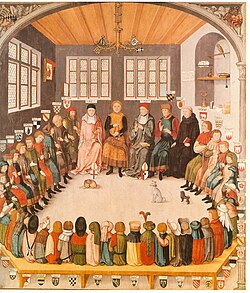
Composition and Power Dynamics
The membership of the Estates reflected the social hierarchy of the time. It included prelates—abbots from the Duchy's fourteen monasteries who served as Ducal appointees after the Reformation—and approximately 30 noblemen, typically senior officials or Ducal councillors. Because the Estates were meant to represent the inhabitants, roughly 75% of participants were townsfolk; however, the peasantry had almost no representation.
Despite their size, the Estates lacked the power to impose their will and remained dependent on the Duke. While they could occasionally secure reforms, such as through the Treaty of Tübingen in 1514, their influence fluctuated. During the minority or absence of a Duke, the Estates exercised significant control over government policy, but this power typically vanished once the Duke reached majority.
Constitutional Struggles and Governance
The relationship between the ruler and the ruled was often defined by compromise. The Treaty of Esslingen in 1492 established that 12 members of the Estates could assume rule if the leader was incompetent, providing a legal basis for future agreements throughout the 16th century.
Under Duke Ulrich, the Estates faced challenges. The 1520 Landtag consisted of burghers from the court and council of 44 towns, all categorized as Ehrbarkeit (honourable and reliable). Their lack of resistance to Ulrich's strong governance highlighted the Estates' lack of permanent constitutional standing and popular support. Nevertheless, the Duke found the Estates indispensable for declaring war and settling debts.
During Duke Ulrich's regency, the Estates attempted to implement a collegiate government consisting of four noble regents and two prelate advisers. However, tensions rose during the Swabian War; while local burghers opposed the conflict, the Estates continued to vote for the men and money required to sustain the war, which ultimately ended in defeat for the Swabian League.
Transition to a Bicameral Parliament
Following the creation of the Kingdom of Württemberg, the Estates were reestablished in 1815 and transitioned into a bicameral parliament by 1819. This structure remained in place until 1918.
| Chamber | Composition | Social Class |
|---|---|---|
| First Chamber (Kammer der Standesherren) | Hereditary Nobility | Aristocracy |
| Second Chamber (Kammer der Abgeordneten) | Elected Representatives | Commoners |
The long history of this institution did not go unnoticed by international observers. In the 1790s, the philosopher Edmund Burke was invited to Stuttgart by Duke Frederick. Although Burke declined due to old age and infirmity, he sent the Duke a copy of his Letters on a Regicide Peace.
Frequently Asked Questions
What was the primary purpose of the Estates of Württemberg?
The Estates primarily functioned to raise taxes for the counts, dukes, and kings of Württemberg and to provide a forum for the Duchy's leading inhabitants to debate public policy.
Who was excluded from the early Estates?
The peasantry had almost no input or representation in the early Diets, which were dominated by townsfolk, noblemen, and prelates.
What happened to the Estates after 1918?
In 1919, the Estates were succeeded by the Landtag of the "Free People's State of Württemberg," which operated as part of the Weimar Republic until 1933.
What was the significance of the Treaty of Esslingen?
The 1492 Treaty of Esslingen allowed 12 members of the Estates to take control of the government in cases of ducal incompetence, serving as a foundation for future compromises between the ruler and the assembly.
How was the parliament structured in its final century?
Between 1819 and 1918, it was a bicameral system consisting of the First Chamber (hereditary nobility) and the Second Chamber (commoners).