Old Württemberg: The History and Structure of the Pre-1803 Duchy
Before the sweeping geopolitical changes of the early 19th century, the region known as Old Württemberg (German: Altwürttemberg) served as a prominent princely territory within the Holy Roman Empire. Defined by its borders prior to the Reichsdeputationshauptschluss—an imperial treaty of 1803 that reorganized German territories—Old Württemberg represents the ancestral heartland of the region, distinct from the "New Württemberg" territories acquired later to the east and south.
Key Facts
- Definition: The territories belonging to the Duchy of Württemberg before the 1803 imperial treaty.
- Core Region: Centered around the Middle Neckar in the former County of Württemberg.
- Political Shift: Transitioned from a duchy with a restrictive estates constitution to a kingdom under Napoleon.
- Key Treaty: The 1514 Treaty of Tübingen shaped the region's constitution for centuries.
- Religious Context: One of the few Protestant territories with a vote in the Circle of Swabia.
Geographic Structure and Territories
The geography of Old Württemberg was a complex mosaic of acquired lands and ancestral holdings. At its core was the former County of Württemberg, situated along the Middle Neckar. Over time, the duchy expanded by incorporating several key regions, including the counties of Calw, Mömpelgard, Tübingen, Urach, and Vaihingen, as well as the baronies of Heidenheim and Teck.
The territory also included the imperial fief (Reichslehen) of Grüningen and various smaller lordships. During the Reformation, Dukes Ulrich and Christoph further expanded the duchy's reach by seizing and secularizing numerous ecclesial territories—lands previously owned by the church.
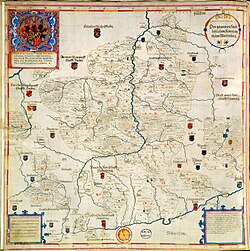
Despite the Duke's power, the region was not a seamless block. Several "islands" of independence existed within Württemberg's borders. These included the imperial towns of Heilbronn, Esslingen, Weil der Stadt, and Reutlingen, as well as the large city of Ulm on the southeastern edge. Additionally, various secular lordships remained independent, as documented by Georg Gadner in his 1596 overview map.
Political Evolution and Governance
The intellectual and political foundation of the region was strengthened early on with the establishment of a university in Tübingen in 1477. The university's founder, Count Eberhard im Bart, was elevated to the rank of duke in 1495.
A pivotal moment in the region's governance occurred in 1514 with the Treaty of Tübingen, signed following the Poor Conrad uprising. This treaty established a constitutional framework that lasted until 1805, featuring a parliamentary assembly dominated by prelates and patricians. This body significantly limited the duke's fiscal policies and general rights.
Interestingly, the organized nobility (the Landstände) ceased to be a political force after the Reformation. Because much of the estate-owning aristocracy remained Roman Catholic, they shifted their allegiance directly to the Holy Roman Emperor as imperial knights, effectively removing themselves from the Duke of Württemberg's feudal authority.
The Transition to New Württemberg
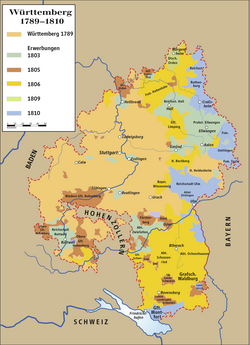
Between 1803 and the dissolution of the Holy Roman Empire in 1806, a separate entity known as New Württemberg existed briefly, with its government based in Ellwangen. While both Old and New Württemberg were ruled by Prince-Elector and Duke Frederick I in a personal union, the parliamentary assembly of Old Württemberg had no jurisdiction over the new territories.
This duality ended when Napoleon amalgamated the two into a single kingdom. This unification allowed the monarchy to officially revoke the restrictive estates constitution of Old Württemberg, rendering the political distinction between "Old" and "New" obsolete, though the terms continued to be used for regional identification.
Legacy in Modern Times
While no longer a political entity, the term "Old Württemberg" persists in cultural and commercial contexts. In the 20th century, it appeared in the names of organizations such as the Kraftwerk Altwürttemberg (Old Württemberg Power Station) and the Bezirksbaugenossenschaft Altwürttemberg (Old Württemberg District Construction Cooperative). Additionally, the Altwürttemberger, a specific breed of horse, carries the name, though the breed is currently threatened by extinction.
| Feature | Details |
|---|---|
| Core Heartland | Middle Neckar / Former County of Württemberg |
| Key Cities/Towns | Tübingen, Heilbronn, Esslingen, Ulm (Imperial) |
| Constitutional Basis | Treaty of Tübingen (1514) |
| Political Status | Duchy (until 1806), then part of a Kingdom |
| Religious Affiliation | Protestant (with Catholic imperial knights) |
Frequently Asked Questions
What is the difference between Old and New Württemberg?
Old Württemberg refers to the territories held by the Duchy prior to 1803. New Württemberg consists of the additional lands acquired through the Reichsdeputationshauptschluss of 1803, primarily to the south and east.
What was the significance of the Treaty of Tübingen?
Signed in 1514 after the Poor Conrad uprising, this treaty created a constitutional system that limited the duke's power and gave a parliamentary assembly of patricians and prelates control over fiscal policies until 1805.
Why did the nobility lose political influence in Old Württemberg?
Following the Reformation, the estate-owning aristocracy largely remained Catholic. They chose to become imperial knights under the direct authority of the Holy Roman Emperor rather than remaining vassals of the Protestant Duke of Württemberg.
How did Old Württemberg become a kingdom?
Under the influence of Napoleon, the territories of Old and New Württemberg were amalgamated into a kingdom, which allowed the ruler to abolish the restrictive estates constitution of the old duchy.
Are there any remaining cultural symbols of Old Württemberg?
Yes, the name survives in some 20th-century institutional names and in the Altwürttemberger horse breed, which is now endangered.