Weather Prediction Center: Precision Forecasting for the United States
The Weather Prediction Center (WPC), based in College Park, Maryland, serves as a critical pillar of the United States' meteorological infrastructure. As one of nine service centers under the National Centers for Environmental Prediction (NCEP), the WPC operates within the National Weather Service (NWS) and the National Oceanic and Atmospheric Administration (NOAA). Its primary mission is to provide essential forecast, guidance, and analysis products to support daily public forecasting and assist government agencies during emergency situations.
Formerly known as the Hydrometeorological Prediction Center (HPC) until March 2013, the WPC specializes in quantitative precipitation forecasting (QPF), medium-range forecasting, and the expert interpretation of numerical weather prediction computer models.
Key Facts
- Headquarters: College Park, Maryland
- Parent Agency: National Oceanic and Atmospheric Administration (NOAA)
- Primary Focus: Precipitation forecasting, medium-range weather, and model interpretation
- Tropical Role: Official backup to the National Hurricane Center (NHC)
- Established: 1942 (as the Analysis Center)
A History of Meteorological Evolution
The roots of the WPC date back to March 1942, when the Weather Bureau established the Analysis Center. Over the decades, the organization has undergone several significant transformations to keep pace with technological advancements.
From Analysis to Numerical Modeling
In 1947, the Analysis Center merged with Air Force and Navy units to form the Weather Bureau-Air Force-Navy (WBAN) Analysis Center. By 1954, the creation of the Joint Numerical Weather Prediction Unit (JNWPU) allowed for the testing of numerical weather prediction (NWP)—the use of mathematical models to predict atmospheric conditions via computer.
This evolution led to the formation of the National Meteorological Center (NMC) in 1958. As computing power grew, the facility achieved a major milestone in June 1966 by running the first global forecast model. In 1995, NMC transitioned into the NCEP, eventually leading to the current structure where the WPC provides specialized services under the NCEP umbrella.
Core Products and Specialized Services
The WPC provides a wide array of data-driven products designed to assist both professional meteorologists and the general public.
Quantitative Precipitation Forecasting (QPF)
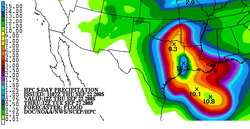
The QPF desks focus on predicting accumulating precipitation, including heavy rain and snow. These forecasts are valid for the following five days and are vital for identifying areas at risk for flash flooding. The National Precipitation Prediction Unit (NPPU), which includes meteorologists from the National Environmental Satellite Data and Information Service (NESDIS), uses satellite data, Doppler weather radar, and NCEP models to create these highly detailed forecasts.
Winter Weather and Short-Term Forecasts
During the cold season (September 15 to May 15), the Winter Weather Desk issues heavy snow and icing guidance for the contiguous United States. These products are often probabilistic, meaning they represent the likelihood of specific accumulations occurring within a 24-hour period to better communicate forecast uncertainty.
For shorter timeframes, the WPC provides graphical short-term forecasts covering 6 to 60 hours. These utilize various global and regional models, such as the Global Forecast System (GFS) and the North American Mesoscale Model (NAM), to depict surface pressure patterns, fronts, and precipitation types.
Medium-Range and Alaska Forecasting
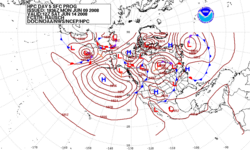
Medium-range forecasters handle predictions for three to seven days into the future. This includes surface pressure, temperature anomalies, and 500 hPa (millibar) height forecasts. Additionally, a dedicated team provides specialized medium-range forecasts for Alaska, offering high-resolution grids for temperature, dewpoint, cloud cover, and wind speed.
Specialized Operational Roles
Tropical Cyclone Support
The WPC serves as the official backup to the National Hurricane Center (NHC). In the event of a total communications failure at the NHC, the WPC is responsible for issuing all tropical cyclone products, including watches and warnings. During the tropical season (May 15 – November 30), the WPC also provides rainfall statements for tropical cyclones making landfall and issues public advisories for systems that have weakened but still pose a flooding threat.
Model Diagnostics and Surface Analysis
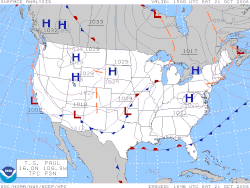
To ensure accuracy, the WPC performs model diagnostics, providing subjective interpretations of how different numerical models are performing. Furthermore, the WPC participates in the Unified Surface Analysis, a collaborative effort to manually analyze surface fronts and pressure patterns across North America every three hours.
Summary of WPC Capabilities
| Service Type | Forecast Horizon | Primary Focus Area |
|---|---|---|
| QPF | 5 Days | Accumulating rain and snow; flash flood potential |
| Short-Range | 6–60 Hours | Surface pressure, fronts, and precipitation types |
| Medium-Range | 3–7 Days | Temperature, pressure, and 500 hPa heights |
| Winter Weather | 3 Days (Probabilistic) | Heavy snow and icing accumulations |
| Alaska Medium-Range | 4–8 Days | High-resolution regional atmospheric data |
Frequently Asked Questions
What is the difference between WPC and the Climate Prediction Center?
The WPC focuses on short-to-medium range weather, such as precipitation and storm systems. The Climate Prediction Center (CPC) handles long-range climatological forecasts, including monthly and seasonal outlooks.
How does the WPC assist during a hurricane?
The WPC acts as the official backup to the National Hurricane Center. If the NHC experiences a communications failure, the WPC takes over the issuance of all tropical cyclone warnings and discussions.
What does "quantitative precipitation forecasting" mean?
It refers to the process of forecasting the specific amount of accumulating precipitation (rain or snow) expected to fall over a certain period.
Who uses the WPC's weather products?
WPC products are used by National Weather Service forecast offices, emergency managers, the media, and various government agencies like FEMA and the Department of Homeland Security.
When does the Winter Weather Desk operate?
The Winter Weather Desk issues products during the cold season, which runs from September 15 through May 15.