Waziristan Campaign 1919–1920: Conflict on the North-West Frontier
The Waziristan campaign of 1919–1920 was a significant military operation conducted by the British Indian Army in the rugged terrain of Waziristan. This conflict pitted the British Empire against the fiercely independent tribes of the North-West Frontier of India during the volatile interwar period. Emerging from the instability of the Third Anglo-Afghan War, the campaign sought to restore imperial control over a region defined by tribal autonomy and strategic instability.
Key Facts
- Duration: November 1919 to December 1920.
- Location: Waziristan and the North-West Frontier of India.
- Outcome: British–Indian victory.
- Primary Opponents: Tochi Wazirs, Wana Wazirs, and the Mahsud tribe.
- British Forces: 4 Brigades and 1 Air Force Wing.
- Casualties: Approximately 2,286 British-Indian losses; tribal losses are unknown.
Background and Causes of the Conflict
The roots of the 1919–1920 campaign trace back to the summer of 1917, when the Mahsud tribe launched an incursion while British forces were heavily committed to the First World War. Although calm was temporarily restored, the conclusion of the Third Anglo-Afghan War in 1919 created a power vacuum and widespread unrest across British India.
Tensions were further inflamed by rumors circulating among the Wazirs and Mahsuds that Britain intended to cede control of Waziristan to Afghanistan as part of the peace settlement. Perceiving British weakness, the tribes launched large-scale raids against British garrisons. By November 1919, these attacks had resulted in over 200 deaths and 200 injuries, necessitating a full-scale military response.
Military Operations and Strategy
The British response began in November 1919 under the command of Major-General Sir Andrew Skeen. The first phase targeted the Tochi Wazirs, resulting in successful operations and agreed terms. By December, Skeen shifted his focus toward the Mahsuds, deploying the 43rd and 67th Brigades as the Derajet Column.
The British forces faced significant challenges. Due to the depletion of the Indian Army during the First World War, many battalions were second-line units composed of very young soldiers and inexperienced officers. These troops met heavy resistance from well-armed and determined tribesmen.
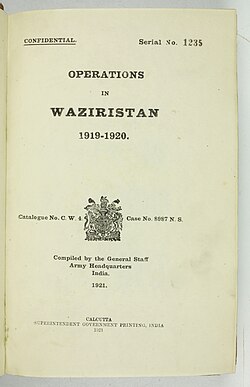
Key Engagements and Valor
The fighting persisted for approximately 12 months, characterized by brutal skirmishes and the strategic use of aircraft to suppress tribal movements. A notable highlight was the eight-day battle at Ahnai Tangi in January 1920, where the 2nd/5th Gurkhas held their ground, supported by the 2nd/76th Punjabis.
The campaign was marked by extraordinary acts of bravery, resulting in three Victoria Crosses—the highest award for gallantry in the British honors system. These were awarded to Lieutenant William David Kenny (posthumously) for leading a 10-man counter-attack by the 4th/39th Garhwal Rifles, as well as to Captain Ishar Singh and Captain Henry John Andrews.
The Role of Air Power and Conclusion
The tide turned against the Mahsuds following the heavy casualties they sustained at Ahnai Tangi and the subsequent destruction of their villages by Royal Air Force bombers. This combination of ground and air pressure temporarily subdued the tribe. When the Wana Wazirs rose in rebellion in November 1920, the weakened Mahsuds were unable to provide support, leading to the collapse of the opposition. Wana was re-occupied on December 22, 1920.
Campaign Summary
| Category | British Empire / India | Waziristan Tribes |
|---|---|---|
| Commanders | Skipton Climo, Andrew Skeen | Musa Khan Mahsud, Fazaldin Khan Mahsud |
| Estimated Strength | 4 Brigades, 1 Air Force Wing | Tochi Wazirs (~13,500), Wana Wazirs (~11,900), Mahsuds (~10,900) |
| Casualties | ~2,286 | Unknown |
| Result | Victory | Defeat |
Aftermath and Long-term Strategy
While the main campaign ended in 1920, minor raids continued into 1921. The British recognized that their previous approach was insufficient and shifted to a strategy of permanent presence. They established a regular troop garrison at Razmak to work alongside reconstituted militia units, many of whom had previously deserted during the war with Afghanistan.
This shift led to further instability. Between 1921 and 1924, British road construction efforts sparked new conflicts. This was followed by "Pink's War" in 1925, an aerial bombardment campaign by the Royal Air Force. The region remained a flashpoint, with another major campaign occurring between 1936 and 1939.
Frequently Asked Questions
What triggered the Waziristan campaign of 1919–1920?
The campaign was triggered by large-scale raids by the Wazirs and Mahsuds following the Third Anglo-Afghan War. These raids were fueled by rumors that Britain would hand over control of Waziristan to Afghanistan.
Why did the British Indian Army struggle initially?
The army was depleted by the First World War, meaning many units were second-line battalions consisting of very young soldiers and inexperienced officers who were unprepared for the determined tribal resistance.
How did the Royal Air Force contribute to the victory?
The RAF was used to suppress tribesmen through aerial strafing and the strategic bombing of Mahsud villages, which played a critical role in breaking the tribes' will to fight.
Who were the Victoria Cross recipients of this campaign?
The Victoria Cross was awarded to Lieutenant William David Kenny, Captain Ishar Singh, and Captain Henry John Andrews for their gallantry during the operations.
What was the long-term result of the campaign?
The British shifted their strategy to maintain a permanent military garrison at Razmak and focused on infrastructure development, such as road construction, though this led to further conflicts in the following decades.