2nd Mounted Division and 5th Cavalry Division: Cavalry Operations in Palestine
During the closing stages of World War I, the Egyptian Expeditionary Force (EEF)—the British military force operating in Egypt and Palestine—underwent a significant reorganization of its mounted troops. Central to this effort was the creation of the 2nd Mounted Division, a specialized cavalry formation that would later be renamed the 5th Cavalry Division. This unit played a pivotal role in the final offensive that secured victory in the Middle Eastern theater.
Key Facts
- Active Period: April 1918 to April 1920.
- Primary Role: Cavalry operations within the British Indian Army.
- Major Engagements: Battle of Megiddo, Capture of Damascus, and the Occupation of Aleppo.
- Command: Notably commanded by Maj.-Gen. H.J.M. Macandrew.
- Structure: Comprised of three main brigades (13th, 14th, and 15th) combining British and Indian regiments.
Formation of the 2nd Mounted Division
The origins of the division lie in the reorganization of the 2nd Indian Cavalry Division, which was broken up in France in March 1918. While Canadian and British units remained on the Western Front, the Indian elements were redeployed to Egypt. On April 24, 1918, the 2nd Mounted Division was officially formed on the Indian Establishment.
The division was constructed by merging existing brigades already present in Palestine with these arriving Indian units. The 5th Mounted Brigade (transferred from the Australian Mounted Division) merged with the 3rd (Ambala) Cavalry Brigade, while the 7th Mounted Brigade merged with the 9th (Secunderabad) Cavalry Brigade. The third pillar of the division was the Imperial Service Cavalry Brigade, which had been active in the region since 1914.
To streamline the force, certain Yeomanry regiments—volunteer cavalry units—were repurposed. The 1/1st Warwickshire Yeomanry and the 1/1st South Nottinghamshire Hussars formed the B Battalion, Machine Gun Corps, and were sent to France. They were replaced by Indian Cavalry Regiments to maintain the division's strength.
Transition to the 5th Cavalry Division
On July 22, 1918, the unit was renumbered as the 5th Cavalry Division. This change included the renumbering of its constituent brigades to the 13th, 14th, and 15th (Imperial Service) Cavalry Brigades, as well as its signal and medical support units.
Divisional Structure and Composition
The division followed the British Indian Army standard, where brigades typically retained one British regiment while the majority of support and combat units were Indian.
- 13th Cavalry Brigade: Included the 1/1st Royal Gloucestershire Hussars, 9th Hodson's Horse, and 18th King George's Own Lancers.
- 14th Cavalry Brigade: Included the 1/1st Sherwood Rangers Yeomanry, 20th Deccan Horse, and 34th Prince Albert Victor's Own Poona Horse.
- 15th (Imperial Service) Cavalry Brigade: Comprised of the Mysore, Hyderabad, and Jodhpur Lancers.
Supporting these brigades were the Essex and Nottinghamshire Batteries of the Royal Horse Artillery (RHA), the 5th Field Squadron of the Royal Engineers (RE), and various Army Service Corps (ASC) companies for logistics.
Major Battles and Campaigns
Operating as part of the Desert Mounted Corps, the division was instrumental in the final push against Ottoman forces. Their operational history includes the Second Transjordan Raid in early 1918 and the Affair of Abu Tellul in July.
The division's most significant contributions occurred during the Final Offensive. They participated in the Battle of Megiddo (September 19–25), a decisive victory that broke the enemy line. This was followed by the rapid Capture of Damascus on October 1 and the subsequent Occupation of Aleppo on October 26.
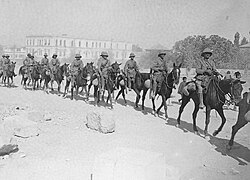
Following the armistice, the division remained in Palestine for occupation duties. Demobilization began in 1919, leading to the gradual dissolution of the brigades. The 14th Brigade was broken up in September 1919, the 15th in January 1920, and the division itself was finally disbanded in April 1920.
Summary of Divisional Organization
| Component | Key Units | Role |
|---|---|---|
| 13th Cavalry Brigade | Royal Gloucestershire Hussars, Hodson's Horse, 18th Lancers | Combat / Cavalry |
| 14th Cavalry Brigade | Sherwood Rangers Yeomanry, 20th Deccan Horse, 34th Poona Horse | Combat / Cavalry |
| 15th (I.S.) Cavalry Brigade | Mysore, Hyderabad, and Jodhpur Lancers | Combat / Cavalry |
| Artillery | Essex Battery, Nottinghamshire Battery (RHA) | Fire Support |
| Divisional Troops | 5th Field Squadron (RE), Signal Squadron, ASC Companies | Engineering, Comms, Logistics |
Frequently Asked Questions
What was the difference between the 2nd Mounted Division and the 5th Cavalry Division?
They were the same unit; the 2nd Mounted Division was simply renamed the 5th Cavalry Division on July 22, 1918, as part of a broader renumbering of brigades and support units.
Who were the Imperial Service Cavalry?
The Imperial Service Cavalry consisted of units provided by the princely states of India, such as the Jodhpur, Mysore, and Hyderabad Lancers, who served as the 15th Cavalry Brigade.
Which major cities did the division help capture?
The division was involved in the capture of Damascus on October 1, 1918, and the subsequent occupation of Aleppo on October 26, 1918.
When was the division officially disbanded?
After performing occupation duties in Palestine following the war, the division and its remaining 13th Cavalry Brigade were broken up in April 1920.
What was the role of the Yeomanry in this division?
The Yeomanry provided British volunteer cavalry regiments, such as the Royal Gloucestershire Hussars and Sherwood Rangers Yeomanry, which operated alongside Indian cavalry regiments.