Waveforms in Electronics and Acoustics
In the realms of electronics and acoustics, a waveform is the visual representation of a signal's shape when plotted as a function of time. Crucially, the waveform describes the pattern of the signal regardless of its magnitude, time scale, or specific displacement in time.
Types of Waveforms
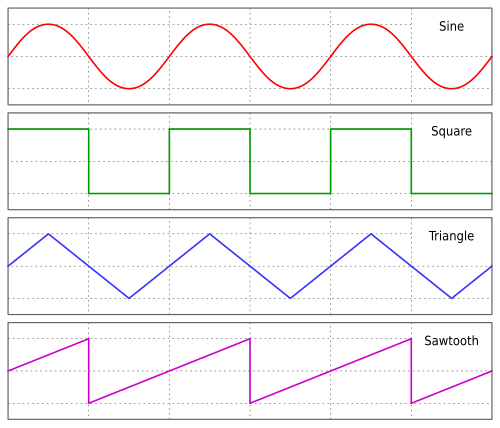
Waveforms are generally categorized by whether they repeat their pattern over time. Periodic waveforms are those that repeat regularly at a constant period. Conversely, aperiodic (or non-periodic) signals do not repeat; common examples include pulses and chirps.
Applications in Electronics
Within electronics, waveforms typically describe time-varying electromagnetic fields, currents, or voltages. In this context, the waveform is an attribute that remains independent of the signal's phase shift, amplitude, or frequency.
Applications in Acoustics
In acoustics, waveforms refer to variations of pressure within air or other media, typically associated with steady periodic sounds. The specific shape of these waveforms is what determines the timbre—the unique quality or color of a sound. This principle allows synthesizers and modern keyboards to create a vast array of complex sounds by generating different waveforms.
Measuring and Generating Waveforms
To visualize an electrical signal, engineers use an oscilloscope or similar devices capable of plotting values across time and value axes. In the medical field, an electrocardiograph is used to record the electrical waveforms produced by the beating heart, providing critical diagnostic data.
For testing and development, electronics laboratories utilize waveform generators. These tools can output periodic currents or voltages in several different predefined shapes.
Key Facts
- A waveform is the shape of a signal's graph over time, independent of scale and magnitude.
- Periodic waveforms repeat at constant intervals, while aperiodic signals (like pulses) do not.
- In acoustics, the waveform shape directly influences the timbre of a sound.
- Oscilloscopes are the primary tool for visualizing electrical waveforms.
- Electrocardiographs use waveform recording for medical heart diagnostics.
| Field | Primary Medium | Key Influence/Use |
|---|---|---|
| Electronics | Voltage, Current, EM Fields | Signal analysis and generation |
| Acoustics | Air/Media Pressure | Sound timbre |
| Medicine | Biological Electric Signals | Cardiac diagnostics |
Frequently Asked Questions
What is the difference between periodic and aperiodic waveforms?
Periodic waveforms repeat their pattern regularly at a constant period, whereas aperiodic waveforms, such as pulses or chirps, do not repeat.
How does a waveform affect sound?
In acoustics, the waveform of a steady periodic sound determines its timbre, which is the characteristic quality that distinguishes different sounds.
What device is used to see an electrical waveform?
An oscilloscope is the standard device used to capture and plot the value of an electrical signal over time.
What is a waveform generator?
A waveform generator is a laboratory tool used in electronics to produce periodic voltages or currents in various specific shapes.
How are waveforms used in medicine?
Medical professionals use an electrocardiograph to record the waveforms of electrical signals from the heart, which serves as a vital diagnostic tool.