Reverberation in Acoustics: Principles, Measurement, and Impact
In the world of acoustics, reverberation (often shortened to reverb) is the persistence of sound after the original source has stopped. This phenomenon occurs when sound waves reflect off surfaces—such as walls, ceilings, furniture, and even people—creating a dense sequence of reflections that gradually decay as the energy is absorbed by the environment. Unlike a distinct echo, which is only detectable when there is a gap of 50 to 100 milliseconds between the original sound and the reflection, reverberation consists of reflections that arrive in intervals of less than 50 milliseconds.
Reverberation is not limited to indoor spaces; it occurs naturally in forests and other outdoor environments where reflective surfaces are present. While it can add a sense of space and naturalness to music and recordings, excessive reverberation can significantly reduce speech intelligibility, making it difficult for listeners—particularly those with hearing loss or those using hearing aids—to distinguish between similar-sounding syllables.

Key Facts
- Definition: The persistence of sound caused by multiple reflections arriving within 50ms of each other.
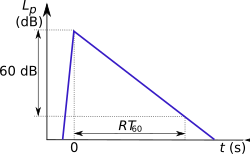
- RT60: The standard objective measure of reverberation time, defined as the time it takes for sound pressure to drop by 60 dB.
- Frequency Dependence: Reverberation varies by frequency; lower frequencies typically decay more slowly than higher frequencies.
- Absorption: The rate of decay is determined by the room's volume and the absorption coefficients of its surfaces.
- Impact: High reverb can hinder speech clarity but enhance the tonal balance and depth of music.
Measuring Reverberation Time
Reverberation time is the duration required for sound to "fade away" in an enclosed area. To quantify this, acousticians use T60, the time it takes for the sound pressure level to reduce by 60 decibels (dB) after a test signal ends.
Measurement Methods
Historically, this was measured using level recorders that graphed noise against time. Today, several digital and physical methods are used:
- Impulse Method: Creating a loud, abrupt noise with a defined cut-off, such as a balloon burst or a blank pistol shot.
- Interrupted Noise Method: Generating a random signal (like white or pink noise) through a loudspeaker and abruptly turning it off.
- Two-Port Measurement: Comparing the signal sent to a loudspeaker with the recording of the sound in the room using a Fourier transform to derive the impulse response. This allows for measurements while an audience is present.
- Simplified Methods: In some cases, simple handclaps can be used for basic measurements.
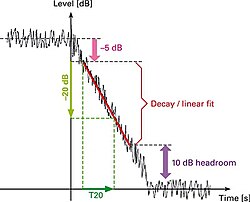
Because it is often difficult to inject enough energy to measure a full 60 dB decay, acousticians use T20 (measuring a 20 dB drop and multiplying by 3) or T30 (measuring a 30 dB drop and multiplying by 2).
Standardization
Reverberation measurements are governed by international standards to ensure consistency across different environments:
- ISO 3382-1: Performance spaces.
- ISO 3382-2: Ordinary rooms.
- ISO 3382-3: Open-plan offices.
- ASTM E2235: General standard for reverberation time.
Mathematical Models of Decay
The Sabine Equation
Developed by Wallace Clement Sabine in the late 19th century, this empirical formula established that reverberation time is proportional to the room's volume and inversely proportional to the total absorption. Sabine found that the more absorbent the surfaces, the faster the sound decays.
The Eyring Equation
Proposed by Carl F. Eyring in 1930, this equation improves upon Sabine's model for "dead" rooms—small spaces with high amounts of absorption, such as recording studio control rooms. While Sabine's formula tends to over-predict reverberation time in these environments, Eyring's logarithmic scaling provides a more accurate estimate.
Absorption Coefficients
The absorption coefficient is a value between 0 and 1 that describes how much sound a material absorbs versus reflects. A value of 0 indicates a perfect reflector (like smooth concrete), while a value of 1 indicates total absorption (like an open window).
| Concept/Model | Primary Use Case | Key Characteristic |
|---|---|---|
| Sabine Equation | Large, "live" rooms | Empirical; proportional to volume/absorption |
| Eyring Equation | Small, "dead" rooms | Logarithmic scaling for high absorption |
| T60 | Objective measurement | Time for 60 dB decay |
| Absorption Coefficient | Material analysis | Ratio of absorbed to reflected sound (0 to 1) |
Reverberation in Music and Audio
Reverberation is one of the oldest sound effects in music, appearing as early as 10th-century plainsong. For example, Gregorian chants may have evolved specifically to accommodate the long reverberation times of cathedrals, which would otherwise cause fast-paced notes to blend chaotically.
In modern production, artificial reverberation is used to add depth and a sense of space. This is achieved through:
- Echo chambers: Physical rooms designed for reflection.
- Mechanical means: Vibrations sent through metal (spring reverb).
- Digital processing: Algorithmic simulations of acoustic spaces.
While reverb adds richness, the process of dereverberation is used to remove these reflections from a signal to improve clarity, particularly in automatic speech recognition systems.
Frequently Asked Questions
What is the difference between reverberation and an echo?
Reverberation consists of reflections that arrive so quickly (less than 50 ms) that they are perceived as a continuous decay of the original sound. An echo is a distinct reflection that is heard at least 50 to 100 ms after the original sound.
Why is RT60 the standard for measuring reverb?
RT60 provides an objective, standardized measurement of the time it takes for sound pressure to drop by 60 dB, allowing acousticians to compare different spaces using a consistent metric.
How does room size affect reverberation?
Generally, larger rooms have longer reverberation times because sound waves must travel further before hitting a surface to be absorbed or reflected.
Can reverberation be harmful to communication?
Yes. Excessive reverberation can overlap syllables in speech, reducing intelligibility. This is particularly challenging for people with hearing loss or for software performing automatic speech recognition.
What is a "dead" room in acoustics?
A "dead" room is a space with a very low reverberation time due to a high quantity of sound-absorbing materials, often found in professional recording studios.