Water Glyphs: Visual Characteristics and Design Variations
Water glyphs are distinct petroglyphs—images created by removing part of a rock surface by incising, picking, or carving—that follow a specific geometric pattern. These carvings are characterized by a consistent set of visual elements, though they exhibit subtle variations across different examples.
Physical Dimensions and Construction
Standard water glyphs typically measure 48 inches in length and 24 inches in width. The carvings are executed as grooves that penetrate the rock surface to a depth of half an inch to one inch.
The Core Symbolic Structure
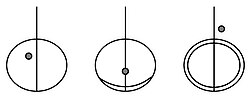
At its most basic level, the symbol consists of a circle or an ellipse that is bisected by a single straight line. This bisecting line generally extends beyond the edge of the circle on one side, with the extension length roughly equaling the diameter of the circle itself. In some instances, this extending line continues until it drops off the edge of the rock or cliff face.
The Role of the Dot
A defining feature of the petroglyph is the presence of a single deep depression, often referred to as a dot, located either within or near the circle. The placement of this dot is variable and can be found in several positions:
- Located entirely outside or inside the circle.
- Positioned to the left or right of the bisecting line.
- Placed directly along one of the circular horizon lines.
Variations in Design
While the basic structure remains constant, certain glyphs feature modifications. Some examples include a double front horizon or the presence of multiple dots. Additionally, the circle may be modified with partial arcs, creating a crescent shape on one side of the ring or forming a double ellipse.
Key Facts
- Standard Size: 48 inches long by 24 inches wide.
- Carving Depth: Between 0.5 and 1 inch deep.
- Primary Shape: A bisected circle or ellipse.
- Distinctive Feature: A deep depression or "dot" located near or inside the circle.
- Line Extension: The bisecting line often extends by a distance equal to the circle's diameter.
| Element | Standard Specification | Common Variations |
|---|---|---|
| Dimensions | 48" L x 24" W | Varies by site |
| Groove Depth | 0.5" to 1" | Consistent depth |
| Central Figure | Bisected circle/ellipse | Double ellipse or crescent arcs |
| Bisecting Line | Extends one side (approx. 1 diameter) | May drop off cliff edge |
| Depressions | Single "dot" | Multiple dots |
Frequently Asked Questions
What are the typical dimensions of a water glyph?
They are usually 48 inches long and 24 inches wide, with grooves carved to a depth of half an inch to one inch.
What is the basic geometric composition of the symbol?
The basic glyph consists of a circle or ellipse that is split by a single straight line, which typically extends beyond the circle's edge.
Where is the "dot" usually located in these petroglyphs?
The dot, or deep depression, can be found inside or outside the circle, to the left or right of the bisecting line, or along the circular horizon lines.
Are there versions of the glyph that are not simple circles?
Yes, some glyphs feature additional arcs that form crescents or a double ellipse, though the fundamental bisected structure remains.
Does the bisecting line always stay on the rock surface?
Not always; in some cases, the extending line drops off the edge of the rock or cliff.