Sacred Geometry in Global Art and Architecture
Throughout human history, the intersection of mathematics and spirituality has manifested in the physical world through sacred geometry—the use of geometric ratios and figures to represent cosmic order and divine truth. From the monumental temples of ancient India to the soaring cathedrals of Medieval Europe, architects and artists have employed specific shapes to align human structures with the perceived laws of the universe.
These principles are not limited to buildings; they extend to the conceptualization of the human body and the natural world. For instance, Leonardo da Vinci's famous Vitruvian Man, based on the writings of the Roman architect Vitruvius, illustrates the geometric proportions of the human form as a reflection of universal harmony.
Key Facts
- Ancient Foundations: Egyptian, Indian, Greek, and Roman architectures relied heavily on geometric ratios.
- Cosmic Analogies: Many traditions use the circle to represent the universe or the perfection of nature.
- Cultural Variations: Buddhism utilizes mandalas, Islam employs complex tessellations, and Chinese traditions focus on the flow of Chi via feng shui.
- Fractal Design: Hindu temples often use self-similar patterns where smaller parts replicate the whole.
Sacred Geometry in Christianity
In Medieval Europe, cathedrals were designed as mathematical tools to help viewers understand the divine. Many of these structures featured a Latin Cross floor-plan, symbolizing the central tenet of the faith.
During the High Middle Ages, philosophers used the microcosm analogy to explain the universe. Hildegard of Bingen described visions of a human figure—representing Christ and mankind—positioned within a circular orb that symbolized the universe, sometimes with God depicted above the entire system.
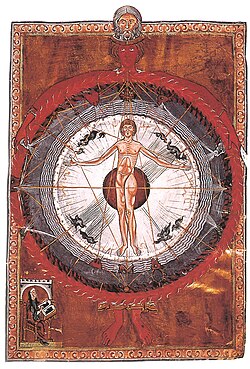
This cosmic order is also evident in literature. In The Divine Comedy, Dante Alighieri utilized concentric circles to categorize the nine layers of Hell and the nine layers of Paradise, a cosmology likely inspired by the ancient astronomer Ptolemy.
As the Renaissance began, architectural preferences shifted toward simple, regular geometries. The circle became a primary symbol of nature's perfection and man's central place in the universe, a concept solidified in Leon Battista Alberti's architectural treatise on the ideal church.
Buddhist Mandalas and Spiritual Art
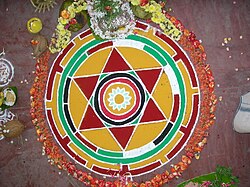
In Buddhism, the mandala is a complex geometric configuration of concentric circles and squares arranged equally around a center. These shapes house deities or symbols of deities, as it is believed that these divine beings can manifest within the mandala.
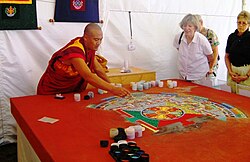
Tibetan Buddhists practice a unique form of mandala creation using colored sand. The process begins with a grid where two Brahman lines must overlap at a precisely calculated center. The grid is then divided into thirteen equal parts through trial and error and purified before the sand is added. Because Buddhism emphasizes impermanence, these intricate works are ritually destroyed and released into the world after they are completed.
Chinese Spiritual Traditions and Feng Shui
Chinese folk religion emphasizes the harmony between humanity and nature, a relationship managed through feng shui. These architectural principles aim to optimize the movement of Chi (life-generating energy) through the use of specific shapes.
Rectangles and squares are preferred in feng shui because unnatural angles are thought to obstruct the flow of Chi. Proportionality is also key; for example, doors are typically not placed directly across from one another to prevent Chi from flowing too rapidly through the home.
The Forbidden City serves as a primary example of these principles. Its rectangular layout measures over half a mile in length and width, with its most important buildings situated on a central axis. The Hall of Supreme Harmony, the Emperor's throne room, sits at the epicenter of this axis to symbolize the Emperor's ceremonial transformation into the center of the universe.
Geometric Complexity in Islamic Art
Islamic art is renowned for its intricate patterns created from repeated, overlapping, and interlaced squares and circles. These often form tessellations (repeating tiles without gaps) and arabesques (intertwining rhythmic linear patterns).
The complexity of these patterns evolved over centuries: starting with simple stars and lozenges in the ninth century, progressing to 6- to 13-point patterns by the 13th century, and reaching 14- and 16-point stars by the sixteenth century. These designs appear in various mediums, including:
- Zellige: Moroccan and Algerian tilework.
- Girih: Persian geometric patterns.
- Muqarnas: Decorative vaulting.
- Jali: Pierced stone screens.
Hinduism and Indic Religious Architecture
The construction of Hindu temples is guided by the Agamas, a collection of scriptures in Sanskrit, Tamil, and Grantha. These texts provide strict rules for Shilpa (the art of sculpture), covering everything from site selection and materials to dimensions, lighting, and air circulation. Key works detailing these rules include the Manasara and Silpasara.
Hindu temples also employ the Vastu Shastra principle of Sukha Darshan. This principle dictates that smaller parts of the temple should be self-similar replicas of the whole, mirroring the fractal patterns found in nature. This proportional repetition creates a sacred geometry that projects a cosmic model onto the physical structure.
| Tradition | Primary Geometric Elements | Key Concept/Principle | Example/Application |
|---|---|---|---|
| Christianity | Latin Cross, Circles | Microcosm Analogy | Medieval Cathedrals |
| Buddhism | Concentric Circles, Squares | Impermanence | Sand Mandalas |
| Chinese | Rectangles, Squares | Feng Shui (Chi flow) | The Forbidden City |
| Islam | Tessellations, Stars | Infinite Patterning | Zellige and Girih |
| Hinduism | Fractals, Self-similarity | Vastu Shastra | Agama-based Temples |
Frequently Asked Questions
What is the purpose of a mandala in Buddhism?
Mandalas serve as geometric representations of the universe where deities can manifest. They are used to provide positive energy and blessings to those who view them, while their ritual destruction symbolizes the Buddhist belief in impermanence.
How does feng shui influence building design?
Feng shui uses specific shapes, primarily rectangles and squares, to ensure the harmonious flow of Chi (life-generating energy). It also dictates the proportional placement of doors to prevent energy from moving too quickly through a space.
What are the Agamas in the context of Hindu architecture?
The Agamas are scriptures that provide the technical and philosophical rules for temple construction, the creation of idols, and the specific proportions and materials required for sacred spaces.
What is the significance of the circle in Renaissance architecture?
During the Renaissance, the circle was viewed as a symbol of the perfection of nature and the central importance of humanity within the universe, leading to its frequent use as the base for sacred buildings.
What is the principle of Sukha Darshan?
Sukha Darshan is a Vastu Shastra principle where the smaller components of a temple are designed to be self-similar replicas of the entire structure, mimicking fractal patterns found in the natural world.