Washington's Army and the Prelude to the Crossing of the Delaware
In December 1776, the American Revolutionary War reached a critical tipping point. George Washington and the Continental Army—the unified military force of the thirteen colonies—found themselves in a precarious position. Following a series of military defeats and the loss of New York, the army had retreated across New Jersey, suffering from depleted supplies, dwindling numbers, and plummeting morale.
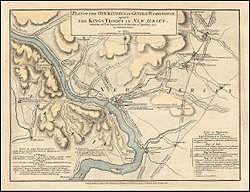
Washington established his camp near McConkey's Ferry in present-day Upper Makefield Township. To remain closer to his troops, he moved his headquarters on December 15 to the home of William Keith. The situation was dire: of the 4,000 to 6,000 men present, approximately 1,700 were unfit for duty and required hospital care. The army was not only physically exhausted but also strategically fragmented, having lost contact with two key divisions during the retreat.
Challenges Facing the Continental Army
Washington faced a convergence of logistical and leadership crises. While he sought reinforcements, coordination with his top generals proved difficult. Horatio Gates was delayed by heavy snowfall while traveling to McConkey's Ferry, and General Charles Lee, who held a low opinion of Washington, delayed following orders and remained on the British flank near Morristown.
Beyond leadership friction, the army faced an existential threat: time. Many enlistments were set to expire at the end of 1776, just one week away. This led to a wave of desertions and a general inclination among soldiers to leave the service once their commissions ended. The loss of Fort Lee had further crippled the force, as critical munitions and supplies were left behind, and many soldiers were killed or captured.
These failures led members of the Second Continental Congress in Philadelphia to question Washington's leadership. Despite this, Washington persisted, recruiting new members—a task aided by the poor behavior of British and Hessian soldiers in New Jersey and Pennsylvania—and securing essential supplies.
The Psychological Turning Point: The American Crisis
As the army neared its breaking point, a powerful literary catalyst arrived. On December 19, 1776, Thomas Paine published The American Crisis. Paine, already famous for Common Sense, wrote words that would define the era: "These are the times that try men's souls; the summer soldier and the sunshine patriot will, in this crisis, shrink from the service of his country; but he that stands it now, deserves the love and thanks of man and woman."
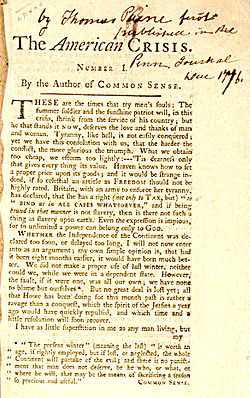
Washington recognized the value of this rhetoric and ordered all his troops to read the pamphlet the following day. Paine's work provided a necessary sense of optimism, arguing that while tyranny is not easily conquered, the harder the conflict, the more glorious the triumph. This not only boosted the morale of the soldiers but also helped the general public across the colonies understand the necessity of the struggle.
Mobilizing for the Attack
Reinforcements eventually arrived to bolster the ranks. On December 20, General John Sullivan led a division of 2,000 troops to the camp; these were the forces previously under General Lee, who had been captured by the British on December 12 after venturing too far from his troops. General Gates' division also arrived, though it consisted of only 600 men due to expired enlistments.
With these additions and local volunteers, Washington had roughly 6,000 men fit for duty. However, this number was reduced by strategic assignments: some were sent to guard supplies at Newtown, others to protect the sick and wounded, and others to secure ferries at New Hope and Dunk's Ferry (now bordered by Neshaminy State Park). Ultimately, Washington was left with approximately 2,400 men capable of taking offensive action against the British and Hessian forces in Trenton.
The final preparation was a logistical victory: on December 24, much-needed provisions, including blankets, arrived at the camp, providing the physical warmth necessary for the covert operation ahead.
Key Facts
- Force Strength: Washington had about 6,000 fit troops, but only 2,400 were available for the offensive action at Trenton.
- Critical Literature: Thomas Paine's The American Crisis was read to all troops on December 20, 1776, to boost morale.
- Leadership Issues: General Charles Lee was captured on December 12, and General Horatio Gates was delayed by heavy snow.
- Logistical Hardships: Approximately 1,700 men were unfit for duty due to illness and injury.
- Strategic Locations: Key sites included McConkey's Ferry, Newtown, and Dunk's Ferry.
| Category | Details |
|---|---|
| Total Fit for Duty | Approximately 6,000 |
| Offensive Force (Trenton) | Approximately 2,400 |
| Unfit/Hospitalized | Approximately 1,700 |
| Key Reinforcements | General Sullivan (2,000 troops) and General Gates (600 troops) |
| Primary Morale Booster | The American Crisis by Thomas Paine |
Frequently Asked Questions
Why was the morale of the Continental Army so low in December 1776?
Morale suffered due to a series of lost battles, the loss of New York, the evacuation of Fort Lee (where critical supplies were left behind), and the fact that many soldiers' enlistments were expiring at the end of the year.
Who was Thomas Paine and how did he help Washington?
Thomas Paine was the author of Common Sense and The American Crisis. His pamphlet, read to the troops on December 20, encouraged soldiers to remain optimistic and persevere through the crisis, viewing the difficulty of the conflict as a precursor to a more glorious victory.
Why didn't Washington have all 6,000 fit troops for the attack on Trenton?
A significant portion of the force was detailed for defensive and support roles, including guarding the sick and wounded, protecting supplies at Newtown, and securing ferries at New Hope and Dunk's Ferry.
What happened to General Charles Lee?
General Lee, who had 2,000 troops under his command, was captured by the British on December 12 after he ventured too far from the protection of his troops while searching for more comfortable lodgings.
How did the behavior of British and Hessian soldiers affect recruitment?
The drunken behavior of British and Hessian soldiers while stationed in New Jersey and Pennsylvania helped Washington successfully recruit new members for the Continental Army.