Walt Whitman's Mickle Street House: The Final Sanctuary of a Poet
For the final years of his life, the legendary American poet Walt Whitman resided in a modest dwelling in Camden, New Jersey. Far from a grand estate, this home—which Whitman affectionately yet self-deprecatingly called his "shanty" or "coop"—served as the backdrop for his final creative triumphs and his gradual decline in health.
The journey to this home began during a period of profound personal loss. In 1873, Whitman suffered a paralytic stroke—a medical event causing sudden loss of muscle function—and lost his mother, Louisa Whitman, in May of that same year. These events plunged him into depression. After a brief return to Washington, D.C., he moved to Camden to live with his brother George on Stevens Street, where he remained for eleven years.
The Purchase of the Mickle Street House
In the spring of 1884, at the age of 65, Whitman made a decision that surprised his inner circle: he purchased the Mickle Street House. This was the first home he ever owned. The decision strained his relationship with his brother George, who had been building a farmhouse in Burlington, New Jersey, with space for the poet. Friends were equally skeptical; one described it as "the worst house and the worst situated," while another remarked it was the last place one would expect a poet to choose.
The property had a humble history. The lot was originally purchased in 1847 by a clerk named Adam Hare for $350, and Hare likely built the structure. By 1884, it was a two-story row house consisting of six rooms and lacking a furnace. Whitman purchased the home for $1,750, funded by a loan from publisher George William Childs and sales from a recent edition of his masterpiece, Leaves of Grass.
Whitman's kindness extended to the previous occupant, Alfred Lay. When Lay could not afford his March rent, Whitman loaned him $16. Lay and his wife continued to live in the house until January 20, 1885, with Lay cooking to offset a weekly rent of $2. Following their departure, Whitman invited Mary Davis, a sailor's widow, to be his housekeeper in exchange for free rent. She moved in on February 24, 1885, bringing a menagerie of animals, including a dog, a cat, a canary, and two turtledoves.
A Hub for Intellectuals and Creativity
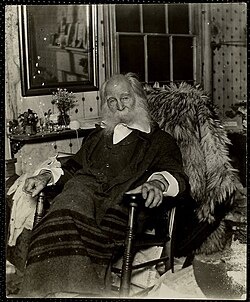
Despite its shabbiness, the house became a destination for admirers. In 1882, during a tour of the United States, the renowned writer Oscar Wilde visited Whitman here. The two shared elderberry wine, and Wilde later expressed his deep love and honor for the poet. In 1890, another visitor, John Johnston, recalled seeing Whitman on a hot summer day, relaxed in a large rocking chair with his shirt open and sleeves rolled up.
The home was also a place of intense productivity. Whitman's bedroom functioned much like a newspaper office, filled with stacks of paper. Here, he prepared the anthology of essays and articles titled November Boughs and wrote several poems regarding public events. One notable work, the sonnet "Ah, Not This Granite Dead and Cold," was published in the Philadelphia Press on February 22, 1885, to commemorate the completion of the Washington Monument.
Financial Struggles and Final Days
While Whitman's literary fame grew, his financial situation remained precarious. During his tenure at the house, he earned approximately $1,300. Only $20 of this came from Leaves of Grass royalties, and $350 came from new works; the vast majority of his income consisted of donations from well-wishers.
As his health declined—compounded by a second stroke in 1888—Whitman began preparing for the end of his life. He commissioned a granite, house-shaped mausoleum for $4,000. His final years were marked by immense physical suffering, which he described as a "monotony in pain." Despite this, he remained dedicated to his life's work, spending his last days refining the final edition of Leaves of Grass.
In January 1892, Whitman announced via the New York Herald that the new 1892 edition should "absolutely supersede all previous ones," calling it his "entire self-chosen poetic utterance." This version is now known as the "deathbed edition."
The End of an Era
Walt Whitman passed away at 6:43 p.m. on March 26, 1892, shortly before his 73rd birthday. An autopsy performed at the home revealed that his left lung had collapsed and his right lung was at only one-eighth of its breathing capacity. The community's respect for the poet was evident during his public viewing at the house, where over one thousand people visited within three hours.
Though he viewed his arrival in Camden as an "accident," Whitman remained grateful for the city and his home, noting that it had brought him "blessed returns."
Key Facts
- Purchase Price: Whitman bought the Mickle Street House for $1,750 in 1884.
- Home Description: A two-story, six-room row house with no furnace, which Whitman called his "shanty."
- Notable Visitor: Oscar Wilde visited the home and shared elderberry wine with the poet.
- Final Work: The 1892 "deathbed edition" of Leaves of Grass was completed here.
- Financials: Most of Whitman's late-life income came from donations rather than royalties.
- Death: Whitman died in the home on March 26, 1892, at age 72.
| Detail | Information |
|---|---|
| Location | Camden, New Jersey |
| Years of Residency | 1884–1892 |
| Purchase Price | $1,750 |
| Key Works Completed | November Boughs, 1892 edition of Leaves of Grass |
| Housekeeper | Mary Davis |
Frequently Asked Questions
Why did Whitman's brother disapprove of the Mickle Street House?
George Whitman had built a farmhouse in Burlington, New Jersey, with accommodations for Walt. He disapproved of Walt's decision to purchase the shabby Mickle Street property instead of moving into the new farmhouse.
How did Walt Whitman afford to buy his first home?
The $1,750 purchase was funded through a combination of a loan from his publisher, George William Childs, and earnings from the sales of a recent edition of Leaves of Grass.
What was the "deathbed edition" of Leaves of Grass?
It is the final edition of his most famous work, published in 1892. Whitman spent his final years preparing it and requested that it supersede all previous versions as his definitive poetic utterance.
Who was Mary Davis?
Mary Davis was a sailor's widow who lived nearby. Whitman invited her to serve as his housekeeper in exchange for free rent, and she moved into the house in February 1885 with several pets.
What did the autopsy reveal about Whitman's health at the time of death?
The autopsy, performed at his home, showed that Whitman's left lung had collapsed and his right lung had only one-eighth of its normal breathing capacity.