Wachovia and First Union: A History of Banking Mergers and Acquisitions
The evolution of the American banking landscape is often defined by aggressive expansion and strategic consolidation. Few stories illustrate this better than the trajectory of First Union and Wachovia. From their humble beginnings in North Carolina to their eventual transformation into a national financial powerhouse, these institutions navigated a complex path of growth, hostile takeover attempts, and high-risk acquisitions.
The Foundations of First Union
First Union began as the Union National Bank on June 2, 1908, starting as a small banking desk in a Charlotte hotel lobby founded by H.M. Victor. The institution expanded significantly in 1958 by merging with the First National Bank and Trust Company of Asheville, North Carolina, becoming the First Union National Bank of North Carolina. By 1967, First Union Corporation was officially incorporated.
During the 1990s, First Union emerged as a regional powerhouse in the South, mirroring the growth of its Charlotte rival, NCNB (which later became NationsBank and eventually Bank of America). The bank shifted its focus toward the Northeast in 1995 by acquiring First Fidelity Bancorporation of Newark, New Jersey. This expansion continued in 1998 with the acquisition of CoreStates Financial Corporation of Philadelphia. Notably, one of CoreStates' predecessors, the Bank of North America, was the first bank proposed and chartered in America on December 31, 1781.

The Rise of Wachovia
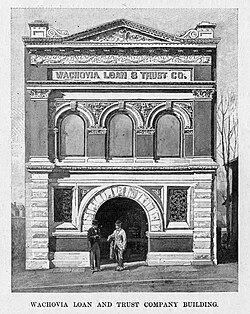
Wachovia Corporation was established on June 16, 1879, in Winston-Salem, North Carolina, as the Wachovia National Bank, co-founded by James Alexander Gray and William Lemly. In 1911, it merged with the Wachovia Loan and Trust Company, which had been founded in 1893 and was the largest trust company between Baltimore and New Orleans.
Wachovia's growth was bolstered by its relationship with the R.J. Reynolds Tobacco Company. By December 31, 1964, it became the first bank in the Southeastern United States to exceed $1 billion in resources. The bank expanded its footprint through several key acquisitions:
- First Atlanta (1986): The oldest national bank in Atlanta, giving Wachovia dual headquarters in Winston-Salem and Atlanta.
- South Carolina National Corporation (1991): Providing entry into the South Carolina market.
- 1st United Bancorp and American Bankshares Inc (1997): Marking the bank's first entry into Florida.
- Jefferson National Bank and Central Fidelity Bank (1998): Expanding presence in Virginia.
- Republic Security Bank (2000): The final purchase before the major merger.

The Landmark Merger of 2001
On April 16, 2001, First Union announced it would acquire Wachovia in a deal valued at approximately $13.4 billion in stock. While First Union was the acquiring party and the nominal survivor—retaining the corporate structure and stock price history—the merged entity adopted the Wachovia name and stock ticker symbol.
The merger was not without controversy. It sparked a hostile takeover attempt by SunTrust on May 14, 2001, which offered a higher cash price. However, Wachovia's board rejected SunTrust, and shareholders approved the First Union deal on August 3, 2001. To mitigate civic concerns in Winston-Salem regarding the move of the headquarters to Charlotte, First Union established its wealth management and Carolinas-region headquarters in Winston-Salem.
The integration process was handled cautiously to avoid the mistakes of previous acquisitions. The conversion of computer systems was phased in over two years, concluding on August 18, 2003. This deliberate approach resulted in high customer satisfaction ratings from the University of Michigan's American Customer Satisfaction Index.
Expansion and Diversification (2001–2007)
Following the merger, the new Wachovia sought to become a comprehensive national financial services provider through several strategic moves:
Brokerage and Securities
On July 1, 2003, Wachovia Securities and the Prudential Securities Division of Prudential Financial combined. Wachovia held a 62% controlling stake, creating the third-largest full-service retail brokerage firm in the U.S. with $532.1 billion in client assets. In October 2003, the bank further expanded by acquiring Metropolitan West Securities.
Regional Banking Growth
In November 2004, Wachovia acquired SouthTrust Corporation for $14.3 billion, making it the largest bank in the Southeast and the fourth largest in the U.S. by holdings. In 2006, the acquisition of Westcorp (parent of Western Financial Bank) provided a foothold in Southern California and made Wachovia the ninth-largest auto finance lender in the U.S.

The Golden West Financial Acquisition
In May 2006, Wachovia agreed to purchase Golden West Financial (operator of World Savings Bank) for nearly $25.5 billion. Golden West specialized in option ARMs (Adjustable Rate Mortgages) known as "Pick-A-Pay," which allowed borrowers to defer part of their interest payments.
While CEO Ken Thompson viewed Golden West as a "crown jewel," the move proved disastrous. Many Pick-A-Pay loans were concentrated in California, Florida, and Arizona—regions hit hardest by the housing market collapse. The poor credit quality of these loans led to massive writedowns, eventually contributing to the "fire-sale" of Wachovia to Wells Fargo.

Final Acquisitions
Wachovia's final major move was the $6.8 billion purchase of A.G. Edwards on May 31, 2007, aiming to create the second-largest retail brokerage firm in the country. The A.G. Edwards brand was phased out by March 2008.
Key Facts
- First Union was founded in 1908; Wachovia was founded in 1879.
- The 2001 merger used First Union's corporate structure but kept the Wachovia name.
- Wachovia was the first Southeastern bank to exceed $1 billion in resources (1964).
- The acquisition of Golden West Financial introduced high-risk "Pick-A-Pay" loans to Wachovia's portfolio.
- The merger with SouthTrust in 2004 created the largest bank in the Southeast.
Summary of Major Corporate Milestones
| Year | Event | Key Detail |
|---|---|---|
| 1908 | First Union Founded | Started as Union National Bank in Charlotte. |
| 1986 | Wachovia buys First Atlanta | Established dual headquarters in Winston-Salem and Atlanta. |
| 2001 | First Union & Wachovia Merger | First Union acquired Wachovia; entity renamed Wachovia. |
| 2004 | SouthTrust Acquisition | $14.3 billion deal; largest bank in the Southeast. |
| 2006 | Golden West Acquisition | $25.5 billion deal; introduced high-risk mortgage assets. |
| 2007 | A.G. Edwards Purchase | $6.8 billion deal to expand retail brokerage. |
Frequently Asked Questions
Who actually acquired whom in the 2001 merger?
First Union was the acquiring party and the nominal survivor, meaning the merged bank used First Union's corporate structure and stock price history. However, the company adopted the Wachovia name and ticker symbol.
What were "Pick-A-Pay" loans?
Pick-A-Pay loans were option ARMs (Adjustable Rate Mortgages) offered by World Savings Bank. They allowed borrowers to choose their payment plan, including the option to defer part of the interest, which was then added to the loan balance.
Why was the Golden West Financial acquisition considered a failure?
Wachovia purchased Golden West at the peak of the U.S. housing boom. The high concentration of risky Pick-A-Pay loans in declining markets (California, Florida, Arizona) led to severe losses and writedowns.
How did Wachovia handle the hostile takeover attempt by SunTrust?
Wachovia's board of directors rejected SunTrust's higher cash offer, remaining loyal to the merger agreement with First Union. Shareholders ultimately approved the First Union deal on August 3, 2001.
What happened to the First Union credit card portfolio?
First Union had sold its portfolio to MBNA in 2000. After the merger, the new Wachovia bought back its own portfolio from Bank One (paying a $350 million fee) and subsequently resold it to MBNA before eventually creating its own Visa card division.