Deutsche Bank: A History of Global Finance and Evolution
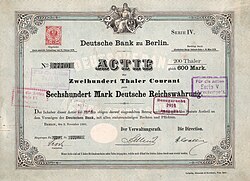
Founded on March 10, 1870, Deutsche Bank has evolved from a national institution into one of the world's most prominent financial services providers. Headquartered in the iconic Twin Towers of Frankfurt, Germany, the bank serves as a cornerstone of the European economy and a major player in global markets. Over its 156-year history, it has navigated the complexities of industrialization, global conflicts, and the volatile shifts of modern finance.
The bank was established by Ludwig Bamberger and Adelbert Delbrück to facilitate international trade and support German industry. Today, it operates as a public company traded on the Frankfurt Stock Exchange (FWB: DBK) and the New York Stock Exchange (NYSE: DB), maintaining its status as a key DAX component.
Key Facts
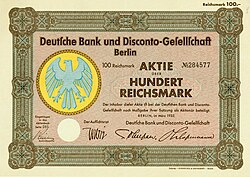
- Founded: March 10, 1870
- Headquarters: Frankfurt, Germany
- CEO: Christian Sewing
- Total Assets (2025): €1,435 billion
- Net Income (2025): €7.1 billion
- Global Workforce: 89,879 employees (2025)
- Core Services: Asset management, investment banking, wealth management, and retail banking.
Corporate Structure and Services
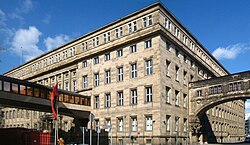
![Former Disconto-Gesellschaft branch building in Frankfurt on the Roßmarkt [de] (erected 1904), which served as head office of Deutsche Bank's Hesse unit from 1947 to 1952, of Süddeutsche Bank from 1952 to 1957, then of Deutsche Bank itself from 1957 to 1984](/images/09/9f/099fe189443b2bc42bc58151f75df17080a4c362a10862d60cb3b63726c4fedb.jpg)
Deutsche Bank organizes its vast operations into several specialized business divisions to manage diverse financial needs. These include the Corporate and Investment Bank (CIB), which handles large-scale corporate finance and trading, and the Private and Commercial Bank, focusing on individual and small-business clients.
Additionally, the bank operates Deutsche Asset Management (DWS), providing sophisticated investment strategies for institutional and private investors. Its product suite is comprehensive, spanning equities trading, commodities, mortgage loans, private equity, and insurance.
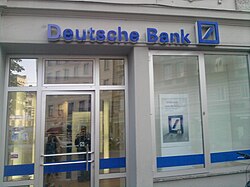
Historical Evolution and Expansion
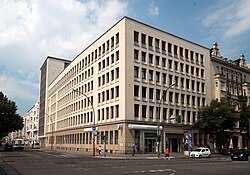
![Head office of Disconto-Bank, Deutsche Bank's Berlin unit, designed by Paul Schwebes [de]; completed 1951 and photographed in 1952](/images/74/1b/741b7708cc2f7ed2b137ea8611a48e90b2412dfe0c0091dee832d448628e0bea.jpg)
The bank's physical and operational footprint has expanded significantly since the 19th century. Early growth saw the establishment of branches in major cities like Hamburg (1872) and the acquisition of regional entities such as the Hannoversche Bank in 1920.
![Former Deutsche Bank headquarters [de] on Mauerstrasse 25–28 in Berlin, photographed in 1909](/images/5c/6c/5c6c34e9f4b34ed6ade15054b448aea2b52fb72777a4b3c94c966886de085dd6.jpg)
Throughout the 20th century, the bank's architecture mirrored its growth. From the early headquarters on Mauerstrasse in Berlin to the mid-century modern designs of the 1950s and 60s, the bank's presence was a symbol of German economic recovery and ambition.
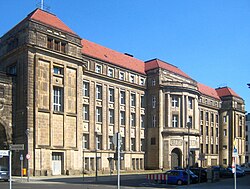
International Reach
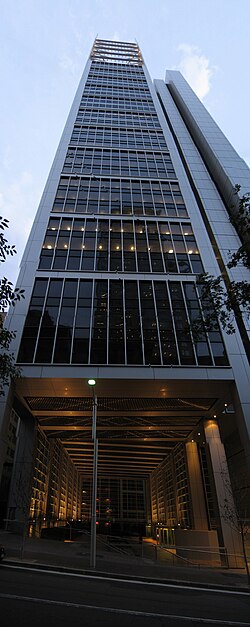
Deutsche Bank's ambition was global from the start. This included establishing a presence in Brussels in 1912 and expanding into markets as far-reaching as Sydney, Australia.
![Office building erected 1912 by Deutsche Bank for its branch in Brussels, expropriated following World War I, later head office of Kredietbank[26]](/images/96/1a/961ad2f1a6141fb0261b928549e5b6baf05873c1a3ead9ef88ef8b70acf7bc9c.jpg)
Strategic Acquisitions
In the 21st century, the bank pursued an aggressive acquisition strategy to bolster its capabilities. Notable acquisitions include:
- Scudder Investments (2001) and RREEF (2002) for asset management.
- Norisbank (2006) and Deutsche Postbank (2010) to expand retail reach.
- Sal. Oppenheim (2010) to enhance private banking.
- Numis (2023) to strengthen investment banking.
Financial Performance and Market Trends
The bank's financial trajectory has been marked by periods of immense growth and significant volatility. While total assets peaked around 2008, the subsequent decade saw a restructuring of the balance sheet to ensure stability.
![Highrise of the Deutsche Bank in Berlin, designed by Friedrich Koch and Günter Hönow [de], 1966–1968](/images/82/ac/82ac2dd216b72d153e826e8f2a336f36b649a471b3fb181bdd43066765c6be14.jpg)
| Year | Revenue (€ billions) | Net Income (€ billions) | Total Assets (€ billions) | Employees |
|---|---|---|---|---|
| 2007 | 30.7 | 6.5 | 2,020 | 78,291 |
| 2012 | 33.7 | 0.3 | 1,611 | 98,219 |
| 2017 | 26.4 | -0.7 | 1,475 | 97,535 |
| 2021 | 25.4 | 1.9 | 1,324 | 82,969 |
| 2025 | 32.1 | 7.1 | 1,435 | 89,879 |
Challenges and Controversies
Like many global systemic banks, Deutsche Bank has faced significant legal and regulatory hurdles. These include its role in the 2008 financial crisis, the Libor rate-rigging scandal (2015), and various fines related to money laundering operations and sanctions violations.
More recently, the bank has dealt with allegations of greenwashing (misleading claims about environmental efforts) via its DWS unit and fines related to the improper handling of American Depositary Receipts (ADRs).
Frequently Asked Questions
Who is the current CEO of Deutsche Bank?
Christian Sewing has served as the CEO since 2018.
Where is Deutsche Bank headquartered?
The bank is headquartered in the Deutsche Bank Twin Towers located in Frankfurt, Germany.
What are the primary business divisions of the bank?
The bank is divided into the Corporate and Investment Bank (CIB), the Private and Commercial Bank, and Deutsche Asset Management (DWS).
How many employees does Deutsche Bank have?
As of 2025, the bank employs 89,879 people globally.
What is the bank's current financial status as of 2025?
In 2025, Deutsche Bank reported revenue of €32.1 billion, net income of €7.1 billion, and total assets of €1,435 billion.