Vowel Articulation and Acoustics: A Comprehensive Overview
In the study of linguistics, vowels are fundamental building blocks of speech. While we often think of them simply as sounds, they are defined through two distinct lenses: phonetics, which describes the physical production of sound with no constriction in the vocal tract, and phonology, which identifies sounds that form the peak of a syllable. This distinction is crucial; for instance, the approximants [j] and [w] are phonetically vowel-like due to their lack of constriction, yet they function phonologically as consonants at the onset of syllables.
![X-rays of Daniel Jones' [i, u, a, ɑ]](/images/8f/41/8f417fedfa56cbc41dd1fb743ef80ff5ae0a06c2aefeb4b37fd69bf956fe9f2e.jpg)
The Mechanics of Vowel Production
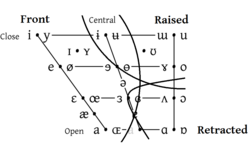
Traditionally, vowel quality has been described using articulatory dimensions. Although modern science has refined our understanding, the pedagogical model of using tongue position and lip rounding remains a highly effective way to explain how different vowels are distinguished.
Articulatory Dimensions
Vowel space is primarily defined by three dimensions:
- Height: Often referred to as the vertical dimension, this describes how high or low the tongue is in the mouth. Categories include close (high), mid, and open (low).
- Backness: This describes the horizontal position of the tongue, ranging from front to central to back.
- Roundedness: This refers to the shape of the lips during production.
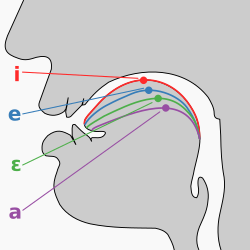
Tongue Position and Height
The vertical position of the tongue is categorized into several levels of precision. For example, close vowels (such as [i] or [u]) involve a high tongue position, while open vowels (such as [a] or [ɑ]) involve a low tongue position. Between these extremes lie various mid-levels, such as close-mid and open-mid.
Acoustic Phonetics and Formants
While articulation describes how we move our mouths, acoustics describes the actual sound waves produced. Modern phoneticians use formants—specific resonant frequencies of the vocal tract—to identify vowel qualities accurately.
The first formant, known as F1, corresponds to vowel height. Open vowels exhibit high F1 frequencies, whereas close vowels have low F1 frequencies. The second formant, F2, corresponds to vowel backness. Front vowels are characterized by high F2 frequencies, while back vowels have lower F2 frequencies.
![Spectrogram of vowels [i, u, ɑ]. [ɑ] is a low vowel, so its F1 value is higher than that of [i] and [u], which are high vowels. [i] is a front vowel, so its F2 is substantially higher than that of [u] and [ɑ], which are back vowels.](/images/01/46/014669327c54b248d1f0badb8ea4d93cb4d1be162638fcc1f23a155db57ae393.png)
Rounding also has a measurable acoustic impact. Rounded vowels typically cause a lowering of F2, which reinforces the perception of backness. In front rounded vowels, the third formant (F3) is also lowered. Furthermore, rhotic vowels (often called "R-colored vowels") are uniquely identified by markedly lowered F3 values.
Vowel Classifications and Systems
Vowels can be categorized by their stability and the complexity of their movement:
- Monophthongs: Pure, stable vowels where the quality remains constant.
- Diphthongs: Vowel sounds that glide from one quality to another.
- Triphthongs: Sounds that glide successively through three different qualities.
The number of vowels in a language varies significantly. While many languages possess fewer than ten distinct vowel qualities, others have much larger inventories. For example, the Germanic languages often feature large sets, such as Standard Danish, while Romance languages like Spanish may have as few as five basic vowel qualities.
![The original vowel quadrilateral, from Jones' articulation. The vowel trapezoid of the modern IPA, and at the top of this article, is a simplified rendition of this diagram. The bullets are the cardinal vowel points. (A parallel diagram covers the front and central rounded and back unrounded vowels.) The cells indicate the ranges of articulation that could reasonably be transcribed with those cardinal vowel letters, [i, e, ɛ, a, ɑ, ɔ, o, u, ɨ], and non-cardinal [ə]. If a language distinguishes fewer than these vowel qualities, [e, ɛ] could be merged to ⟨e⟩, [o, ɔ] to ⟨o⟩, [a, ɑ] to ⟨a⟩, etc. If a language distinguishes more, ⟨ɪ⟩ could be added where the ranges of [i, e, ɨ, ə] intersect, ⟨ʊ⟩ where [u, o, ɨ, ə] intersect, and ⟨ɐ⟩ where [ɛ, ɔ, a, ɑ, ə] intersect.](/images/86/81/86816bf3d700c825dcf6bb975ba5dac9bec3410dd01f1aceffe90f5fcc302b77.webp)
Key Facts
- Phonetic vs. Phonological: A phonetic vowel has no vocal tract constriction, while a phonological vowel forms the syllable peak.
- F1 and Height: The first formant (F1) is inversely related to tongue height; higher F1 means a more open vowel.
- F2 and Backness: The second formant (F2) indicates backness; higher F2 means a more fronted vowel.
- Rounding: Lip rounding generally lowers the F2 frequency.
- Rhoticity: R-colored vowels are characterized by significantly lowered F3 values.
Vowel Dimension Summary
| Dimension | Articulatory Feature | Acoustic Correlate |
|---|---|---|
| Height | Tongue vertical position | F1 (First Formant) |
| Backness | Tongue horizontal position | F2 (Second Formant) |
| Rounding | Lip shape | F2 and F3 lowering |
| Rhoticity | R-coloring | Lowered F3 |
Frequently Asked Questions
What is the difference between a monophthong and a diphthong?
A monophthong is a "pure" vowel where the sound quality remains stable throughout its duration. A diphthong is a sound that glides from one vowel quality to another within a single syllable.
How do formants help identify vowels?
Formants are resonant frequencies in the speech signal. By measuring F1 and F2, linguists can mathematically determine the height and backness of a vowel, providing an objective measure of its quality.
Why are [j] and [w] sometimes considered consonants?
Although they are produced without significant constriction (making them phonetically vowel-like), they often occur at the beginning of syllables, which gives them a phonological role as consonants.
What determines the "height" of a vowel?
Vowel height is determined by the vertical position of the tongue in the vocal tract. This is categorized as close (high), mid, or open (low).
Do all languages have the same number of vowels?
No. Vowel inventories vary widely. Some languages have very few (like Spanish with five), while others, such as certain Germanic or Mon–Khmer languages, have much larger inventories.