Voice Onset Time: Measuring the Mechanics of Stop Consonants
In the study of phonetics—the scientific study of speech sounds—one of the most critical parameters for distinguishing consonants is Voice Onset Time (VOT). This acoustic measurement describes the precise interval between the release of a stop consonant and the beginning of voicing, which is the vibration of the vocal folds (also known as periodicity).
By analyzing this timing, linguists can categorize how different languages produce sounds like /p/, /t/, /k/ versus /b/, /d/, /g/. Understanding VOT is essential for distinguishing between sounds that might otherwise seem similar to the untrained ear.

Key Facts
- VOT measures the time between a consonant's release and the onset of vocal fold vibration.
- Positive VOT indicates aspiration (a breathy release).
- Negative VOT indicates that voicing begins during the period of articulatory closure.
- Tenuis stops have a VOT near zero, meaning voicing begins almost immediately upon release.
- The terms fortis and lenis describe the relative strength of these timing differences.
The Evolution of VOT as a Concept
While the relationship between consonant release and laryngeal vibration was noted as early as 1899 by Adjarian in his studies of Armenian stops, the formal concept of VOT gained widespread scientific recognition in the 1960s. During this era, phoneticians were debating which attributes—such as voicing, aspiration, or articulatory force—best distinguished voiced and voiceless stops.
A significant challenge arose in English: while voicing effectively separates /b, d, ɡ/ from /p, t, k/ in the middle of words, it is less reliable for word-initial positions. In English, word-initial voiced stops are often only partially voiced. The term "Voice Onset Time" was eventually solidified following the landmark 1964 study by Leigh Lisker and Arthur Abramson at Haskins Laboratories.
Classifying Stop Consonants by VOT
Linguists generally categorize the phonation of stops into three major types based on their VOT values:
1. Tenuis (Simple Unaspirated Voiceless Stops)
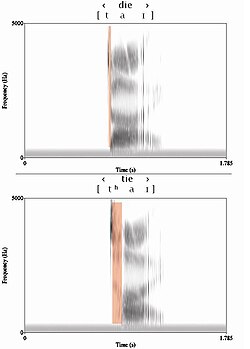
Tenuis stops have a VOT at or very near zero. This means the voicing of the following sound (such as a vowel) begins almost exactly when the stop is released. In practical terms, an offset of 15 ms or less for [t] and 30 ms or less for [k] is considered inaudible and is classified as tenuis.
2. Aspirated Stops
Aspirated stops feature a positive VOT, where a period of breathy air follows the release before voicing begins. The length of the VOT serves as a measure of the strength of the aspiration. For example, Navajo features much stronger aspiration than English; a Navajo [kʰ] may have a VOT of 160 ms, compared to approximately 80 ms in English.
3. Voiced Stops
Voiced stops are characterized by a negative VOT. This occurs when the vocal cords begin vibrating before the consonant is actually released. In "fully voiced" stops, voicing coincides with the onset of the stop, whereas in "partially voiced" stops (like English /b, d, ɡ/ at the start of a word), voicing begins during the period of articulatory closure, or occlusion.
Relative Strength: Fortis and Lenis
Because aspiration and voicing exist on a spectrum rather than as absolute binaries, linguists often use the terms fortis and lenis. Fortis refers to a series of consonants with higher (more positive) VOT, while lenis refers to those with lower (more negative) VOT. It is important to note that these terms are relative; what constitutes a fortis sound in one language may differ in another.
Comparative Analysis of VOT Across Languages
| Language Group | Strong Aspiration (Fortis) | Moderate/Mild Aspiration | Tenuis | Partially Voiced | Fully Voiced (Lenis) |
|---|---|---|---|---|---|
| English | Yes | - | Yes | Yes | Yes |
| Navajo | Yes | - | - | - | - |
| Japanese | - | Yes | Yes | - | - |
| Spanish / Russian | - | - | Yes | - | Yes |
Frequently Asked Questions
What is the difference between positive and negative VOT?
Positive VOT refers to aspirated stops where there is a delay between the release of the consonant and the start of voicing. Negative VOT refers to voiced stops where the vocal cords begin vibrating before the consonant is released.
Why is VOT sometimes difficult to use in analysis?
Some researchers argue that VOT is an acoustic parameter that may be harder to interpret than aerodynamic parameters (like airflow or pressure) or articulatory parameters (like the timing of vocal fold movement), which may offer stronger explanatory power for how speech is physically produced.
How is aspiration transcribed in linguistics?
Aspiration is commonly transcribed using the symbol ⟨ ◌ʰ ⟩, while extra-long or strong aspiration can be indicated with ⟨ ◌ʰʰ ⟩.
Can all consonants be measured by VOT?
No. While voicing contrasts apply to all types of consonants, aspiration is generally a feature specifically associated with stops and affricates.
What are tenuis stops?
Tenuis stops are simple, unaspirated voiceless stops. They have a VOT near zero, meaning the voicing of the subsequent sound begins almost immediately upon the release of the consonant.