The Legacy of John C. Wells: Mapping the Sounds of English and Beyond
Language is more than just words and grammar; it is the physical manifestation of sound. For decades, John Christopher Wells has been one of the world's most influential figures in understanding how those sounds vary across the globe. A distinguished British phonetician and Esperantist, Wells has spent his career decoding the complexities of speech, from the nuances of regional British dialects to the construction of a universal auxiliary language.
A Life Dedicated to Phonetics
Born on March 11, 1939, in Bootle, Lancashire, John C. Wells developed an early fascination with language. He pursued his academic foundations at Trinity College, Cambridge, where he earned his bachelor's degree, followed by a master's and a PhD from the University of London. His doctoral research, completed in 1971, focused on the phonological adaptation of Jamaicans living in the London area.
Wells spent the majority of his professional career at University College London (UCL), where he served as the departmental chair in phonetics—the scientific study of the production and perception of speech sounds—until his retirement in 2006. His leadership extended to the global stage, serving as the president of the International Phonetic Association from 2003 to 2007.
Redefining the Study of English Accents
One of Wells's most enduring contributions to linguistics is his comprehensive analysis of how English is spoken worldwide. In 1982, he published the three-volume work Accents of English, which provided a consistent phonetic framework for describing accents that had previously been studied in isolation.
Within this work, Wells introduced the concept of lexical sets. A lexical set is a group of words that share a specific phonetic characteristic, named after a representative word. For example, the "BATH" lexical set includes words that are pronounced with the /æ/ phoneme in the United States but with the /ɑː/ phoneme in Received Pronunciation (the standard accent traditionally associated with southern England). Additionally, Wells is credited with popularizing the term rhotic to describe accents where the letter 'r' is pronounced whenever it appears in the spelling.
The Longman Pronunciation Dictionary
In 1990, Wells expanded the accessibility of phonetic knowledge by authoring the Longman Pronunciation Dictionary. At the time, the UK had lacked a comprehensive pronunciation dictionary for over a decade. Wells's work was groundbreaking because it moved beyond a single standard, incorporating American pronunciations, various non-standard British accents, and the native pronunciations of foreign words and place names.
Bridging Language and Technology
Long before the modern era of digital linguistics, Wells was a pioneer in adapting phonetic notation for computers. Because the International Phonetic Alphabet (IPA) uses symbols that early computers could not display, Wells invented X-SAMPA. This ASCII-based phonetic alphabet allowed researchers to encode IPA symbols using standard keyboard characters, ensuring that phonetic data could be shared digitally.
His embrace of technology continued into the 1990s when he learned HTML to create web resources for linguistic study, including a compilation of references to "Estuary English," a variety of speech found in the southeast of England. He also maintained a dedicated phonetic blog from 2006 until 2013, sharing his observations with a global audience.
A Global Vision: Esperanto and Spelling Reform
Beyond his work with English, Wells is a passionate advocate for Esperanto, a constructed international auxiliary language designed to facilitate global communication. His contributions to the community are vast, including the authorship of the most widely used English-Esperanto dictionary. His leadership roles in the field have been extensive:
- President of the World Esperanto Association (1989–1995)
- President of the Esperanto Academy (2007–2013)
- President of the Esperanto Association of Britain (2011–2013)
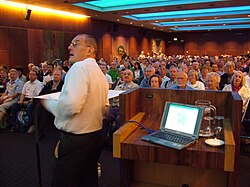
Wells also championed the cause of spelling reform as the president of the Spelling Society from 2003 to 2013. His advocacy for a more tolerant and logical approach to spelling occasionally drew political attention, including a 2008 mention by then-Leader of the Opposition David Cameron regarding the tolerance of text-based spelling.
Personal Life and Artistic Pursuits
The son of a parish vicar, Wells grew up in Up Holland, Lancashire, where he noticed the sharp contrast between the local accent and the Received Pronunciation spoken in his home. A polyglot with a working knowledge of ten languages, he also taught himself Gregg shorthand and learned Welsh.
In his personal life, Wells has been a member of the London Gay Men's Chorus and is a skilled melodeon player. In September 2006, he entered a civil partnership with Gabriel Parsons, a native of Montserrat, who had been his partner since 1968. Parsons passed away on November 16, 2023.
Summary of Key Contributions
The following table summarizes the primary academic and professional achievements of John C. Wells.
| Area of Impact | Key Contribution/Work | Significance |
|---|---|---|
| Phonetics | Lexical Sets | Standardized the description of vowel sounds across English accents. |
| Linguistics | Accents of English | Provided a global, consistent phonetic analysis of English varieties. |
| Technology | X-SAMPA | Created a digital encoding system for the International Phonetic Alphabet. |
| Lexicography | Longman Pronunciation Dictionary | Integrated American and regional British pronunciations into one resource. |
| Internationalism | Esperanto Leadership | Led major global organizations to promote a universal auxiliary language. |