International Phonetic Alphabet
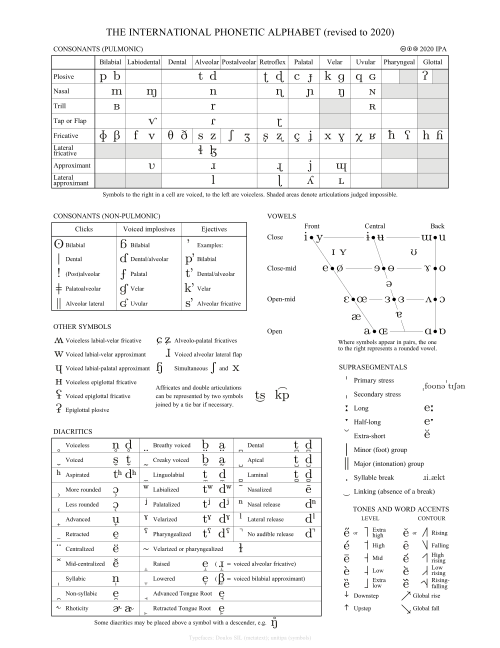
The International Phonetic Alphabet (IPA) is a standardized system of phonetic notation designed to represent the sounds of any oral language. Established in 1888, it provides a universal framework for linguists, lexicographers, and language learners to transcribe speech with precision, ensuring that a specific sound is represented by a unique symbol regardless of the language's native orthography.
At its core, the IPA operates on the principle of providing one letter for each distinctive sound, known as a phoneme. This eliminates the ambiguity found in standard spelling—where a single letter might represent multiple sounds or multiple letters might represent one—by creating a direct mapping between a symbol and a specific articulatory gesture.
Key Facts
- Purpose: Used for phonetic and phonemic transcription of all spoken languages.
- Origin: Developed in 1888 and maintained by the International Phonetic Association.
- Scope: Covers pulmonic consonants, non-pulmonic consonants, vowels, and suprasegmentals (like tone and stress).
- Flexibility: Includes a system of diacritics to modify symbols for finer phonetic detail.
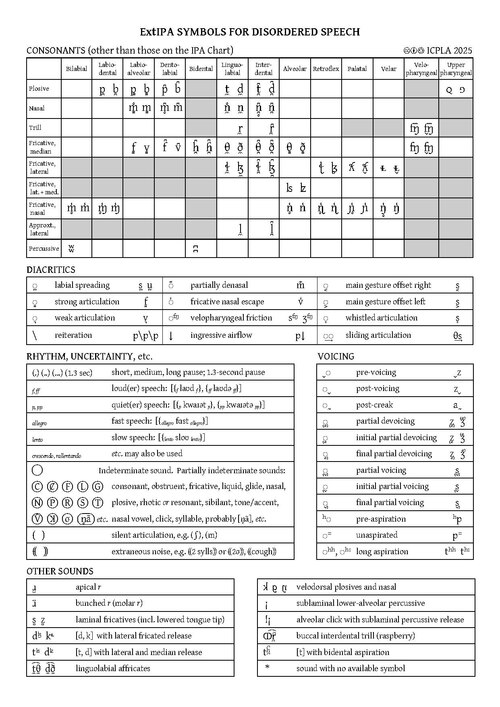
- Extensions: The extIPA provides additional symbols for disordered speech and clinical phonetics.
Consonants in the IPA
Consonants are categorized primarily by their place of articulation (where the airflow is obstructed) and manner of articulation (how the airflow is obstructed).
Pulmonic Consonants
Pulmonic consonants are sounds produced using air expelled from the lungs. These are the most common sounds across world languages and include:
- Plosives: Sounds where airflow is completely blocked and then released (e.g., [p], [t], [k]).
- Fricatives: Sounds produced by forcing air through a narrow channel, creating turbulence (e.g., [f], [s], [h]).
- Nasals: Sounds where the oral cavity is closed and air escapes through the nose (e.g., [m], [n], [ŋ]).
- Approximants and Liquids: Sounds with less obstruction than fricatives, including laterals like [l].
Non-Pulmonic Consonants
Some languages use airstreams not originating from the lungs. These include implosives (air drawn inward), ejectives (air compressed in the glottis), and clicks (air trapped between two points of closure in the mouth).
![The authors of textbooks or similar publications often create revised versions of the IPA chart to express their own preferences or needs.[citation needed] In this image, all pulmonic consonants are moved to the consonant chart. Only the blackwhite symbols are on the official IPA chart; additional symbols are in grey. The grey fricatives are part of the extIPA, and the grey retroflex letters are mentioned or implicit in the Handbook. The grey click is a retired IPA letter that is still in use.](/images/74/1a/741adcf9dcda3649636ce1afda76e02786bf19eedb8d70d851180833a951731c.png)
Vowels and Diphthongs
Unlike consonants, vowels are characterized by an open vocal tract. The IPA classifies vowels based on the position of the tongue, specifically its height (close to open) and backness (front to back).
Vowels are mapped on a chart that reflects the physical space of the mouth. For example, [i] is a close front unrounded vowel, while [u] is a close back rounded vowel. When two vowel sounds glide together in a single syllable, they are referred to as diphthongs.
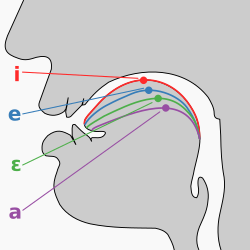
![X-ray photos show the sounds [i, u, a, ɑ].](/images/8f/41/8f417fedfa56cbc41dd1fb743ef80ff5ae0a06c2aefeb4b37fd69bf956fe9f2e.jpg)
Diacritics and Suprasegmentals
To capture the nuance of human speech, the IPA uses diacritics—small marks added to a base symbol to indicate a modification in sound. These can denote voicing (voiced vs. voiceless), nasalization, or specific tongue positions (such as dental or retroflex).
Beyond individual sounds, the IPA tracks suprasegmentals, which are features that extend over more than one sound segment:
- Stress: Indicated by marks before the stressed syllable (primary ˈ and secondary ˌ).
- Length: Marked by a colon-like symbol [ː] for long sounds.
- Tone and Pitch: Represented by diacritics or Chao tone letters to indicate rising, falling, or level pitches.
Practical Applications and Typography
The IPA is widely used in dictionaries to show pronunciation and by linguists to document endangered languages. In classical singing, it helps performers master the correct vowel shapes for foreign languages.
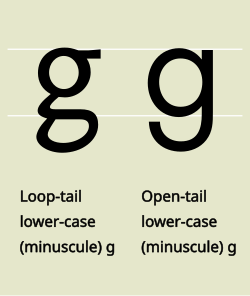
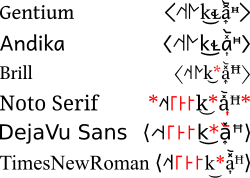
Because the IPA requires a vast array of specialized characters, typography is critical. While many modern fonts support the IPA, some symbols—such as the turned small-capital omega for [ʊ]—may vary in appearance across different typefaces.

For clinical purposes, the Extensions to the International Phonetic Alphabet (extIPA) are used to transcribe speech disorders, providing symbols for sounds that fall outside the norm of standard linguistic patterns.
IPA Summary Table
| Category | Key Feature | Examples/Symbols |
|---|---|---|
| Pulmonic Consonants | Lung-based airflow | [p], [s], [m], [l] |
| Non-Pulmonic Consonants | Non-lung airflow | Clicks [ʘ], Ejectives [pʼ] |
| Vowels | Tongue height and backness | [i], [a], [u] |
| Diacritics | Articulatory modification | [ ◌̥ ] (voiceless), [ ◌̃ ] (nasal) |
| Suprasegmentals | Prosody and rhythm | [ ˈ ] (stress), [ ː ] (length) |

Frequently Asked Questions
What is the difference between phonetic and phonemic transcription?
Phonemic transcription (usually in /slashes/) represents the abstract mental category of a sound, while phonetic transcription (usually in [brackets]) represents the actual physical sound produced, including all subtle variations.
Is the IPA the same as the NATO phonetic alphabet?
No. The NATO phonetic alphabet (Alpha, Bravo, Charlie) is a spelling alphabet used to avoid confusion during radio communication. The IPA is a linguistic tool used to transcribe the actual sounds of speech.
Why are some IPA symbols not found in standard alphabets?
Standard alphabets are designed for specific languages and often lack symbols for sounds found in other languages. The IPA creates new or modified symbols to ensure every possible human speech sound has a unique representation.
What is the extIPA?
The extIPA (Extensions to the International Phonetic Alphabet) is a set of additional symbols used primarily in clinical linguistics to transcribe disordered speech or non-standard phonetic realizations.
How does the IPA handle tones in languages like Mandarin?
The IPA uses a combination of diacritics (like [á] for high tone) and Chao tone letters (like [˥] or [˩]) to indicate the pitch contour and register of a syllable.