Volcanic Ash Advisory Centers (VAAC): Global Monitoring and Coordination
Ensuring aviation safety requires constant vigilance against atmospheric hazards, one of the most critical being volcanic ash. To manage this risk, the global aviation community relies on a network of Volcanic Ash Advisory Centers (VAAC). These specialized hubs are responsible for monitoring volcanic activity and providing essential data to keep aircraft away from hazardous ash clouds.
The operation of these centers is governed by the International Airways Volcanic Ash (IAVW) program, established by the International Civil Aviation Organization (ICAO). The specific areas of responsibility for each center are detailed in the IAVW Handbook, ensuring that no part of the globe is left unmonitored.
To maintain a seamless flow of information, VAACs coordinate closely with adjacent centers, flight control centers, and national meteorological offices within and surrounding their designated areas of operation.
Key Facts
- There are nine VAAC locations distributed globally.
- Responsibility areas are defined by geographic coordinates or Flight Information Regions (FIR)—specified volumes of airspace for air traffic control.
- The network operates under the ICAO's IAVW program.
- Each center is hosted by a national meteorological or weather organization.
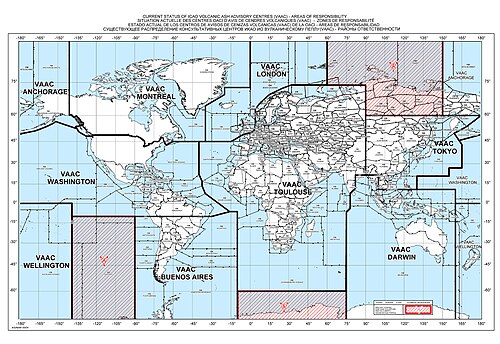
Global Distribution of VAACs
The division of the world into nine monitoring zones ensures that local expertise and regional data are utilized to provide the most accurate ash advisories. These zones cover everything from the dense airspace of Europe and North America to the remote reaches of the Arctic and Antarctic.
Regional Responsibilities
Each center manages a complex set of boundaries. For example, the Washington VAAC and Anchorage VAAC divide the North American and North Pacific regions, while the Toulouse VAAC manages a vast area spanning the EUR, MID, and parts of the ASIA regions.
In the Southern Hemisphere, the Wellington and Buenos Aires centers ensure that flights over the South Pacific and South America are monitored, extending their reach down to the South Pole.
Operational Coordination
Because volcanic ash can travel across thousands of miles of airspace, VAACs do not operate in isolation. They maintain constant communication with neighboring centers to hand over tracking data as ash clouds migrate across FIR boundaries.
VAAC Summary Table
| VAAC Name | Host National Organisation | Primary Area of Responsibility |
|---|---|---|
| Anchorage | National Weather Service | Anchorage Oceanic, Continental, and Oakland Oceanic FIRs (North/West regions) |
| Buenos Aires | Servicio Meteorológico Nacional - Argentina | South of S1000 between W01000 and W09000 |
| Darwin | Bureau of Meteorology | Colombo, Melbourne, and Brisbane FIRs; specific coordinates from N2000/N1000 |
| London | Met Office | North of N7100 to South Pole (Prime Meridian to E09000); various European FIRs |
| Montreal | Meteorological Service of Canada | Søndrestrøm, Gander Oceanic, and Canadian Continental FIRs (including Arctic) |
| Tokyo | Japan Meteorological Agency | N6000 to N1000 (E09000 to Oakland/Anchorage boundaries) |
| Toulouse | Météo-France | AFI, MID, and ASIA regions (West of E09000); Santa Maria Oceanic FIR |
| Washington | NOAA | US Continental FIRs, New York/Oakland Oceanic, Nadi and Nauru FIRs (North of Equator) |
| Wellington | Meteorological Service of New Zealand Limited | Southward from Equator (160E to 140W) and 10S (140W to 90W) |
Frequently Asked Questions
How many Volcanic Ash Advisory Centers are there?
There are nine VAAC locations worldwide, each responsible for a specific geographic area.
What is an FIR in the context of VAACs?
FIR stands for Flight Information Region. These are internationally agreed-upon areas of airspace where flight information and alerting services are provided, used by VAACs to define their boundaries of responsibility.
Which organization oversees the IAVW program?
The IAVW (International Airways Volcanic Ash) program is managed by the ICAO (International Civil Aviation Organization).
Who hosts the VAACs?
VAACs are hosted by national meteorological organizations, such as NOAA in the United States, the Met Office in the UK, and Météo-France in France.
How do VAACs handle ash clouds that move between regions?
VAACs coordinate with adjacent centers, flight control centers, and meteorological offices to ensure a continuous and accurate track of ash movement across different areas of responsibility.