International Airports: Infrastructure, Operations, and Global Standards
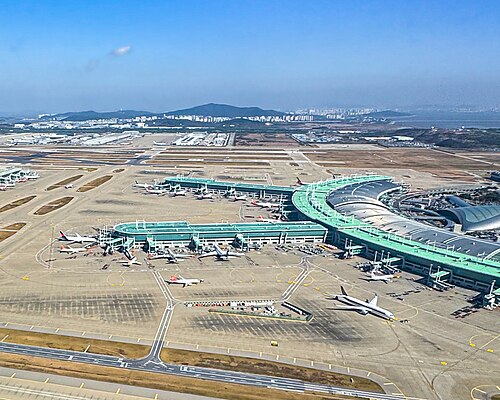
An international airport is a specialized aviation hub equipped with customs and border control facilities, allowing passengers and cargo to move between different countries. While the term is sometimes used for marketing, these facilities are fundamentally different from domestic airports. They are typically larger, featuring longer runways to accommodate heavy, long-haul aircraft such as the Boeing 747, Boeing 777, and the Airbus A380.
Beyond facilitating intercontinental travel, international airports often host domestic flights, creating a network that feeds passengers and cargo into global routes. Since the mid-20th century, these hubs have evolved into some of the most complex interconnected structures in the world. As of January 2023, there were over 1,200 international airports globally, handling approximately 3.8 billion international passengers and 50 million metric tonnes of cargo annually.
Key Facts
- Global Scale: Over 1,200 international airports existed by the second decade of the 21st century.
- Traffic Volume: Approximately 3.8 billion international passengers traveled through these hubs as of January 2023.
- Largest by Area: King Fahd International Airport in Saudi Arabia is the world's largest, covering over 300 square miles.
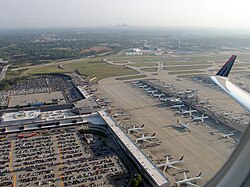
- Busiest Hub: Hartsfield-Jackson Atlanta International Airport recorded the highest total traveler count (107 million in 2018).
- Longest Route: The longest scheduled passenger flight connects Singapore Changi Airport and New York's JFK International Airport (15,349 km).
The Evolution of International Aviation
The history of scheduled international commercial service began in August 1919 at Hounslow Heath Aerodrome in London, England, which was later replaced by Croydon Airport in 1920. In the Americas, Douglas Municipal Airport in Arizona became the first international airport in 1928.
Technological advancements have frequently dictated the viability of these airports. For example, Canton Island Airport in Kiribati served as a vital refueling stop for Qantas in the late 1950s. However, the introduction of long-range jet aircraft like the Boeing 707 in the early 1960s eliminated the need for mid-Pacific stops, leading to the airport's closure for regular commercial use. Similarly, Kai Tak Airport in Hong Kong was decommissioned once it reached capacity and became technologically inadequate.

Design and Infrastructure
Airports are categorized as towered or non-towered based on their funding and the density of air traffic. Due to high capacity and busy airspace, most international airports maintain on-site air traffic control.
Construction often extends beyond the airfield to ensure urban connectivity. Hong Kong International Airport, for instance, required a high-speed railway and an automobile expressway, including the Ma Wan viaduct and the Tsing Ma and Kap Shui Mun bridges, to link the terminal with the city.
Global Standards and Management
To ensure safety and consistency, technical standards are governed by international agreements. Two primary organizations lead these efforts:
- International Air Transport Association (IATA): Formed in 1945, this is an association of airline companies.
- International Civil Aviation Organization (ICAO): A United Nations body that succeeds committees dating back to 1903.
Because these organizations set regulations without direct input from the airports themselves, the resulting tension led to the formation of the Airport Operators Council in 1948 (now Airports Council International – North America, or ACI-NA). This group was founded by representatives from 19 major US cities, including New York, Chicago, and Los Angeles, to resolve common operational challenges.
Logistics, Security, and Border Control
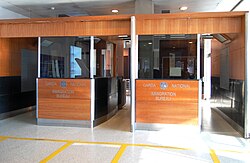
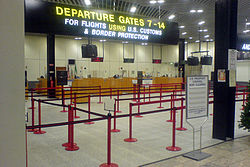
The defining feature of an international airport is its customs and immigration facilities, which grant the legal right of entry into a country. While some countries have agreements allowing connecting flights to bypass these checks, these facilities remain the standard.
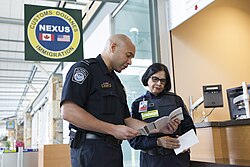
Some regions utilize preclearance, where travelers clear customs and immigration at the departure airport. For example, certain airports in Ireland and Canada host U.S. border preclearance facilities, allowing flights to land at smaller U.S. airports that lack their own customs infrastructure.
Passenger Transportation and Amenities
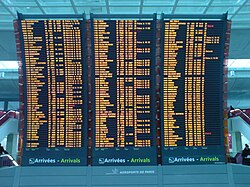
Large hubs often implement intermodal centers or ground transportation centers to manage passenger flow. At Chicago's O'Hare International Airport, some waiting areas are located away from the main terminal, with shuttles transporting passengers. These centers provide essential amenities such as restrooms, food, retail, and climate-controlled boarding areas.
Airport Naming and Identification
International airports are identified by IATA 3-letter codes (e.g., JFK, LAX, CDG) and ICAO 4-letter codes (e.g., KATL, VOMM). These codes often become the airport's common nickname.
Naming conventions vary widely, with a study showing that 44% of airports are named after toponyms (place names). Other common naming categories include:
- Politicians and Statesmen: John F. Kennedy International (USA) or Ninoy Aquino International (Philippines).
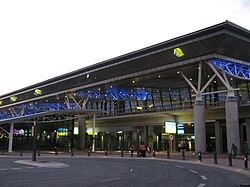
- Royalty: King Shaka International (South Africa) or Chhatrapati Shivaji Maharaj International (India).
- Public Figures and Scientists: Galileo Galilei Airport (Italy) or John Wayne Airport (USA).
- Ideals and Mythology: El Dorado International Airport.
Summary of Global Airport Statistics
| Metric | Airport / Entity | Detail |
|---|---|---|
| Highest Passenger Volume (2018) | Hartsfield-Jackson Atlanta | 107 Million Passengers |
| Largest Land Area | King Fahd International | Over 300 Square Miles |
| Busiest International Traffic | Dubai International | 83.1 Million International Passengers |
| Longest Scheduled Flight | Singapore Changi to JFK | 15,349 Kilometres |
| Top Rated (2020) | Singapore Changi | World Airport Awards Winner |
Frequently Asked Questions
What makes an airport "international"?
An airport is considered international if it possesses customs and border control facilities that enable passengers and cargo to travel between different countries, regardless of whether scheduled international flights are currently operating.
What is U.S. border preclearance?
Preclearance is a process where travelers clear U.S. customs and immigration at a foreign departure airport (such as in Canada or Ireland) before boarding, allowing them to arrive in the U.S. as domestic passengers.
Who sets the safety standards for international airports?
Technical standards and operating procedures are established through international agreements led by the International Civil Aviation Organization (ICAO) and the International Air Transport Association (IATA).
How are airports identified globally?
Airports use two primary coding systems: a 3-letter IATA code used primarily for commercial purposes and a 4-letter ICAO code used for technical and flight planning purposes.
Which airport is the largest in the world by area?
King Fahd International Airport in Dammam, Saudi Arabia, is the largest in the world, encompassing more than 300 square miles.