Vittorio Pozzo: The Architect of Italy's Golden Era of Football
In the annals of football history, few figures loom as large as Vittorio Pozzo. Known as Il Vecchio Maestro ("The Old Master"), Pozzo was a visionary player, journalist, and manager who transformed the Italian national team into a global powerhouse during the 1930s. He remains the only manager to lead a national team to two FIFA World Cup titles, cementing his legacy as one of the greatest tactical minds the sport has ever known.
Key Facts
- World Cup Success: Only manager to win two FIFA World Cups with a national team (1934 and 1938).
- Olympic Glory: Led Italy to a gold medal at the 1936 Berlin Olympics.
- Tactical Innovation: Creator of the Metodo system, a revolutionary tactical formation.
- Longevity: Holds the record for the longest reign of any European men's senior national team coach.
- Unique Achievement: The only manager to win both the Olympic Games and the World Cup.
Early Life and Playing Career
Born on March 2, 1886, in Turin, Vittorio Pozzo's journey in football began on the pitch. He started his professional playing career in Switzerland with Grasshoppers during the 1905–06 season. Upon returning to Italy, he became a pivotal figure in the founding of Torino (then known as "Foot-Ball Club Torino"), where he played as a midfielder for five seasons until his retirement in 1911.
Following his playing days, Pozzo transitioned into administration, serving as Torino's technical director from 1912 to 1922. Outside of sports, he pursued a career at Pirelli and worked as a journalist for La Stampa, a role he maintained for much of his life.
The Evolution of a Manager
Pozzo's managerial journey with the Italian national team was marked by persistence. He was appointed as Italy's first official head coach for the 1912 Summer Olympics, though he resigned shortly after a disappointing exit. He returned in 1921 as part of a "technical commission"—a collaborative committee of managers, referees, and journalists—and again as sole head coach for the 1924 Olympics, where Italy reached the quarter-finals.
It was in December 1929 that Pozzo returned on a permanent basis, sparking the most successful era in Italian football history. He quickly established dominance, winning the Central European International Cup in 1930 by defeating Hungary 5–0 in Budapest.
The Golden Era: World Cups and Olympics
The 1930s saw Pozzo elevate Italy to the pinnacle of the sport. Under his guidance, Italy won the 1934 FIFA World Cup on home soil and successfully defended the title at the 1938 tournament in France. Between these victories, he secured an Olympic gold medal at the 1936 Berlin Games.
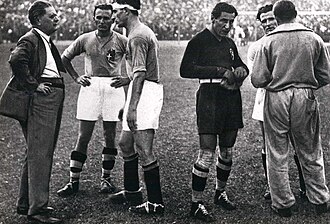
Pozzo's statistical dominance during this period was unprecedented. Between November 1935 and July 1939, he led Italy on a 30-match unbeaten streak and achieved nine consecutive wins, a record that stood until 2019. His tenure concluded after the 1948 Summer Olympics, leaving a final record of 63 wins, 17 draws, and 16 defeats in 95 matches.
Tactical Mastery and the Metodo System
Pozzo's success was rooted in his tactical ingenuity. At the time, most teams used the "Pyramid of Cambridge" (a 2–3–5 formation). Pozzo, alongside Hugo Meisl of Austria, developed the Metodo, a system that evolved the pyramid into a more balanced and flexible approach.
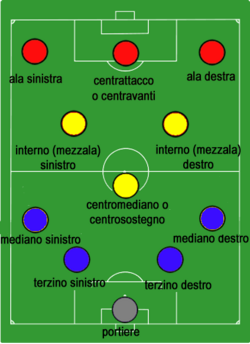
Beyond tactics, Pozzo utilized oriundi—foreign-born players of Italian ancestry. By recruiting talented players from South America, such as Luis Monti from Argentina and Michele Andreolo from Uruguay, he added a layer of international quality to the squad. He was also known for his ability to adapt players to new roles, such as converting the legendary Giuseppe Meazza from a striker into an inside forward.
Controversies and Political Tension
Pozzo's career coincided with the rise of the fascist regime in Italy, leading to moments of high tension. During the 1938 World Cup in France, the Italian team was met with hostility from anti-fascist refugees. In a controversial move to prevent his players from being demoralized by jeers, Pozzo ordered the team to perform the fascist salute a second time after the initial crowd reaction, claiming that winning the "battle of intimidation" was key to their subsequent victory on the pitch.
Legacy and Honors
Vittorio Pozzo passed away on December 21, 1968, in Turin. His contributions to the game are immortalized in Italy; the Stadio Communale di Torino was renamed in his honor (now the Stadio Olimpico Grande Torino), and a museum dedicated to his memorabilia was opened in Ponderano in 2016.
| Competition | Achievement | Year(s) |
|---|---|---|
| FIFA World Cup | Winner | 1934, 1938 |
| Olympic Games | Gold Medal | 1936 |
| Central European International Cup | Winner | 1927–30, 1933–35 |
| Central European International Cup | Runner-up | 1931–32 |
Frequently Asked Questions
What was the Metodo system?
The Metodo was a tactical formation developed by Vittorio Pozzo and Hugo Meisl. It was an evolution of the traditional 2–3–5 "Pyramid" formation, designed to provide better balance and tactical flexibility on the field.
Who were the oriundi?
The oriundi were foreign-born players, primarily from South America, who were eligible to play for the Italian national team because they could claim Italian ancestry.
How many World Cups did Vittorio Pozzo win?
Vittorio Pozzo won two FIFA World Cups as the manager of Italy, in 1934 and 1938.
What is Pozzo's record for the Italian national team?
Pozzo finished his tenure with 63 wins, 17 draws, and 16 defeats across 95 matches, making him the longest-serving European men's senior national team coach.
Why was Pozzo nicknamed "Il Vecchio Maestro"?
He was called "The Old Master" in recognition of his profound tactical knowledge, his experience, and his status as a pioneer of modern football management.