Virus Classification: Systems, Taxonomy, and the Baltimore Method
Virus classification is the scientific process of naming viruses and organizing them into a taxonomic system. While similar to the classification used for cellular organisms, viral taxonomy must account for the unique nature of viruses, which lack a cellular structure and vary wildly in their genetic makeup.
Scientists classify viruses based on phenotypic characteristics—observable physical and biochemical traits. These include the virus's morphology (shape), the type of nucleic acid it carries, its mode of replication, the host organisms it infects, and the specific diseases it causes.
Key Facts
- The International Committee on Taxonomy of Viruses (ICTV) is the official body responsible for formal viral taxonomy.
- The Baltimore classification system groups viruses into seven categories based on how they synthesize messenger RNA (mRNA).
- As of 2025, the ICTV recognizes 16,213 named virus species across 7 realms.
- Since 2021, the ICTV has mandated a binomial format (Genus species) for naming new viral species.
- A viral "species" is defined as a polythetic class of viruses forming a replicating lineage within a specific ecological niche.
The ICTV Taxonomic Hierarchy
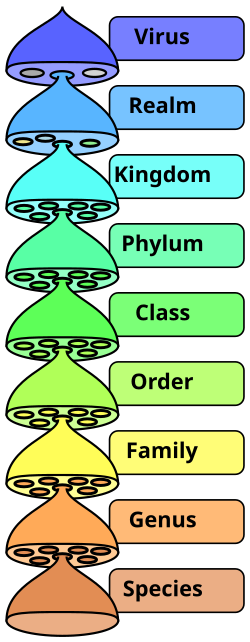
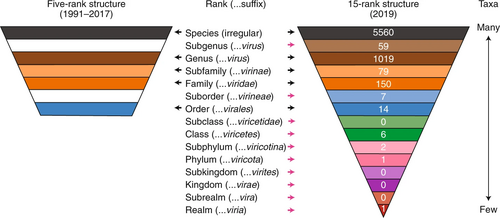
The ICTV provides a rigorous framework for organizing the virosphere. This hierarchy ranges from the broadest category, the realm, down to the individual species. Each level has a specific taxonomic suffix to denote its rank.
- Realm (-viria)
- Kingdom (-virae)
- Phylum (-viricota)
- Class (-viricetes)
- Order (-virales)
- Family (-viridae)
- Genus (-virus)
- Species (-virus)
It is important to note that the term "kingdom" in virology does not function the same way it does in other biological groups, where it typically separates entirely different kinds of organisms. Additionally, the ICTV has transitioned to binomial nomenclature to align with cellular biology; for example, the virus causing COVID-19 is classified within the species Betacoronavirus pandemicum.
Below the Species Rank
Many viruses are named at a level below the species rank, such as strains or isolates. For instance, SARS-CoV-1 and SARS-CoV-2 are distinct viruses, but both belong to the same species, Betacoronavirus pandemicum. The naming of these sub-species entities is handled by international specialty groups rather than the ICTV directly.
The Baltimore Classification System
While the ICTV focuses on evolutionary relationships, the Baltimore classification focuses on the mechanism of mRNA synthesis. Because all viruses must produce mRNA to be translated by host ribosomes, this system provides a functional way to group them into seven categories.
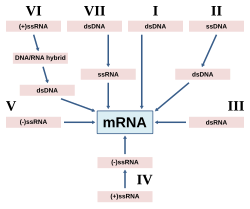
- Group I: Double-stranded DNA (dsDNA) viruses.
- Group II: Single-stranded DNA (ssDNA) viruses.
- Group III: Double-stranded RNA (dsRNA) viruses.
- Group IV: Positive-sense single-stranded RNA ((+)ssRNA) viruses.
- Group V: Negative-sense single-stranded RNA ((-)ssRNA) viruses.
- Group VI: ssRNA-RT viruses (RNA with a DNA intermediate).
- Group VII: dsDNA-RT viruses (DNA with an RNA intermediate).

Comparison of Viral Groups
| Family | Example | Capsid | Nucleic Acid | Baltimore Group |
|---|---|---|---|---|
| Adenoviridae | Common cold | Naked / Icosahedral | dsDNA | I |
| Parvoviridae | Canine parvovirus | Naked / Icosahedral | ssDNA | II |
| Reoviridae | Rotavirus | Naked / Icosahedral | dsRNA | III |
| Coronaviridae | SARS-CoV-2 | Enveloped / Helical | ssRNA | IV |
| Orthomyxoviridae | Influenza | Enveloped / Helical | ssRNA(-) | V |
| Retroviridae | HIV | Enveloped / Dimer | ssRNA-RT | VI |
| Hepadnaviridae | Hepatitis B | Enveloped / Icosahedral | dsDNA-RT | VII |
Subviral Agents and Viriforms
Not all infectious agents fit the standard definition of a virus. Subviral agents are simpler entities that often rely on a helper virus to replicate.
- Viroids: Small, circular RNA molecules without a protein coat, primarily infecting plants (e.g., Pospiviroidae).
- Satellite Viruses: Viruses that require a helper virus for replication, such as the Tonesaviridae family.
- Satellite Nucleic Acids: Genetic elements that do not encode their own capsid proteins.
- Defective Interfering Particles: Viral particles that contain deletions in their genome, preventing them from replicating independently.
Frequently Asked Questions
What is the difference between ICTV and Baltimore classification?
The ICTV system is a formal taxonomic hierarchy (similar to the biological tree of life) based on evolutionary relationships and morphology. The Baltimore system is a functional classification based specifically on how a virus produces its mRNA.
Why did the ICTV move to binomial nomenclature?
The move to a binomial format (Genus species) in 2021 was intended to standardize virus naming and make it consistent with the naming conventions used for all other cellular organisms in biology.
What is a "polythetic class" in viral species definition?
A polythetic class means that a virus species is defined by a set of shared characteristics, but not every single member of the species must possess every single characteristic to be included in that group.
What are viroids?
Viroids are the simplest known infectious agents. They consist solely of a short strand of circular, single-stranded RNA without a protective protein capsid, and they typically cause diseases in plants.
How are SARS-CoV-1 and SARS-CoV-2 related taxonomically?
While they are different viruses that cause different clinical outcomes, both are classified under the same species, Betacoronavirus pandemicum, within the family Coronaviridae.