Understanding Virus Classification: How Scientists Organize the Viral World
Unlike animals or plants, viruses do not fit neatly into the traditional tree of life because they are not cellular organisms. To make sense of this vast and diverse group of biological entities, scientists use virus classification—the process of naming viruses and organizing them into a taxonomic system. This allows researchers to communicate clearly and predict the behavior of new viruses based on their relatives.
The primary authority for this work is the International Committee on Taxonomy of Viruses (ICTV), which maintains the formal global standard. However, because viruses are so unique, scientists often use complementary systems, such as the Baltimore classification, to group them by how they replicate. This guide explores the complex layers of viral taxonomy, from the broadest realms to the smallest subviral agents.
Key Facts
- Governing Body: The International Committee on Taxonomy of Viruses (ICTV) is the sole authority for universal virus taxonomy.
- Naming Standard: Since 2021, the ICTV has mandated a binomial format (Genus species) for naming new species.
- Current Scale: As of 2025, the ICTV recognizes 16,213 named virus species across 7 realms.
- Baltimore System: A separate, widely used system that categorizes viruses into seven groups based on their method of mRNA (messenger RNA) synthesis.
- Defining a Virus: Formally, viruses are defined as a type of Mobile Genetic Element (MGE)—genetic material capable of moving—that encodes at least one major protein for its protective shell (virion).
The ICTV Taxonomic Hierarchy
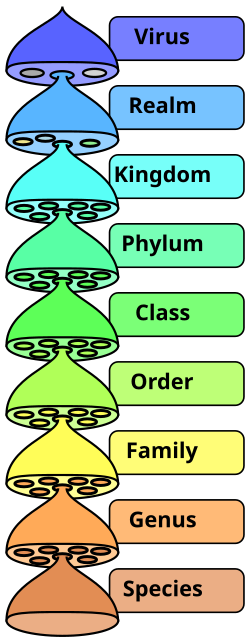
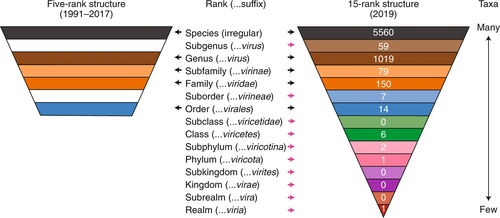
The ICTV system mirrors the structure used for cellular life but with specific suffixes to identify the rank of the taxon (the group being classified). The hierarchy moves from the most inclusive "Realm" down to the most specific "Species."
The full taxonomic order is as follows:
- Realm (-viria)
- Subrealm (-vira)
- Kingdom (-virae)
- Subkingdom (-virites)
- Phylum (-viricota)
- Subphylum (-viricotina)
- Class (-viricetes)
- Subclass (-viricetidae)
- Order (-virales)
- Suborder (-virineae)
- Family (-viridae)
- Subfamily (-virinae)
- Genus (-virus)
- Subgenus (-virus)
- Species (-virus)
A major shift occurred in 2021 when the International Code of Virus Classification and Nomenclature (ICVCN) adopted binomial nomenclature. This means species are now named using two parts, such as Betacoronavirus pandemicum. By 2025, nearly all recognized species had been transitioned to this format.
Defining Virus Species and Strains
In virology, a species is not defined by the ability to interbreed (as it is in animals), but as a monophyletic group—a group consisting of all the descendants of a common ancestor—of MGEs. These groups are distinguished by criteria such as host range, pathogenicity, and genome relatedness.
It is important to note that many well-known viruses exist below the species rank. For example, SARS-CoV-1 and SARS-CoV-2 are different viruses, but both belong to the same species: Betacoronavirus pandemicum. The naming of these specific strains or isolates is handled by international specialty groups rather than the ICTV itself.
The Baltimore Classification System
While the ICTV focuses on evolutionary relationships, the Baltimore classification, developed by Nobel laureate David Baltimore, focuses on the mechanism of replication. It groups viruses based on their nucleic acid type (DNA or RNA), whether they are single-stranded (ss) or double-stranded (ds), and how they synthesize mRNA.
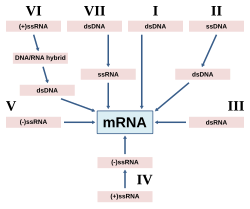
This system is highly practical for researchers because viruses in the same Baltimore group generally behave similarly during their life cycle.
| Group | Genome Type | Replication Characteristic | Examples |
|---|---|---|---|
| I | dsDNA | Double-stranded DNA | Adenoviruses, Herpesviruses |
| II | ssDNA | Single-stranded DNA | Parvoviruses |
| III | dsRNA | Double-stranded RNA | Reoviruses, Rotavirus |
| IV | (+)ssRNA | Positive-sense single-stranded RNA | Coronaviruses, Hepatitis C |
| V | (-)ssRNA | Negative-sense single-stranded RNA | Influenza, Ebola, Rabies |
| VI | ssRNA-RT | RNA with DNA intermediate | Retroviruses (e.g., HIV) |
| VII | dsDNA-RT | DNA with RNA intermediate | Hepadnaviruses (e.g., Hepatitis B) |

DNA and RNA Virus Groups
DNA Viruses are primarily found in the realms Duplodnaviria, Monodnaviria, and Varidnaviria. These include everything from the complex coats of Poxviruses to the icosahedral (20-sided) symmetry of Papovaviridae.
RNA Viruses that encode an RNA-dependent RNA polymerase (RdRp) belong to the kingdom Orthornavirae within the realm Riboviria. This group includes highly contagious viruses like the influenza virus and the various coronaviruses.
Reverse Transcribing Viruses are a specialized group that uses reverse transcriptase (an enzyme that creates DNA from an RNA template). These are categorized into the class Revtraviricetes. This includes Group VI (Retroviruses) and Group VII (Hepadnaviruses).
Subviral Agents and Viriforms
Not all infectious genetic elements are full viruses. Some are subviral agents, which are smaller and possess only some viral properties.
- Viroids: Small, circular RNA molecules without a protein coat, primarily infecting plants (e.g., Potato spindle tuber viroid).
- Satellites: Agents that require a "helper virus" to replicate. If they encode their own coat protein, they are satellite viruses; otherwise, they are satellite nucleic acids.
- Defective Interfering Particles: Viruses that have lost essential genes and can only replicate in the presence of a parental helper virus.
- Viriforms: Endogenous viral elements that have been "domesticated" by a host. An example is the Polydnaviriformidae used by wasps to suppress the immunity of their prey.
Frequently Asked Questions
What is the difference between the ICTV and Baltimore classifications?
The ICTV system is a formal taxonomic hierarchy based on evolutionary descent and genomic relationships, similar to how animals are classified. The Baltimore system is a functional classification based on how a virus produces its mRNA, which helps scientists understand its replication cycle.
Why did the ICTV switch to binomial nomenclature?
The switch to a binomial format (Genus species) was implemented in 2021 to bring virus naming in line with the standards used for other cellular organisms in biology, providing a more consistent and professional naming convention.
What is a Mobile Genetic Element (MGE)?
An MGE is a segment of DNA or RNA that can move within a genome or move between different genomes. The ICTV defines viruses as a specific type of MGE that encodes a protein to form a protective shell called a virion.
Are viroids considered viruses?
No, viroids are classified as subviral agents. They are simpler than viruses because they consist only of RNA and lack the protein capsid (shell) that characterizes true viruses.
What are "incertae sedis" taxa?
The term "incertae sedis" is Latin for "of uncertain placement." In virus taxonomy, it is used for families, classes, or genera that cannot yet be accurately placed within the established taxonomic hierarchy due to a lack of data.