Villa Domínico: A History of Growth and Development
The story of Villa Domínico is a reflection of the broader evolution of the Buenos Aires Province, transitioning from vast colonial land grants to a bustling residential community. Its origins are rooted in the early Spanish expeditions and the gradual subdivision of land that eventually paved the way for industrialization and urban settlement.
Colonial Foundations and Early Land Ownership
The area's history began with a 1580 expedition led by Captain Juan de Garay, the founder of present-day Buenos Aires. This expedition resulted in land grants awarded to Luis Gaitán, a Regidor (a city council member), and Torres de Vera, an Adelantado (a colonial governor or explorer). By 1619, Melchor Maciel purchased the land from Gaitán's heirs. Following Maciel's death in 1633, his widow expanded the estate to a massive 24,000 hectares (60,000 acres).
The estate underwent significant changes in the 18th century. After the death of Luis Pesoa de Figueroa in 1725, his widow divided the land into four equal parcels. Three of these lots were acquired by Juan Estanislao Zamudio, while the fourth was donated to the Roman Catholic Dominican Order, which established the Convent of Santo Domingo.
From Rural Outpost to Industrial Beginnings
As infrastructure expanded, the region became more accessible. The Real Consulado de Buenos Aires ordered the extension of the Camino Real (the Royal Road) south from Sarandí. The construction of a pontoon bridge to facilitate this extension gave the area its first informal name: Paraje del Puente Chico, or the Little Bridge Outpost.
In 1820, Andrés Pazos purchased a significant portion of the land, and his rural residence was recorded in the 1838 census commissioned by Governor Juan Manuel de Rosas. The area's first step toward industrialization occurred in 1850, when Patricio Brown established a salted meat maker.
The Birth of Villa Domínico
The modern identity of the town began in 1856 when Jorge Domínico purchased the land. Domínico later sold a portion of his property to the Buenos Aires and Ensenada Port Railway, which completed its line in 1872. The formal transition to a residential settlement began on August 11, 1894, when the first lots were sold to homesteaders.
Further expansion occurred in 1908 when neighboring landowner Federico Gattemeyer also began selling lots. This growth was solidified in 1909 when the Port Railway opened the Villa Domínico station.
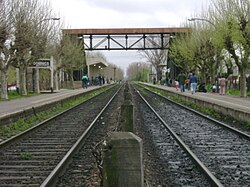
Fueled by a wave of immigration to Argentina, the settlement expanded rapidly. By 1910, the population had reached approximately 1,100 inhabitants. This growth led to the creation of essential community infrastructure, including the Villa Domínico Community Development and Mutual Aid Society on August 28, 1910, the first fire house in 1912, and the consecration of the Church of San José on April 23, 1918.
Infrastructure and Modern Evolution
As the community grew, managing the local environment became a priority. Fabían Onzari, the city's representative in the Provincial Legislature, successfully advocated for a comprehensive flood control plan in 1923. This network of canals and ancillary works, known as the Onzari Plan, was completed in 1929.
In the following decades, Villa Domínico evolved into a bedroom community—a residential area where inhabitants commute to nearby urban centers for work—supported by a services-oriented economy.
Key Facts
- Founded on: Land grants from a 1580 expedition by Juan de Garay.
- Original Name: Informally known as Paraje del Puente Chico.
- Railway Influence: The Buenos Aires and Ensenada Port Railway opened a station here in 1909.
- Population Growth: Reached roughly 1,100 residents by 1910 due to immigration.
- Flood Control: The Onzari Plan (1923–1929) established a critical canal network.
| Year | Event |
|---|---|
| 1580 | Initial land grants by Juan de Garay |
| 1850 | First industrial establishment (salted meat maker) |
| 1856 | Jorge Domínico purchases the land |
| 1894 | First lots sold to homesteaders |
| 1909 | Opening of the Villa Domínico railway station |
| 1929 | Completion of the Onzari Plan flood control system |
Frequently Asked Questions
Who was the first person to establish an industry in Villa Domínico?
Patricio Brown established the first industrial facility in 1850, which was a salted meat maker.
How did the area get its first informal name?
The area was called Paraje del Puente Chico (Little Bridge Outpost) because of a pontoon bridge built to extend the Camino Real south from Sarandí.
What was the Onzari Plan?
The Onzari Plan was a comprehensive flood control system consisting of a network of canals and ancillary works, enacted in 1923 and completed in 1929.
When did the railway station open in Villa Domínico?
The Buenos Aires and Ensenada Port Railway opened the station in 1909.
What caused the rapid population growth around 1910?
The settlement grew quickly, reaching about 1,100 inhabitants by 1910, primarily driven by a wave of immigration to Argentina.