Victoria Giant Waterlilies: Nature's Remarkable Aquatic Wonders
In the tranquil waters of tropical basins, few botanical specimens command as much awe as the genus Victoria. Named in honor of Queen Victoria of the United Kingdom, these giant waterlilies are among the most striking aquatic herbs on Earth. Known for their massive, floating leaves and spectacular nocturnal blooms, they represent a pinnacle of evolutionary adaptation in the family Nymphaeaceae.
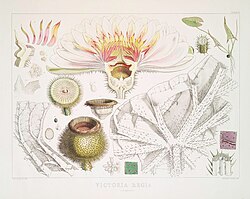
Key Facts
- Genus Name: Victoria (named after Queen Victoria).
- Leaf Size: Can reach widths of over 3.2 meters (10 feet) in some species.
- Flower Behavior: Nocturnal, thermogenic (heat-producing), and change color from white to pink.
- Pollination: Primarily facilitated by Cyclocephala beetles.
- Habitat: Shallow waters, lakes, and streams in South American river basins.
Botanical Characteristics and Growth
The Victoria genus consists of rhizomatous, perennial herbs. They grow from tuberous rhizomes—thickened underground stems—that utilize contractile adventitious roots to anchor themselves. The most iconic feature of these plants is their peltate (shield-shaped) and orbicular leaves. These leaves feature a raised rim, typically 10–20 cm high, which helps contain the leaf's structure.
To manage water levels, the leaf surface contains stomatodes, which are microscopic perforations that allow rainwater to escape. The underside of the leaves is highly specialized; for instance, Victoria amazonica features a red underside with long, hard spines, while Victoria cruziana possesses a purple underside covered in a soft, peach-like fuzz.
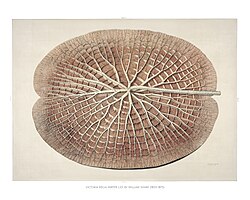
The growth cycle of these plants is a complex process, moving from small seedlings to massive, structural pads capable of supporting significant weight.
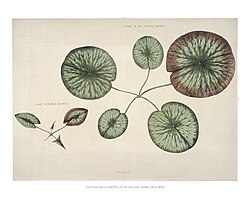
The Spectacular Bloom
The flowers of the Victoria genus are as extraordinary as their leaves. They are nocturnal, meaning they open at night, and thermogenic, a biological process where the flower generates its own heat. These solitary, actinomorphic (radially symmetrical) flowers can reach up to 25 cm in width.
The reproductive structure is intricate, featuring 150–200 stamens and 30–44 fused carpels. The petals undergo a fascinating transformation: in V. amazonica, the flowers appear white on the first night of opening and transition to pink on the second night. This process is closely tied to their pollination by scarab beetles.
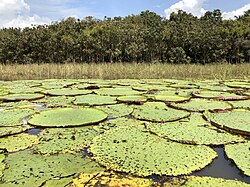
Comparing Victoria Species
While all members of the genus share impressive traits, there are distinct differences in their distribution and physical appearance. Below is a summary of the three primary species recognized in the genus.
| Scientific Name | Primary Distribution | Distinguishing Features |
|---|---|---|
| Victoria amazonica | Amazon River basin (oxbow lakes/bayous) | White to pink flowers; red leaf underside with hard spines. |
| Victoria cruziana | Parana - Paraguay basin | Purple leaf underside with soft fuzz; slightly smaller than V. amazonica. |
| Victoria boliviana | Bolivia | Largest leaves (up to 3.2m); larger seeds and ovules. |
Human Interaction and Utility
Beyond their beauty, these plants have various uses. In horticulture, they are highly prized ornamental plants. Historically and culturally, the seeds, petioles (leaf stalks), and rhizomes have been used as food sources. Additionally, extracts from the roots can be utilized to produce black dye.
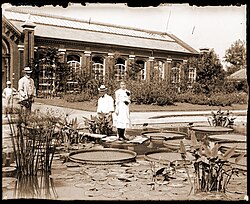
The structural integrity of the leaves is so profound that, with careful weight distribution, they can support human weight. This is often demonstrated in botanical gardens using planks to spread the load across the leaf surface.
Frequently Asked Questions
How large can Victoria leaves grow?
The size varies by species. While many are large, Victoria boliviana is known to produce leaves reaching widths of more than 3.2 meters (10 feet).
What causes the flowers to change color?
In Victoria amazonica, the flowers are white during their first night of opening and transition to pink on the second night.
How are these giant lilies pollinated?
The flowers rely on Cyclocephala beetles for pollination, attracted by the flower's nocturnal blooming and heat production.
What is thermogenesis in waterlilies?
Thermogenesis is the ability of the flower to generate heat, which helps facilitate the pollination process by attracting beetles and aiding in scent dispersal.
Can a person stand on a Victoria leaf?
Yes, the leaves are remarkably strong. However, to prevent damage, weight must be distributed carefully, often using a wooden plank to spread the load across the surface.