Exploring the Common Bladderwort (*Utricularia vulgaris*)
In the diverse world of aquatic vegetation, few plants are as specialized as the common bladderwort. Known scientifically as Utricularia vulgaris, this fascinating species has adapted to life in the water through unique biological mechanisms that set it apart from typical rooted plants.
Biological Classification
Understanding the place of the common bladderwort within the natural world requires looking at its complex scientific taxonomy. As a member of the Lentibulariaceae family, it belongs to a group of plants known for their specialized survival strategies.
Taxonomy and Classification
The scientific hierarchy for Utricularia vulgaris is as follows:
- Kingdom: Plantae
- Clade: Embryophytes, Tracheophytes, Angiosperms, Eudicots, and Asterids
- Order: Lamiales
- Family: Lentibulariaceae
- Genus: Utricularia
- Species: U. vulgaris
Physical Characteristics
The common bladderwort possesses a distinct physical structure designed for a free-floating existence. Unlike many aquatic plants, it does not put down roots to anchor itself in the substrate.
Stems and Leaves
During a single growing season, the plant's stems can reach impressive lengths of over one metre. The leaves are finely pinnately divided, meaning they are split into small leaflets arranged on either side of a central axis. These leaves typically measure between one and eight centimetres in length and are equipped with numerous bladder-like traps used for capturing prey.
Flowers and Inflorescence
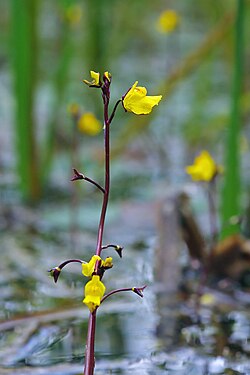
Between April and August, the plant produces striking yellow flowers. These are borne on stalks that rise above the water's surface in an inflorescence—a cluster of flowers arranged on a stem. This flowering period is a vital part of the plant's seasonal cycle.
Habitat and Life Cycle
Utricularia vulgaris is primarily found in Asia and Europe. It is important to note that in North America and eastern Asia, a related species, U. macrorhiza, typically occupies its ecological niche.
Because the plant is free-floating, it moves with the water currents. To survive the colder months, the plant undergoes a seasonal change where the stems die back and the plant forms turions, which are specialized overwintering buds that allow the species to persist through the winter.
Key Facts
- Conservation Status: Classified as Least Concern (IUCN 3.1).
- Growth Habit: A free-floating aquatic plant that does not use roots.
- Stem Length: Can exceed one metre in a single season.
- Flowering Season: Occurs annually between April and August.
- Leaf Structure: Pinnately divided leaves featuring bladder-like traps.
| Feature | Description |
|---|---|
| Common Name | Common bladderwort |
| Scientific Name | Utricularia vulgaris |
| Primary Habitat | Asia and Europe |
| Flower Color | Yellow |
| Survival Mechanism | Formation of winter turions |
Frequently Asked Questions
Does the common bladderwort have roots?
No, the common bladderwort is a free-floating species and does not put down roots.
Where is this plant naturally found?
It is native to the regions of Asia and Europe.
How does the plant survive during the winter?
The plant's stems die back in the winter, and it survives by forming turions, which are specialized overwintering buds.
When does the common bladderwort flower?
The yellow flowers typically bloom between the months of April and August.
What is the conservation status of Utricularia vulgaris?
According to the IUCN 3.1, the species is currently classified as Least Concern.