Vega Rocket: The Legacy of Europe's Small-Lift Launch Vehicle
The Vega rocket served as a cornerstone of European access to space for over a decade. Developed as a small-lift launch vehicle, it was specifically designed to deliver payloads into polar and Sun-synchronous orbits (SSO)—orbits where the satellite passes over any given point of the Earth's surface at the same local mean solar time.
Manufactured by Avio, the Vega program was a multi-national European effort. While Italy led the program by contributing 65% of its funding, the project received vital support from France, Spain, Belgium, the Netherlands, Switzerland, Sweden, and other nations. After a successful career spanning 22 launches, the original Vega has been retired, making way for its more powerful successor, the Vega C.
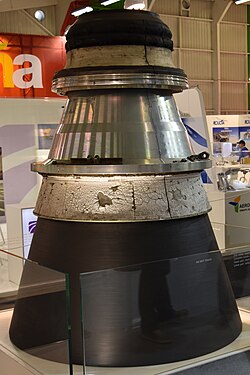
Key Facts
- Manufacturer: Avio
- Primary Function: Small-lift launch vehicle
- Total Launches: 22 (20 successes, 2 failures)
- First Flight: 13 February 2012
- Last Flight: 5 September 2024
- Launch Site: Guiana, ELV
- Cost per Launch: Approximately US$ 37 million
Technical Specifications and Performance
The Vega rocket was a four-stage vehicle characterized by its height of 30 meters and a diameter of 3 meters. Its design allowed for versatile mission profiles, depending on the target orbit and payload mass.
Payload Capacities
Vega was highly specialized for specific orbital requirements:
- Polar Orbit (700 km altitude): 1,430 kg
- Sun-Synchronous Orbit (400 km altitude): 1,450 kg
- Elliptic Orbit (1,500 km × 200 km): 1,963 kg

The Four Stages of Vega
The rocket utilized a combination of solid and liquid propulsion to achieve its mission objectives:
- First Stage (P80FW): A solid motor with a maximum thrust of 2,261 kN and a burn time of 107 seconds.
- Second Stage (Zefiro 23): A solid motor providing 871 kN of thrust.
- Third Stage (Zefiro 9): A solid motor with a burn time of 117 seconds.
- Fourth Stage (AVUM): The Attitude & Vernier Upper Module, a liquid-fueled stage powered by an RD-843 engine. Unlike the solid stages, the AVUM could perform up to five separate burns to precisely position the payload.
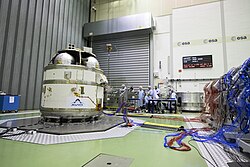
Evolution: From Vega to Vega C and Beyond
As space requirements evolved, the Vega program transitioned into more advanced iterations. The Vega C, which entered service in 2022, represents a significant upgrade over the original model. It incorporates the P120C first stage (the same booster used for the Ariane 6) and replaces the Zefiro 23 with the Zefiro 40. It also features the larger AVUM+ upper module.
Looking further ahead, Avio is developing the Vega-E, which is expected to feature the M10 engine. The maiden flight for the Vega-E is currently planned for 2027.
Summary of Vega Specifications
| Feature | Specification |
|---|---|
| Total Height | 30 m (98 ft 5 in) |
| Total Mass | 137,000 kg (302,000 lb) |
| Number of Stages | 4 |
| Payload Fairing Height | 7.8 m (25 ft 7 in) |
| Payload Fairing Diameter | 2.6 m (8 ft 6 in) |
Frequently Asked Questions
What was the primary purpose of the Vega rocket?
The Vega was a small-lift launch vehicle designed primarily to carry satellites into polar and Sun-synchronous orbits.
Who manufactured the Vega rocket?
The rocket was manufactured by Avio, with Italy providing the majority of the program's funding.
How does the Vega C differ from the original Vega?
The Vega C is a more powerful evolution that uses the P120C first stage, the Zefiro 40 second stage, and an upgraded AVUM+ fourth stage.
When did the original Vega rocket complete its final mission?
The original Vega rocket performed its final flight on 5 September 2024, carrying the Sentinel-2C payload.
What is the AVUM stage?
AVUM stands for Attitude & Vernier Upper Module. It is the fourth stage of the Vega rocket, designed to provide precise orbital positioning through multiple engine burns.