Urban Design: Shaping the Cities of Tomorrow
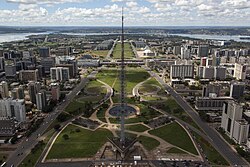
Urban design is the multidisciplinary art of shaping the buildings and the spaces between them. Unlike narrow architectural focus, it looks at the "bigger picture," integrating geographical location with economic, social, and environmental values. From the layout of a single public square to the master plan of an entire metropolis, urban design bridges the gap between architecture, landscape architecture, and urban planning to create organized, community-focused environments.
By focusing on both physical features and social design, urban designers aim to improve the quality of life for residents while ensuring that cities remain functional and sustainable as they grow.
Key Facts
- Interdisciplinary Scope: Combines architecture, landscape architecture, and urban planning.
- Garden City Movement: Pioneered by Sir Ebenezer Howard in 1898 to create self-contained communities surrounded by parks.
- Professionalization: The first academic course in urban planning was offered by the University of Liverpool in 1909.
- Social Model of Disability: A shift in the 1970s that viewed accessibility barriers as design failures rather than individual tragedies.
- Modern Focus: Current trends emphasize sustainable urbanism and New Urbanism to combat climate change and urban sprawl.
The Evolution of Urban Design
Early Modern and Industrial Shifts
While early examples like the Circus in Bath (completed 1768) showed early structured design, the 19th century brought rapid industrialization. During the Victorian era, private businesses drove city expansion, often leading to poor public health and hardships for the working class. As "New Liberalism" replaced laissez-faire governance, the public began demanding healthier living environments, sparking the birth of modern urban design around 1900.
The Garden City Movement
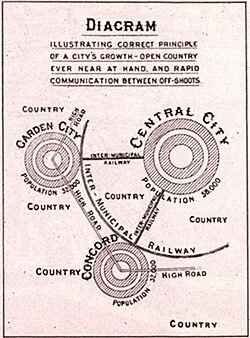
Sir Ebenezer Howard became the first modern urban planning theorist. In 1898, he published Garden Cities of To-morrow, proposing self-sufficient communities of 32,000 people on 6,000 acres. These cities were designed in a concentric pattern with public parks and six radial boulevards, 120 feet wide. Howard envisioned these as satellites linked by road and rail to a central city of 50,000 people.
Professionalization in the 20th Century
Urban planning transitioned from utopian theory to a professional discipline in the early 1900s. Key milestones included the founding of the Town and Country Planning Association in 1899 and the Housing, Town Planning, &c. Act 1909 in the UK, which mandated building standards. In the United States, Harvard University established the first urban planning course in 1924.
By 1928, the International Congresses of Modern Architecture (CIAM) was founded by Le Corbusier and others, promoting architecture as a "social art." This era laid the groundwork for the modernist approach to city design.

Modern Paradigms and Current Trends
New Urbanism and Sustainability
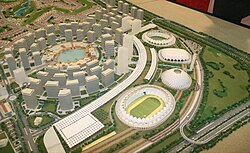
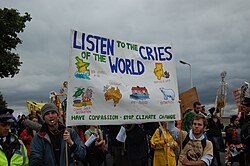
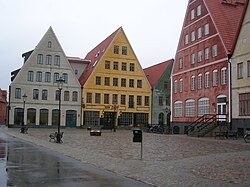
Recent decades have seen a shift toward New Urbanism and Sustainable Urbanism. These approaches prioritize walkability, mixed-use development, and the reduction of environmental impact. Projects like BedZED in London and the Jakriborg eco-town in Sweden exemplify the move toward environmentally conscious living.
The Integrative Approach
Modern urban design is an integrative profession that balances several critical factors to ensure a city is livable:
- Accessibility and Legibility: Ensuring safe transportation and clear wayfinding (information about destinations).
- Animation and Function: Designing spaces that stimulate public activity and support their intended uses.
- Character and Continuity: Respecting heritage and contemporary culture while recognizing the unique identity of different places.
- Civil Society: Creating environments where people can interact as civic equals to build social capital.
Urban Design Education
Education in this field has evolved from the first school at the University of Liverpool (1909) to specialized graduate programs. In the U.S., Harvard University established the first Master of Architecture in Urban Design in 1956, followed by Washington University in St. Louis in 1961. Today, numerous institutions, including Columbia, Georgia Tech, and UC Berkeley, offer advanced degrees that combine interdisciplinary studios with independent study.
Addressing Accessibility and Social Issues
Until the 1970s, urban design largely ignored the needs of people with disabilities. This led to the rise of the social model of disability, which argues that barriers are created by the built environment and societal attitudes rather than the individual's impairment. This movement led to the creation of "access officers" and legislation such as the Disability Discrimination Act 1995 and Part M of the Building Regulations (1992) to enforce accessibility standards.
| Era/Movement | Key Figure/Event | Primary Focus |
|---|---|---|
| Garden City (1898) | Sir Ebenezer Howard | Self-contained, concentric communities with greenbelts. |
| Modernism (1920s) | CIAM / Le Corbusier | Architecture as a social art; professionalized planning. |
| Accessibility Shift (1970s) | Access Groups | Social model of disability; removing built environment barriers. |
| Current Trends | New Urbanism | Sustainability, walkability, and eco-friendly towns. |
Frequently Asked Questions
What is the difference between urban planning and urban design?
While urban planning typically deals with the broader regulatory and strategic framework of land use, urban design focuses on the specific design processes and physical outcomes of buildings and the spaces between them.
Who was Sir Ebenezer Howard?
Sir Ebenezer Howard was a pioneer of modern urban planning who initiated the garden city movement in 1898, proposing planned communities that balanced residential, industrial, and agricultural areas.
What is the "social model" of disability in urban design?
The social model posits that people are disabled by barriers in the built environment and the attitudes of others, rather than by their physical or mental impairments.
What are the goals of New Urbanism?
New Urbanism aims to create more livable, walkable, and sustainable communities, often emphasizing mixed-use development and a reduction in car dependency.
Where can one study urban design?
Urban design is taught globally, with historic programs at the University of Liverpool and Harvard, and modern programs at institutions such as Columbia, Georgia Tech, and the University of Texas at Austin.