Unterseen History: From Medieval Stronghold to Tourism Hub
Nestled between the stunning lakes of the Bernese Oberland, Unterseen possesses a rich historical tapestry that stretches from prehistoric times to the dawn of modern tourism. While often overshadowed by its neighbor, Interlaken, Unterseen was once a strategic bastion of secular power, designed to balance the influence of religious institutions in the region.
Ancient Roots and Early Settlements
The human presence in the Unterseen area dates back to the Neolithic period, evidenced by scattered stone tools. By the second century AD, the area served as a site for a Roman graveyard. As the region transitioned into the Early Middle Ages, cemetery findings confirm continued habitation, and by the High Middle Ages, the landscape featured at least three forts.
By 1133, the area was referred to as Interlacus, coinciding with the founding of the Interlaken Monastery on the opposite side of the Aare river. The village of Interlaken subsequently grew across from the monastery, evolving from villa Inderlappen in 1239 to civitas Inderlappen by 1280.
The Founding of Unterseen
The city of Unterseen was officially founded on July 13, 1279. King Rudolf I von Habsburg granted Baron Berchtold III of Eschenbach-Oberhofen the permission to construct a stronghold between the two lakes. The name "Unterseen" is derived from the Middle High German words unter (meaning "between") and seen (meaning "lake").
This new fortification was granted Stadtrecht, or town privileges, as part of the agreement. By 1281, the records mention Interlaken and Unterseen collectively as stat ze Inderlappen oder Undersewen, and by 1291, they were referred to as Inderlappen, genant Undersewen.
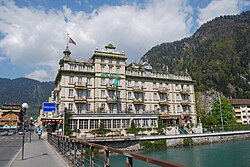
Power Struggles and Bernese Influence
Unterseen was established by secular nobles specifically to curb the expanding power of the Interlaken Monastery and to maintain control over the bridge crossing the Aare. This strategic positioning led to persistent conflicts between the town and the monastery, prompting Unterseen to seek protection from Bern.
Following the Swiss Confederation's victory at the Battle of Sempach in 1386, the villages came under the administration of Bern, which appointed a bailiff to oversee the area.
Fire, Reformation, and Resilience
The town's history was marked by devastating fires. In 1364, a fire started at the monastery's mill and spread, destroying much of Unterseen. A second major fire occurred in 1470, after which Bern led the reconstruction efforts, including the creation of a central town house. The local chapel, first mentioned in 1353 and rebuilt after the 1470 fire, eventually gave way to the current church building constructed in 1852 following a partial collapse of the older structure.
During the Reformation, Unterseen aligned itself against the Interlaken Monastery. Because the town remained loyal and did not join the Berner Oberland uprising, it was rewarded with the Alp Sefinen.
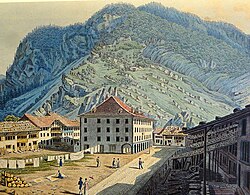
Political Unrest and the Unspunnenfest
Following the establishment of the Helvetic Republic, Unterseen became a focal point of resistance against the return of Bernese feudalism. In an attempt to reconcile the tensions between urban and rural citizens, the Unspunnenfest was organized in 1805 and 1808. However, the effort failed, and the government subsequently banned the festival. Political instability continued into 1815, when many citizens participated in unrest within Interlaken.
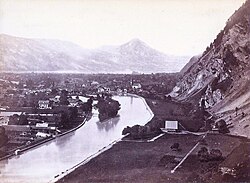
Transition to the Modern Era
As the town evolved, its medieval defenses became obsolete. The town wall and moat were dismantled in the early 19th century, and the gate house was finally demolished in 1855.
During the mid-18th century, Unterseen played a pivotal role in the region's burgeoning tourism industry. Over time, however, much of this tourism prominence shifted toward the neighboring town of Interlaken.
Key Facts
- Founded: July 13, 1279, by Baron Berchtold III of Eschenbach-Oberhofen.
- Etymology: Derived from Middle High German for "between lakes."
- Strategic Purpose: Built to limit the power of the Interlaken Monastery and control the Aare bridge.
- Major Disasters: Devastating fires occurred in 1364 and 1470.
- Political Shift: Came under Bernese control after the Battle of Sempach in 1386.
| Period/Date | Key Event/Status | Significance |
|---|---|---|
| Neolithic/Roman | Early settlements and graveyard | Earliest evidence of habitation |
| 1279 | Official Founding | Granted town privileges (Stadtrecht) |
| 1386 | Bernese Control | Integration into Bernese administration |
| 1470 | Second Great Fire | Led to Bernese-led reconstruction |
| 1805/1808 | Unspunnenfest | Attempted reconciliation between urban and rural citizens |
| 1855 | Demolition of Gate House | End of the town's fortified era |
Frequently Asked Questions
Why was Unterseen founded?
Unterseen was founded by secular nobles to limit the growing influence of the Interlaken Monastery and to maintain strategic control over the bridge crossing the Aare river.
What does the name Unterseen mean?
The name comes from Middle High German, where "unter" means "between" and "seen" means "lake," referring to its location between the two lakes.
How did the town recover from the fire of 1470?
Following the fire, the city of Bern undertook the reconstruction of the town, which included building a town house in the center and rebuilding the local chapel.
What was the purpose of the Unspunnenfest?
The Unspunnenfest of 1805 and 1808 was planned as a means of reconciliation between urban and rural citizens following resistance against reestablished Bernese feudalism.
When did Unterseen lose its fortifications?
The town wall and moat were broken down in the early 19th century, and the gate house was demolished in 1855.