United States Readiness Command: Evolution and Mission
The architecture of American military readiness underwent a significant transformation during the Cold War, moving toward a more integrated, joint-service approach. This evolution is best exemplified by the trajectory of the United States Readiness Command, a pivotal organization that bridged the gap between traditional service-specific operations and the modern unified command structure used today.
The Birth of USSTRICOM
In March 1961, Secretary of Defense Robert McNamara directed the Joint Chiefs of Staff (JCS) to create a plan that would integrate the Strategic Army Corps (STRAC) and the Tactical Air Command (TAC) into a single, unified command. While the Chairman of the JCS, the Chief of Staff of the Army (CSA), and the Chief of Staff of the Air Force (CSAF) supported the move, the Chief of Naval Operations (CNO) expressed concerns. The CNO feared that assigning naval forces to a command tailored for Army and Air Force assets would sacrifice the inherent flexibility of the Navy.
Despite these objections, Secretary McNamara proceeded with the plan. On January 1, 1962, the United States Strike Command (USSTRICOM) was activated under the leadership of an Army general. The command initially assumed operational control over the combat-ready forces of TAC and the Continental Army Command (CONARC). By 1965, the United States Atlantic Fleet joined as the naval component command.
Initial Missions and Expansion
Under the leadership of General Theodore J. Conway (1966–1969), USSTRICOM focused on four primary objectives:
- Maintaining a reserve of general-purpose forces to reinforce other unified commands.
- Training the general reserve.
- Developing joint doctrine—the standardized principles that guide how different military services operate together.
- Planning and executing contingency operations.
Over time, the command's scope expanded to include the planning and execution of operations in the Middle East, sub-Sahara Africa, and Southern Asia, a region collectively known as MEAFSA.
Transition to Readiness Command (REDCOM)
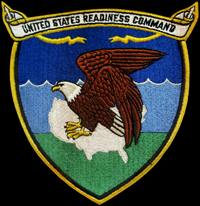
In 1972, USSTRICOM was redesignated as the United States Readiness Command (REDCOM). While this was primarily a name change, the command was divested of its MEAFSA responsibilities. REDCOM's updated mission focused on integrating and training CONUS-based (Continental United States) general-purpose forces and providing joint task force headquarters for operations in areas not already assigned to other unified commands.
A critical development occurred in 1979 when national command authorities ordered the Commander-in-Chief of REDCOM (CINCRED) to establish the Rapid Deployment Joint Task Force (RDJTF) as a separate subordinate command. General Volney F. Warner led REDCOM from 1979 to 1981 during this transitional period.
The Path to USCENTCOM and USSOCOM
The RDJTF eventually outgrew its subordinate status, becoming an independent unified command in 1983 known as the United States Central Command (USCENTCOM). By 1987, the Readiness Command was officially replaced by the United States Special Operations Command (USSOCOM). In a seamless transition of leadership, the final CINCRED, General James J. Lindsay, became the first Commander-in-Chief of Special Operations Command (CINCSOC).
Specialized Support: The CSE
Supporting these broad strategic goals were specialized units like Detachment 1 of the 1150th USAF Special Activities Squadron. Known as the Communications Support Element (CSE) and based at MacDill AFB, this unit was subordinate to USSTRICOM. Comprised of an equal mix of Air Force and Army personnel, the CSE operated as a mobile tactical communications outfit divided into Field Unit "A" (FUA) and Field Unit "B" (FUB).
Command Summary
| Era/Command | Active Period | Primary Focus | Key Successor/Outcome |
|---|---|---|---|
| USSTRICOM | 1962–1972 | Joint Army-Air integration & MEAFSA | REDCOM |
| REDCOM | 1972–1987 | CONUS-based force integration | USSOCOM |
| RDJTF | 1979–1983 | Rapid deployment capabilities | USCENTCOM |
Key Facts
- Established: USSTRICOM was activated on January 1, 1962.
- Integration: It combined the Strategic Army Corps (STRAC) and Tactical Air Command (TAC).
- Regional Scope: It managed operations in the Middle East, sub-Sahara Africa, and Southern Asia (MEAFSA).
- Evolution: USSTRICOM became REDCOM in 1972, which was later replaced by USSOCOM in 1987.
- Legacy: The Rapid Deployment Joint Task Force (RDJTF) within REDCOM evolved into USCENTCOM in 1983.
Frequently Asked Questions
What was the primary purpose of USSTRICOM?
USSTRICOM was created to integrate Army and Air Force forces into a unified command to provide a general-purpose reserve, train forces, develop joint doctrine, and execute contingency operations.
How did REDCOM differ from USSTRICOM?
While largely a redesignation, REDCOM was divested of its responsibilities for the Middle East, sub-Sahara Africa, and Southern Asia (MEAFSA), focusing more on CONUS-based force integration.
What was the role of the Rapid Deployment Joint Task Force (RDJTF)?
Established in 1979 as a subordinate command within REDCOM, the RDJTF was designed for quick-response operations and eventually became the independent USCENTCOM in 1983.
Who was the first leader of USSOCOM?
General James J. Lindsay, who served as the final Commander-in-Chief of REDCOM, became the first Commander-in-Chief of USSOCOM when it replaced REDCOM in 1987.
What was the Communications Support Element (CSE)?
The CSE was a mobile tactical communications unit subordinate to USSTRICOM, consisting of a 50-50 mix of Army and Air Force personnel operating out of MacDill AFB.