United States Army Military Government in Korea (USAMGIK)
From 1945 to 1948, the southern half of the Korean Peninsula was administered by the United States Army Military Government in Korea (USAMGIK). This military occupational transitional government emerged in the wake of World War II, filling the power vacuum left by the surrender of the Empire of Japan. While intended to stabilize the region and prepare it for independence, the period was marked by intense political friction, economic instability, and social unrest.
The USAMGIK operated during the early stages of the Cold War, navigating a complex landscape of competing ideologies and a population eager for self-governance. The administration's struggle to balance security with political legitimacy eventually paved the way for the establishment of the Republic of Korea.
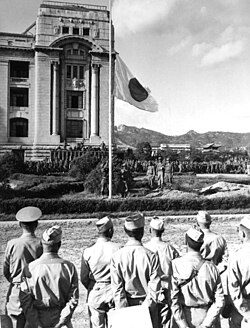
Key Facts
- Duration: September 9, 1945, to August 15, 1948.
- Jurisdiction: Southern half of the Korean Peninsula (below the 38th Parallel).
- Commander-in-Chief: Lt. General John R. Hodge.
- Capital: Seoul.
- Preceded by: Japanese colonial rule (Chōsen).
- Succeeded by: The Republic of Korea.
The Division of the Peninsula
Between 1910 and 1945, Korea was a colony of the Empire of Japan. As World War II neared its end on August 11, 1945, U.S. Army planning officers designated the 38th Parallel—an invisible line across the peninsula—to divide Korea into two occupation zones: the Soviet Union in the north and the United States in the south.
General Douglas MacArthur, serving as the Supreme Commander for the Allied Powers, was given broad authority to manage the region. He ordered the XXIV Corps, led by Lt. General John R. Hodge, to accept the Japanese surrender and establish a military government. U.S. forces landed at Jinsen on September 8, 1945, and officially began their administration the following day.

Political Turmoil and Popular Resistance
The USAMGIK faced immediate challenges due to a lack of linguistic and political knowledge of Korea. One of the most controversial early decisions was the announcement that the Japanese colonial government and its personnel would remain intact to maintain order. Although Hodge later replaced the governor-general with an American, he continued to employ former Japanese bureaucrats as advisors, fueling public anger.
The People's Republic and the Provisional Government
Before the U.S. arrival, the People's Republic of Korea (PRK) had been established in August 1945 and had rapidly gained control. However, the USAMGIK outlawed the PRK, forcing its leader, Yeo Un-hyeong, to form the People's Party of Korea. Similarly, the U.S. refused to recognize the Provisional Government of the Republic of Korea, led by Kim Ku, treating its members as private citizens rather than official representatives.
![Anti-trusteeship movement [ko] protest, December 1945](/images/2e/49/2e49744e9c16c701644279542c268bbb3fe427bb6b2b10a34081ddf172c37112.jpg)
Uprisings and Martial Law
Tensions peaked in 1946. After the Communist Party of Korea initiated a General Strike in September, the USAMGIK responded with military force and support for right-wing anti-communist groups. On October 1, a protest in Daegu turned violent, sparking the Autumn Uprising. The U.S. administration declared martial law and fired into crowds, resulting in an unknown number of casualties.
Further instability occurred in April 1948 with the Jeju uprising. Triggered by calls from left-wing radicals to oppose the upcoming 1948 elections, the conflict between guerrillas, police, and right-wing groups led to atrocities on both sides. It is estimated that between 14,000 and 30,000 people died before the uprising was suppressed by May 1949.
Economic and Educational Administration
The economy under USAMGIK was characterized by chaos and mismanagement. A 1947 report by the State-War-Navy Coordinating Committee noted that the U.S. failed to implement necessary land and labor reforms. The imposition of free-market reforms on rice production led to hoarding, profiteering, and widespread hunger, despite an increase in crop yields. Inflation became rampant, and counterfeiting became a significant issue.
In education, the military government reopened schools in November 1945 but largely maintained the existing Japanese colonial system. While sweeping changes were not immediate, a council of 100 Korean educators was convened in 1946 to plan future reforms, which were later implemented by the First Republic.
The Path to Independence
The U.S. attempted to create a stable political transition through the South Korean Interim Legislative Assembly in December 1946. However, the assembly failed to gain broad support; the left-wing South Korean Workers Party boycotted it, and the conservative Korea Democratic Party felt excluded. The assembly was led by the moderate Kim Kyu-sik, but he lacked the charisma to unite the fractured political factions.
Following general elections on May 10, 1948, and the adoption of a constitution on July 17, the Republic of Korea was officially established on August 15, 1948. This marked the end of the USAMGIK's ruling authority, though American troops remained stationed in the country until 1949.
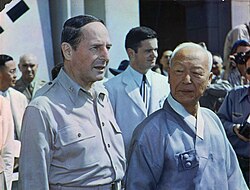
| Category | Details |
|---|---|
| Key Leaders | John R. Hodge (Commander), Syngman Rhee (First President of ROK) |
| Major Conflicts | Autumn Uprising (1946), Jeju Uprising (1948) |
| Economic Issues | Hyperinflation, rice profiteering, lack of land reform |
| Political Shift | From military occupation to the Republic of Korea |
| Boundary | 38th Parallel (Dividing North and South) |
Frequently Asked Questions
Why did the U.S. divide Korea at the 38th Parallel?
The division was decided by two U.S. Army planning officers in Washington on August 11, 1945, to split the former Japanese colony into Soviet and American occupation zones to facilitate the acceptance of the Japanese surrender.
Why was the USAMGIK unpopular with many Koreans?
Discontent stemmed from the U.S. decision to keep former Japanese colonial officials as advisors, the outlawing of the popular People's Republic of Korea, and the perceived support for elections that permanently divided the country.
What was the Autumn Uprising of 1946?
It was a series of demonstrations and strikes that began in Daegu on October 1, 1946, following a general strike by railway and industrial workers. The U.S. military government responded with martial law and force.
How did the USAMGIK handle the economy?
The administration implemented free-market reforms that removed controls on rice, which inadvertently led to hoarding and hunger. A 1947 internal U.S. assessment admitted that the economy had been mismanaged and lacked basic land and labor reforms.
When did the USAMGIK officially end?
The USAMGIK's rule ended on August 15, 1948, with the official proclamation of the Republic of Korea, although U.S. troops did not fully withdraw until 1949.