The Life and Legacy of Chun Doo-hwan: South Korea's Fifth President
Chun Doo-hwan was a central and controversial figure in modern South Korean history. A former army general, he served as the fifth president of South Korea from 1980 to 1988. His leadership, characterized by the Fifth Republic, was marked by a transition from military rule to a period of significant economic and political tension.
Rising to power through a military coup, Chun's presidency remains a subject of intense historical debate, spanning from his military achievements to the legal battles that followed his departure from office.

Key Facts
- Term of Office: September 1, 1980 – February 25, 1988.
- Political Party: Democratic Justice Party.
- Military Rank: General.
- Key Historical Period: The Fifth Republic of Korea.
- Legal Outcome: Convicted of crimes; later pardoned in 1997.
Early Life and Military Career
Born on January 18, 1931, in Gosen, Keishōnan Province, Chun Doo-hwan attended the Korea Military Academy. His military service spanned several decades, from 1951 to 1987, during which he served in both the Korean War and the Vietnam War.
Chun's ascent through the ranks was rapid. By 1970, he was a colonel commanding the 29th Regiment of the 9th Infantry Division. Following his service in Vietnam, he commanded the 1st Special Forces Brigade (Airborne) and was promoted to brigadier general. His influence grew further when he served as the deputy chief of the Presidential Security Service, eventually reaching the rank of major general.

The Rise to Power
Chun's path to the presidency was paved by the political instability following the assassination of President Park Chung Hee in 1979. As a leader within the Hanahoe—a powerful secret military faction—Chun played a decisive role in the December 12 mutiny. This move allowed him to exert de facto (actual, rather than official) control over the country starting in late 1979.
His transition to official presidency was marked by significant unrest. In May 1980, demonstrators in Gwangju protested against the declaration of martial law, leading to a violent crackdown. This period remains one of the most somber chapters of his rule.

The Fifth Republic and Dictatorship
Chun officially assumed the presidency on September 1, 1980. During his tenure, he led the Democratic Justice Party and oversaw the Fifth Republic. His administration focused on various domestic and foreign policies, including economic management and navigating complex relations with the United States and North Korea.
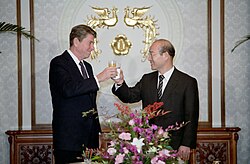
His foreign policy involved high-level diplomatic engagements, such as meetings with U.S. President Ronald Reagan in 1983. However, his domestic rule faced increasing pressure from democratization movements, culminating in the June Struggle of 1987, which eventually forced political reforms and a move toward direct presidential elections.
Legal Challenges and Later Life
Following the end of the Fifth Republic, Chun faced intense legal scrutiny. In 1993, investigations were launched into the alleged theft of 400 billion won from the South Korean people. Chun was eventually convicted and sentenced to death, a sentence that was later commuted to life imprisonment and a substantial fine of ₩220 billion.
On December 21, 1997, President Kim Young-sam granted Chun a pardon at the request of President-elect Kim Dae-jung. While he was freed, he remained under significant financial and legal pressure regarding his unpaid fines. Chun passed away on November 23, 2021, at the age of 90 in Seoul.

Summary of Presidential Tenure
| Category | Details |
|---|---|
| Official Title | 5th President of South Korea |
| Term Duration | 1980 – 1988 |
| Political Era | Fifth Republic |
| Successor | Roh Tae-woo |
| Predecessor | Choi Kyu-hah |
Frequently Asked Questions
What was the Hanahoe?
The Hanahoe was a secret military faction that Chun Doo-hwan was a member of, which played a significant role in his rise to political power.
How did Chun Doo-hwan's presidency end?
His presidency ended in 1988, following the political shifts caused by the June Struggle democratization movement and the subsequent transition to a new administration under Roh Tae-woo.
What happened to the fines imposed on Chun Doo-hwan?
Although sentenced to pay a fine of ₩220 billion, Chun only paid ₩53.3 billion before his pardon. A significant portion of the remaining fine was never collected.
Who succeeded Chun Doo-hwan?
Chun Doo-hwan was succeeded by Roh Tae-woo.
What was the significance of the Gwangju uprising?
The Gwangju uprising involved demonstrators protesting against martial law in May 1980, which resulted in a violent confrontation with military troops under Chun's control.