Union Jack Origins: The Evolution of the English and Scottish Flags
The story of the Union Jack is more than just a design choice; it is a visual record of the political merging of two sovereign nations. The process began not with a legal treaty, but with a personal union. In 1603, the Union of the Crowns occurred when King James VI of Scotland also became King James I of England, placing both crowns on a single head.
To symbolize this new era, King James instructed his heralds to create a flag that combined the distinct symbols of his two kingdoms: the red St George's Cross of England and the white St Andrew's Saltire (a diagonal cross) of Scotland.
The First Union Flag of 1606
After rejecting several initial designs, King James selected a version in 1606 where the red Cross of Saint George surmounted the white Cross of Saint Andrew. This decision was formalized through Orders in Council to resolve disputes between sailors from "South and North Britaine" regarding which flag to fly at sea.
The regulations specified that all subjects of the Isle and Kingdom of Great Britain were to fly this conjoined flag on their main-toppe (the highest mast). However, to maintain regional identity, sailors from South Britain continued to fly the red cross alone on their fore-toppe, while those from North Britain flew the white cross on their fore-toppe.
The Scottish Variant and National Identity
The 1606 design was not universally accepted. Many Scottish ship owners and masters felt the design was prejudicial to the dignity of Scotland. They argued that because the English cross was drawn "haldin haill" (whole) through the Scottish cross, the Saltire was divided and obscured, making the Scottish arms nearly invisible.
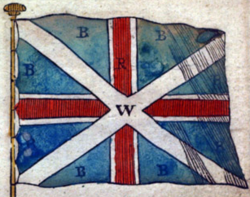
Through the influence of John Erskine, the 19th Earl of Mar, these grievances were sent to the King via the Privy Council of Scotland. While the official design remained unchanged, an unofficial Scottish variant emerged. In this version, the Scottish cross was placed uppermost, ensuring it remained prominent.
Evidence of this variant appears in various historical records, including a 1704 edition of The Present State of the Universe by John Beaumont.
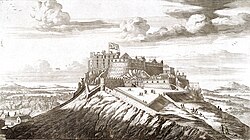
On land, the Scottish variant was also documented. John Slezer's engravings from approximately 1693, specifically in the series Theatrum Scotiae, depict this version of the flag flying from the Palace block of Edinburgh Castle.
Records suggest this variant persisted for some time; a 1785 manuscript by William Fox indicates the "scoth union" flag may have been used up until the addition of the Cross of St Patrick in 1801.
The Formalization of the Kingdom of Great Britain (1707)
For over a century following the Union of the Crowns, England and Scotland remained separate states with their own laws, currencies, and parliaments. It was not until 1707 that King James' vision of a unified kingdom was realized by his great-granddaughter, Queen Anne.
On April 17, 1707, two weeks before the Acts of Union took effect, the official flag for the new Kingdom of Great Britain was chosen. Sir Henry St George, the Garter Principal King of Arms, presented several designs to the Queen and her Privy Council.
At the request of Scottish representatives, the council considered the "Scotts union flagg" (with the Saltire uppermost). Ultimately, however, Queen Anne and her Council approved Sir Henry's original design, which maintained the English cross as the dominant element.
Key Facts
- 1603: The Union of the Crowns brings England and Scotland under King James VI and I.
- 1606: The first official Union Flag is created, combining the St George's Cross and St Andrew's Saltire.
- Main-toppe vs. Fore-toppe: The Union flag flew from the main mast, while national flags flew from the foremast.
- Scottish Variant: An unofficial version existed where the Scottish Saltire was uppermost to avoid being obscured by the English cross.
- 1707: The flag was formally adopted for the newly created Kingdom of Great Britain under Queen Anne.
| Version | Primary Feature | Status | Period of Use |
|---|---|---|---|
| James I Official | St George's Cross surmounting St Andrew's Saltire | Official | 1606–Present (evolved) |
| Scottish Variant | St Andrew's Saltire uppermost | Unofficial | 17th Century – c. 1801 |
| Proposed Alternative | White Saltire with blue fimbriation over red cross | Proposed | Early 17th Century |
Frequently Asked Questions
Why was the first Union Flag created?
It was created by King James VI and I in 1606 to resolve disputes between English and Scottish sailors and to symbolize the personal union of the two crowns.
What was the main complaint from Scottish ship owners?
They believed the official design obscured the Scottish Saltire because the English red cross was drawn over it, which they felt diminished the dignity of the Scottish nation.
How did the flag usage differ between the main-toppe and fore-toppe?
The combined Union flag was flown from the main-toppe, while the fore-toppe continued to fly the individual national flags (red for England, white for Scotland).
When did the flag become the official symbol of a unified state?
While used since 1606, it was formally chosen as the flag of the unified Kingdom of Great Britain on April 17, 1707, just before the Acts of Union took effect.
Who was responsible for the final 1707 design?
Sir Henry St George, the Garter Principal King of Arms, provided the designs, and the final selection was approved by Queen Anne and her Privy Council.