Underway Replenishment: The Evolution of Naval Logistics at Sea
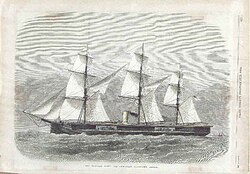
For centuries, the reach of a navy was limited by the distance its ships could travel before needing to refuel. Historically, this reliance on land-based coaling stations—specialized ports for refueling coal-fired ships—created a strategic bottleneck. While the Royal Navy once maintained a vast global network of these stations, the system had critical flaws: the infrastructure was vulnerable to attack, and the predictable movement of ships toward these hubs allowed enemies to anticipate naval maneuvers.
The solution was underway replenishment (UR), the process of transferring fuel, ammunition, and stores between ships while they are moving. This capability transformed navies from coastal defenders into true blue-water forces capable of projecting power across entire oceans without returning to port.
Key Facts
- Early Limitations: 1870s attempts at coaling at sea were too slow (5 tons per hour) and required perfectly calm weather.
- The Oil Transition: The shift from coal to oil made underway replenishment practicable because liquids are easier to pump than solids.
- Operational Milestone: The USS Maumee achieved the first operational underway refueling in 1917, supporting 34 destroyers.
- Modern Standard: The Standard Tensioned Replenishment Alongside Method (STREAM) is the current preferred system for U.S. Navy logistics.
- Strategic Impact: UR allows carrier task forces to remain at sea indefinitely, significantly increasing their striking range.
The Struggle with Coal: Early Experiments
The transition to underway replenishment began with the difficult task of moving solid coal between two moving vessels. In 1883, Lieutenant Robert Lowry proposed a system using watertight coal carriers suspended from cables, arguing that a minimum rate of 20 tons per hour at a speed of five knots was necessary for viability.
Throughout the late 19th and early 20th centuries, various mechanical solutions were tested to maintain a constant distance between ships:
- The Temperley Transporter: Used by the French in 1898 to provision warships at six knots.
- The Miller-Lidgerwood System: Developed in the U.S. and later refined into the Temperley-Miller system, which achieved peak rates of 60 tons per hour in 1902.
- The Metcalfe System: A 1903 Royal Navy design using two cables and a steam ram to maintain tension, reaching 54 tons per hour at 10 knots.

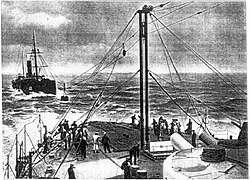
Despite these innovations, coaling at sea remained impractical. A battleship required over 2,000 tons of coal; at the available transfer rates, refueling could take 60 hours or more, leaving both ships dangerously vulnerable to enemy attack.
The Oil Revolution and Early Successes
The adoption of oil as a primary fuel source revolutionized naval logistics. Because liquid fuel could be continuously pumped, the technical hurdles of transferring solids were eliminated.
In 1906, the Royal Navy tested transfers between the oiler Petroleum and the battleship Victorious. Using a series of hoses and a wire jackstay, they achieved a transfer rate of 115 tons per hour at speeds up to 12 knots. This led to the construction of the Burma in 1911, the first oiler specifically designed for supplying destroyers at sea. However, the Royal Navy remained hesitant, preferring harbor refueling until World War II.
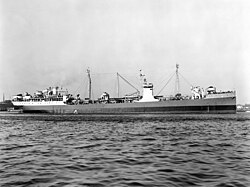
The true operational breakthrough came from the United States Navy. In 1916, Chester Nimitz—then an executive officer on the USS Maumee—developed a "riding-abeam" refueling system using rubber hoses and ship booms. In May 1917, the USS Maumee put this into practice, refueling 34 destroyers en route to Britain. This established the blueprint for mobile logistic support.
Modern Evolution and Specialized Systems
During the interwar period, it was widely believed that larger warships could not be safely refueled alongside. This was debunked by Rear Admiral Nimitz between 1939 and 1940, whose perfected rigs allowed vessels of any size to refuel while underway. This capability was so strategically advantageous during the Pacific theater of World War II that it was classified as a secret.
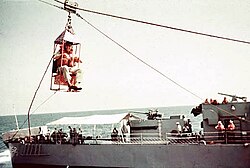
By the 1950s and 1960s, the U.S. Navy introduced multi-product supply ships capable of delivering fuel, ammunition, and stores simultaneously. This era saw the development of the ram tensioner, a device that keeps the highline (the cable connecting the ships) taut regardless of the ships' movement. This evolved into the Standard Tensioned Replenishment Alongside Method (STREAM), which allows for greater separation between ships, increasing safety.
Other nations attempted similar feats; for example, Germany used "milk-cow" submarines to supply U-boats in the Atlantic. However, these required both vessels to be stationary on the surface, making them easy targets for Allied forces.
| Method/System | Fuel Type | Key Characteristic | Primary Limitation |
|---|---|---|---|
| Early Coaling | Coal | Cable-suspended carriers | Extremely slow; weather dependent |
| Nimitz Riding-Abeam | Oil | Rubber hoses and booms | Initially limited to smaller vessels |
| Milk-Cow (German) | Oil/Stores | Submarine-to-submarine | Required stationary surface position |
| STREAM | Multi-product | Ram tensioned highline | Still inherently hazardous |
Frequently Asked Questions
Why was coaling at sea so difficult compared to oil?
Coal is a solid material that must be physically moved in batches using carriers or buckets, which is slow and labor-intensive. Oil is a liquid that can be continuously pumped through hoses, allowing for much higher transfer rates and greater ship speeds during the process.
Who was responsible for the first operational underway refueling?
Chester Nimitz, while serving as the executive officer and chief engineer of the USS Maumee, designed the riding-abeam system that enabled the first operational refueling of destroyers in 1917.
What is the STREAM rig?
The Standard Tensioned Replenishment Alongside Method (STREAM) is a modern U.S. Navy system that uses a ram tensioner to keep the connection cable taut. This allows ships to maintain a safer distance from one another while transferring supplies.
Why was underway replenishment kept secret during World War II?
The ability to refuel large warships at sea allowed U.S. carrier task forces to remain operational indefinitely without returning to port. This provided a massive strategic advantage in range and striking capability that the U.S. did not want enemy nations to duplicate.
Who manages underway replenishment for the U.S. Navy today?
Most current underway replenishment operations for the U.S. Navy are handled by the Military Sealift Command.