UN Partition Plan for Palestine: The History of Resolution 181
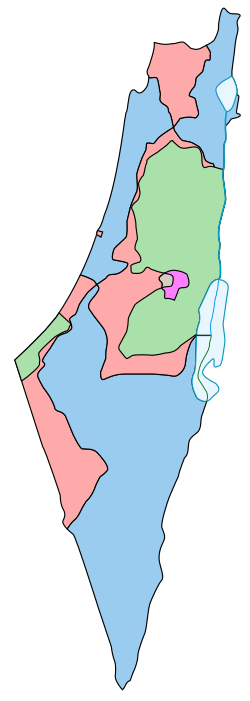
The United Nations Partition Plan for Palestine was a landmark proposal designed to determine the future government of Mandatory Palestine following the end of the British Mandate. Formally adopted as Resolution 181 (II) on November 29, 1947, the plan sought to resolve escalating tensions by dividing the territory into independent but economically linked Arab and Jewish states.
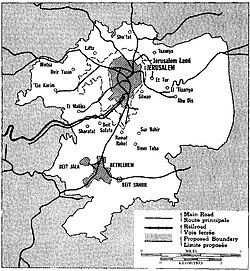
Central to this proposal was the creation of a "Special International Regime" for the city of Jerusalem and its surrounding areas, ensuring the holy city remained under an extraterritorial status due to its global religious significance.
![Report of the Ad Hoc Committee on the Palestinian Question, document A/516, dated 25 November 1947. This was the document voted on by the UN General Assembly on 29 November 1947, and became known as the "United Nations Partition Plan for Palestine".[90]](/images/57/db/57db6e5cef0a2cb0926a8e4597b2c46e751433a01d18fdd0f016243d0e247faa.jpg)
Key Facts
- Resolution Number: UN General Assembly Resolution 181 (II).
- Adoption Date: November 29, 1947.
- Proposed Entities: An independent Jewish state, an independent Arab state, and an international zone for Jerusalem.
- Voting Result: 33 in favor, 13 against, and 10 abstentions.
- Drafting Body: The United Nations Special Committee on Palestine (UNSCOP).
The Path to Partition: UNSCOP and the Ad Hoc Committee
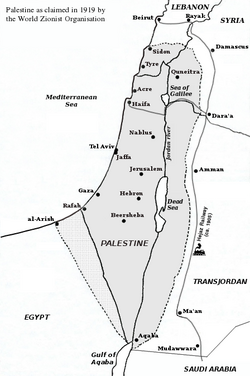
The process began with the United Nations Special Committee on Palestine (UNSCOP), which submitted its report on September 3, 1947. UNSCOP analyzed the complex demographics and land ownership of the region to determine a viable political solution. By the end of 1946, the total population of Palestine was estimated at approximately 1,846,000 people, consisting of roughly 1,203,000 Arabs and 608,000 Jews.
Land ownership was a critical point of contention. As of December 31, 1944, Jewish-owned land constituted 6% of the total land area, though it represented 20% of the cultivatable land. Much of this was held by the Jewish National Fund (JNF) and the Palestine Jewish Colonization Association (PICA).
![Map showing Jewish-owned land as of 31 December 1944, including land owned in full, shared in undivided land, and State Lands under concession. This constituted 6% of the total land area or 20% of cultivatable land,[62] of which more than half was held by the JNF and PICA.[63]](/images/5e/c3/5ec30aa4d4089eb17e7802e83cc2178dbd0095c7179566ae942ac06f2841036b.jpg)
Following the UNSCOP report, a UN Ad Hoc Committee further refined the boundaries and administrative details. The final proposal presented to the General Assembly recommended a partition that balanced population distribution with territorial needs.
Proposed Population and Territorial Distribution
The plan aimed to distribute the population across the proposed states as follows:
| Territory | Arab and Other Population | % Arab/Other | Jewish Population | % Jewish | Total Population |
|---|---|---|---|---|---|
| Arab State | 725,000 | 99% | 10,000 | 1% | 735,000 |
| Jewish State | 407,000 | 45% | 498,000 | 55% | 905,000 |
| International Zone | 105,000 | 51% | 100,000 | 49% | 205,000 |
| Total | 1,237,000 | 67% | 608,000 | 33% | 1,845,000 |
The General Assembly Vote
The vote took place on November 29, 1947, in New York City. The resolution passed with a significant majority, though the voting patterns revealed deep regional divides.
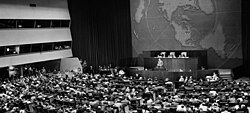
Voting Breakdown
- In Favor (33 countries): Strong support came from Latin American and Caribbean nations (13), Western European and other nations (8), Eastern European nations (5), the Asia-Pacific (3), and North America (2).
- Against (13 countries): Opposition was led primarily by Asia-Pacific nations, specifically those in the Middle East (9), along with Cuba, one African nation, and two Western European/Other nations.
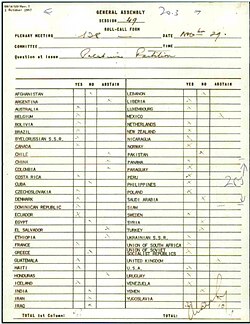
- Abstentions (10 countries): These included the United Kingdom, China, Ethiopia, Yugoslavia, and six Latin American and Caribbean nations.
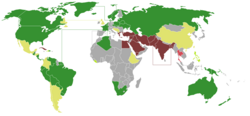
Reactions and Immediate Aftermath
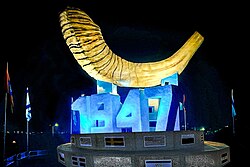
The adoption of Resolution 181 triggered immediate and contrasting reactions. Jewish leadership generally welcomed the plan as a legal basis for statehood, while Arab leaders and the Arab Higher Committee rejected it, arguing that it disregarded the rights of the Arab majority and granted a disproportionate amount of territory to the Jewish state.
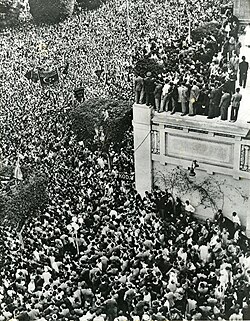
The British government announced that the Mandate would officially end on May 15, 1948, with a full withdrawal of forces by August 1, 1948. However, the period between the vote and the British withdrawal was marked by escalating violence. The first shots of the 1948 Arab-Israeli War were fired shortly after the resolution was passed.
Frequently Asked Questions
What was the primary goal of UN Resolution 181?
The primary goal was to partition Mandatory Palestine into two independent states—one Arab and one Jewish—while maintaining Jerusalem as an international city under a special regime.
Who drafted the original partition plan?
The plan was originally drafted by the United Nations Special Committee on Palestine (UNSCOP) and later refined by a UN Ad Hoc Committee before being voted on by the General Assembly.
How did the UN members vote on the plan?
The resolution was adopted with 33 votes in favor, 13 against, and 10 abstentions. Support was strongest in Latin America and Western Europe, while opposition was concentrated in the Middle East.
What happened to Jerusalem under the plan?
Jerusalem and its surroundings were designated as a "Special International Regime," meaning the city would not belong to either the Arab or Jewish state but would be administered internationally.
When did the British Mandate officially end?
The British government announced that the Mandate would terminate on May 15, 1948, leading to the withdrawal of British forces from the region.